
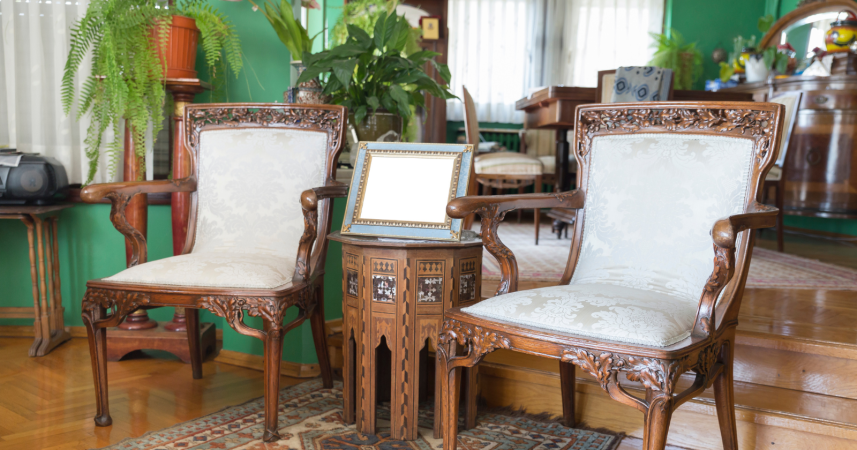
Your love affair with that antique mirror or weathered leather chair reveals more about your personality than you might think, from your creative genius to your deep-seated values that most people completely overlook.

Add VegOut to your Google News feed. 
Ever walked into someone's home and felt instantly transported to another era?
Maybe it was the mid-century modern credenza, the collection of vintage typewriters, or that perfectly worn leather armchair that looked like it had stories to tell.
While some people gravitate toward sleek, minimalist spaces with the latest smart home gadgets, others find themselves drawn to pieces with history, character, and a certain lived-in charm.
Turns out, this preference for vintage over modern decor isn't just about aesthetics. According to psychology, it reveals quite a bit about who we are at our core.
I've always been fascinated by what our spaces say about us. When I helped my aging parents downsize last year, sorting through decades of belongings, I noticed how certain objects held magnetic pull while others felt easily disposable.
That experience, combined with years of observing how different personality types create their environments, has shown me there are distinct traits that vintage lovers tend to share.
Let's explore what psychology tells us about people who choose patina over polish.
1. They have a deep appreciation for authenticity
Have you ever noticed how vintage lovers can spot a reproduction from across the room?
People drawn to vintage decor typically value authenticity above perfection. They'd rather have a dining table with water rings and scratches that tell a story than a pristine piece fresh from the factory. This preference extends beyond furniture into their relationships and life choices.
Research in environmental psychology suggests that our decor choices reflect our core values. Those who choose vintage pieces often prioritize genuine connections over superficial ones, preferring deep conversations to small talk.
They're the friends who remember the details of your stories and ask follow-up questions weeks later.
In my weekly photography walks, I've started noticing how vintage enthusiasts interact with their surroundings differently. They pause to read historical plaques, run their fingers along weathered brick walls, and notice architectural details others rush past.
There's a reverence for what came before, a recognition that authenticity can't be manufactured.
2. They're highly nostalgic and value emotional connections
Psychology professor Constantine Sedikides describes nostalgia as "a resource that people use to move forward in life." And vintage lovers? They've mastered this art.
These individuals don't just see a rotary phone as a decorative object. They remember the weight of the handset, the satisfaction of dialing, maybe even stretching the cord around the corner for privacy during teenage conversations. Every vintage piece becomes a bridge to memories, whether their own or imagined stories of previous owners.
This nostalgic tendency often indicates strong emotional intelligence. They understand that objects carry energy and meaning beyond their functional purpose.
When I started journaling at 36, I began documenting the stories behind objects in my own space. That chipped blue vase? It survived three cross-country moves. The brass desk lamp? Found at an estate sale the week I left my finance career to pursue writing.
Vintage lovers create homes that are essentially three-dimensional scrapbooks, surrounding themselves with pieces that spark joy through memory and association.
3. They tend to be environmentally conscious
Here's something interesting: before "sustainability" became a buzzword, vintage enthusiasts were already practicing it.
Choosing pre-owned items over new production is one of the most environmentally friendly decorating choices you can make. But for vintage lovers, this often goes beyond simple recycling.
They see beauty in giving objects second, third, or fourth lives. They'll spend weekends restoring a dresser rather than buying new, not just for the savings but for the satisfaction of preservation.
Studies show that people who prefer vintage items score higher on measures of environmental concern and long-term thinking. They understand that quality pieces were built to last generations, unlike much of today's disposable furniture.
This mindset typically extends to other areas of their lives, from supporting local businesses to choosing experiences over accumulating more stuff.
4. They possess strong creative and imaginative abilities
Walk into a vintage lover's home and you'll rarely find matching sets or catalog-perfect rooms. Instead, you'll discover unexpected combinations that somehow work beautifully together.
This ability to envision potential and create cohesion from disparate elements indicates strong creative thinking.
Psychologists link this trait to divergent thinking, the ability to generate creative ideas by exploring many possible solutions. Vintage enthusiasts excel at seeing beyond an object's current state to what it could become.
During my weekly artist dates, I often browse antique shops and flea markets. The people I meet there aren't just shopping; they're creating stories, imagining how a particular mirror might transform a hallway or how mixing Victorian and industrial elements could create something entirely new.
This creativity often spills into other areas. Many vintage lovers I know are artists, writers, musicians, or work in creative fields. Even those in traditional careers often have creative hobbies or approach problem-solving with unusual perspectives.
5. They value quality and craftsmanship over trends
When was the last time you saw dovetail joints on IKEA furniture?
Vintage enthusiasts can spend hours appreciating the craftsmanship in a piece: hand-carved details, solid wood construction, hardware that still works smoothly after decades. They understand that true quality transcends trends and that well-made pieces actually improve with age.
This appreciation for craftsmanship reflects a broader personality trait: patience and attention to detail. These are people who read entire articles instead of just headlines, who cook from scratch, who still write thank-you notes by hand.
My analytical background helps me see patterns, and I've noticed vintage lovers consistently choose substance over surface in all life areas.
They're also remarkably trend-resistant. While others might redecorate with each new Pinterest craze, vintage lovers build slowly, selecting pieces that speak to them regardless of current fashion.
6. They're often introverted or highly sensitive
There's something about vintage decor that creates a cocoon-like atmosphere, wouldn't you say?
Research on highly sensitive persons (HSPs) shows they often prefer environments with softer edges, varied textures, and personal meaning.
Vintage decor, with its worn surfaces and unique character, provides exactly this kind of sensory comfort. Unlike stark modern spaces that can feel cold or overwhelming, vintage-filled rooms offer visual interest without assault.
Many vintage lovers I've encountered describe feeling overwhelmed in big box stores or ultra-modern spaces. They prefer the hunt through quiet antique shops, the discovery of hidden treasures, the one-on-one conversations with sellers who know their pieces' histories.
This preference often indicates a need for deeper meaning and connection in their environment. They're creating spaces that nurture rather than impress, that tell stories rather than make statements.
Final thoughts
Our homes are psychological portraits, revealing more about us than we might realize.
If you find yourself drawn to that perfectly imperfect farmhouse table or can't resist rescuing architectural salvage, you're likely someone who values authenticity, creativity, and connection over convenience and conformity.
You see the beauty in stories, the value in preservation, and understand that some things actually do get better with age.
But here's what I find most interesting: these traits aren't fixed or exclusive. Even if you live in a modern space, you might recognize some of these qualities in yourself. Or perhaps reading this has helped explain why certain spaces make you feel more at home than others.
Whether your style is purely vintage, completely modern, or somewhere in between, what matters most is creating a space that reflects your authentic self.
After filling 47 journals with observations about human behavior and environment, I've learned that the most psychologically healthy homes aren't the most stylish or expensive ones. They're the ones that tell the truth about who lives there.
So the next time you're drawn to that vintage piece, trust that instinct. It might be revealing something important about who you are and what you value. And in a world that often prioritizes the new and disposable, those qualities are definitely worth preserving.












