The items we think make our homes look refined often reveal more about our upbringing than our taste.
I still remember visiting a friend’s house when I was in my twenties. She’d just moved into her first place and was so proud to show it off.
The living room was dominated by a huge faux leather sectional, a shiny glass coffee table, and a chandelier that looked like it had been plucked straight out of a banquet hall.
At the time, I thought, Wow, she’s really made it.
But years later, I look back and smile. Those things didn’t scream “class” as much as they screamed “trying really hard.”
And I get it—because I’ve done the same. When you grow up lower middle class, you often reach for décor that signals success rather than pieces that actually feel successful.
It’s about proving you’ve moved up, even if the result doesn’t always land the way you imagine.
There’s a psychological element here. As noted by Pew Research, the middle class’ share of national income has dropped from 62% in 1970 to just 43% today.
That economic squeeze pushes people to show off their progress. And the easiest way to do that? Decorate your home with symbols of “class.”
The only problem: many of those items don’t actually come across as classy. They just look…performative.
Here are nine of the most common culprits.
1. Giant faux leather sectional sofas
Do you know anyone with one of these? Maybe you grew up with one yourself. Oversized, shiny, and shaped like the letter L, they’re often seen as the ultimate family upgrade.
But here’s the truth: they rarely add to a space. Instead of comfort, they bring bulk. Instead of elegance, they bring heaviness.
A smaller, high-quality couch paired with a couple of accent chairs looks far more intentional. It says confidence without the need to overwhelm the room.
2. Ornate glass coffee tables
For decades, these were seen as the peak of sophistication. Thick beveled glass, golden trim, maybe even etched designs or curly legs.
The issue? They’re fragile, hard to clean, and almost impossible to style in a modern way. They also scream mall furniture circa 1985.
A solid wood table that picks up character over time tells a richer story. Think of the scratches and dents as proof of life lived—not flaws to hide.
3. Replica chandeliers
A well-placed light fixture can transform a room. But replica chandeliers? They usually do the opposite.
Fake crystals and ornate swirls can look more like theater props than timeless design. They’re meant to say “elegant,” but they end up saying “discount showroom.”
If you want a bold centerpiece, go for something sculptural or modern. It doesn’t need to mimic Versailles to make an impression.
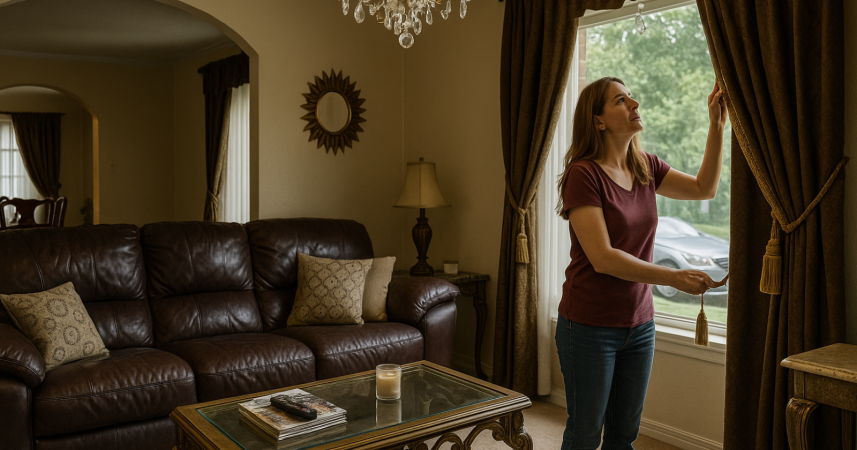
4. Heavy drapes with tassels
Do you remember tugging on those tassel cords as a kid? In many homes, the heavier the drape, the fancier it was thought to be.
But thick velvet curtains close off a room, trap dust, and block natural light. They look more like stage dressing than comfort.
These days, light and airy wins. Linen, cotton, or bamboo shades let light in while still offering privacy. A room that breathes always feels more welcoming.
5. Prominent logo decor
Here’s where psychology and status collide. Towels with brand names embroidered on them. Throw pillows stamped with designer logos. Décor pieces covered in labels.
These aren’t about taste—they’re about proof. Proof that you could afford something “nice.”
But as Yahoo Finance pointed out, prominent logo displays often make brands seem inauthentic and less cool. The same logic applies to your living room. Subtlety speaks volumes.
Ask yourself: do you want people to notice the brand or the atmosphere you’ve created?
6. Dining sets with matching everything
A table, six chairs, a china hutch, and a buffet—all carved out of the same glossy cherry wood. For years, this was the pinnacle of middle-class aspiration.
But the result is usually rigid and impersonal. It feels like the set was purchased in one swoop at a warehouse store, not curated over time.
The most interesting homes mix things up—chairs in different finishes, a rustic table with modern lighting, or heirloom pieces alongside new finds. A little variety shows confidence.
7. Wall-to-wall carpeting
Carpet once meant comfort. It was cozy, soft, and a clear departure from the cold linoleum of earlier decades.
But it doesn’t age well. Carpet traps odors, stains, and allergens. And instead of making a home look luxurious, it usually dates it instantly.
Hardwood, tile, or even polished concrete offer a cleaner canvas. Layer rugs on top for warmth without the drawbacks of wall-to-wall.
8. Faux marble everything
True marble has elegance because it’s natural. Faux marble has the opposite effect because you can spot the difference instantly.
Whether it’s laminate countertops or plastic side tables with marbled designs, they often read as shortcuts. And shortcuts rarely say “class.”
If real stone isn’t in the budget, opt for other authentic materials—wood, metal, or glass. They’ll age better and give your home more integrity.
9. Flashy cars in the driveway
This one may sit outside the front door, but it’s still part of the performance.
A luxury car in the driveway is one of the clearest signals of “success.” But it’s not always real success. According to Experian Automotive, 61% of households earning over $250,000 actually drive Hondas, Toyotas, and Fords—not luxury brands.
That’s the paradox: the truly wealthy often don’t flaunt it. They don’t need to. Flashiness isn’t confidence—it’s insecurity dressed up in chrome.
Final thoughts
If you spotted one or two of these items in your own home, don’t feel bad. Most of us have bought something we thought was classy only to realize later it wasn’t. I’ve done it too.
But here’s the thing: your home doesn’t need to perform success for anyone. It just needs to hold you.
A well-loved chair, a sunlit corner, a handmade rug—these say more about comfort and real taste than any logo pillow or faux marble countertop ever could.
So next time you’re tempted to buy something because it “looks classy,” pause and ask yourself: does this item bring warmth, longevity, and authenticity?
Or is it just a symbol meant to impress?
Because at the end of the day, quiet confidence is far more elegant than shouting success.
Just launched: Laughing in the Face of Chaos by Rudá Iandê
Exhausted from trying to hold it all together?
You show up. You smile. You say the right things. But under the surface, something’s tightening. Maybe you don’t want to “stay positive” anymore. Maybe you’re done pretending everything’s fine.
This book is your permission slip to stop performing. To understand chaos at its root and all of your emotional layers.
In Laughing in the Face of Chaos, Brazilian shaman Rudá Iandê brings over 30 years of deep, one-on-one work helping people untangle from the roles they’ve been stuck in—so they can return to something real. He exposes the quiet pressure to be good, be successful, be spiritual—and shows how freedom often lives on the other side of that pressure.
This isn’t a book about becoming your best self. It’s about becoming your real self.