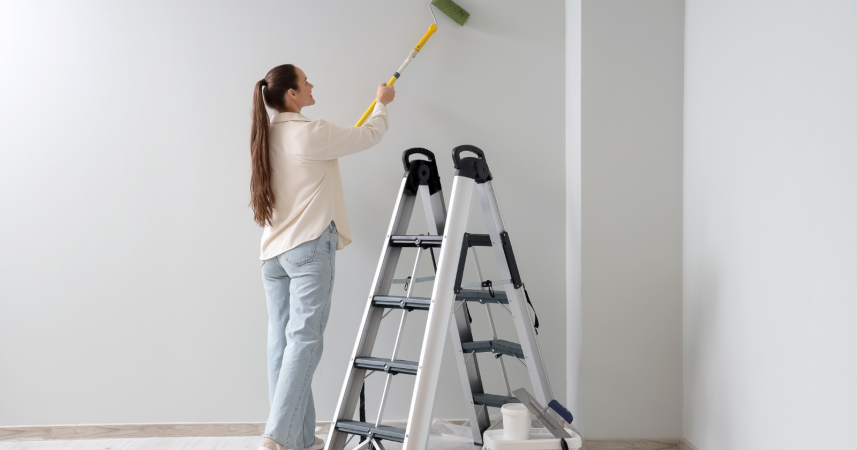
Your urge to refresh your space may reveal more about your mind than your furniture.
Have you ever walked into your living room, looked around, and suddenly felt like the whole place needed a shake-up?
Maybe the couch feels stale, the wall color doesn’t fit anymore, or the bookshelves need to be rearranged.
If this urge hits you regularly, you’re not alone. Some people see decorating as a once-every-few-years project.
For others, the itch to switch things up never really goes away. And psychology has a lot to say about why that happens.
Here are seven traits I’ve noticed in people who always feel the pull to redecorate.
1. A need for novelty
Let’s start with one of the most obvious reasons: the craving for something new.
People who thrive on change often get bored with routines, and their living spaces are no exception.
When the environment starts to feel predictable, the brain craves stimulation. Moving the furniture, adding a new lamp, or changing artwork scratches that itch for novelty.
I’ve felt this myself after long winters. The same four walls can start to feel suffocating, so even small shifts—like swapping curtains or reorganizing the kitchen shelves—bring a sense of freshness.
Novelty-seeking isn’t just about restlessness. Psychologists say it’s linked to dopamine, the “reward” chemical.
Research shows dopamine plays a key role in why people are drawn to new experiences and options.
2. Heightened self-awareness
Have you ever noticed how your surroundings mirror your mental state?
Some people are highly sensitive to this connection. If they’re stressed, they notice clutter more sharply. If they’re excited, they crave spaces that feel vibrant and alive.
Redecorating becomes a way to align the outer world with the inner one.
When I left my corporate job years ago, I remember stripping my home office of anything that reminded me of spreadsheets and deadlines.
I replaced sterile furniture with plants, soft lighting, and art that inspired me. That change felt symbolic—and it boosted my sense of possibility.
People with this heightened self-awareness don’t just redecorate for aesthetics. They do it because the space becomes a physical extension of who they are at that moment.
3. A perfectionist streak
Sometimes, the urge to redecorate isn’t about change—it’s about fine-tuning.
Perfectionists rarely feel satisfied with “good enough.” They spot details others miss: a painting that’s slightly off-center, a mismatched rug, or a color palette that feels just a shade too dark.
These little imperfections keep gnawing until adjustments are made.
Environmental psychologist Sally Augustin has emphasized that our surroundings strongly influence how we function: “Your home is not only an echo of who you are now, but a tool you can use to become what you want to be in the future.”
For perfectionists, the drive to redecorate isn’t frivolous—it’s their way of aligning their space with their inner standards.
4. Creative expression
For many, redecorating isn’t just about furniture and paint—it’s a form of art.
Think of it like journaling, painting, or cooking. The home becomes a blank canvas where ideas, feelings, and identity come alive in tangible form.
People who score high on creativity often see endless possibilities for reinvention, which makes redecorating exciting rather than exhausting.
I have a friend who treats her living room like a rotating gallery. Every few months she rearranges her art, swaps in different textiles, and experiments with color combinations. She says it’s not about impressing guests—it’s about giving herself an outlet for self-expression.
Research also supports this connection. Engaging in visual experimentation—whether in art, design, or even rearranging your home—has been linked to enhanced exploration and problem-solving.
5. Emotional regulation through environment
This is one of the most fascinating traits, in my opinion. Some people redecorate not just for fun but as a way to cope with stress, sadness, or transition.
Have you ever noticed that after a breakup or a big life change, you feel an overwhelming urge to move furniture, paint walls, or buy new bedding? That’s no coincidence.
Environmental psychologists often highlight that people shape their spaces, and their spaces, in turn, influence mood and behavior.
Redecorating can become a tool for creating stability, control, or renewal during turbulent times.
I remember repainting my kitchen a warm yellow during a particularly tough year. It didn’t solve my problems, but it gave me a renewed sense of hope every time I walked in.
For people who are emotionally in tune, redecorating becomes less about aesthetics and more about survival.
6. Strong identity shifts
People who frequently redecorate often experience evolving identities. They see themselves as works in progress, and they want their spaces to reflect that.
This doesn’t mean they’re fickle—it means they understand that personal growth often comes with changing tastes, values, and priorities.
Maybe someone starts gardening and suddenly craves earthy tones, natural wood, and more plants indoors.
Or maybe a new phase in life—becoming a parent, starting a business, retiring—sparks a desire to redesign the environment to match that identity.
When your home reflects who you are becoming, it serves as both a reminder and a motivator. Redecorating becomes part of the personal evolution process.
7. Sensitivity to aesthetics
Finally, some people just feel their environment more deeply than others.
If you’ve ever been distracted by clashing colors or restless in a room that feels visually heavy, you probably know what I mean.
People with a strong aesthetic sensitivity are naturally attuned to harmony, balance, and visual flow.
Design isn’t just about aesthetics. Ilse Crawford emphasizes that “good design is more than the way it looks. It’s about wellbeing and making life better—not just for us, but for others and the environment.”
For highly sensitive people, a mismatched or chaotic environment doesn’t just look off—it feels wrong. Redecorating helps them restore that sense of harmony.
This trait is often linked with high empathy and intuition. If you’ve ever walked into a friend’s home and felt “something’s off,” even without pinpointing why, that’s your sensitivity to aesthetics kicking in.
Final thoughts
So, what does all this mean if you’re someone who’s always tempted to redecorate?
It doesn’t mean you’re shallow, restless, or wasteful.
More often than not, it’s a reflection of deeper psychological traits—your creativity, emotional sensitivity, self-awareness, and desire for growth.
The next time you feel that familiar itch to rearrange or refresh, pause for a moment. Ask yourself: What part of me is this reflecting? What am I craving right now?
Your home can be more than just walls and furniture. It can be a mirror, a coping tool, and a canvas for your evolving story.
And if redecorating helps you feel more aligned with who you are, maybe that urge is worth listening to after all.