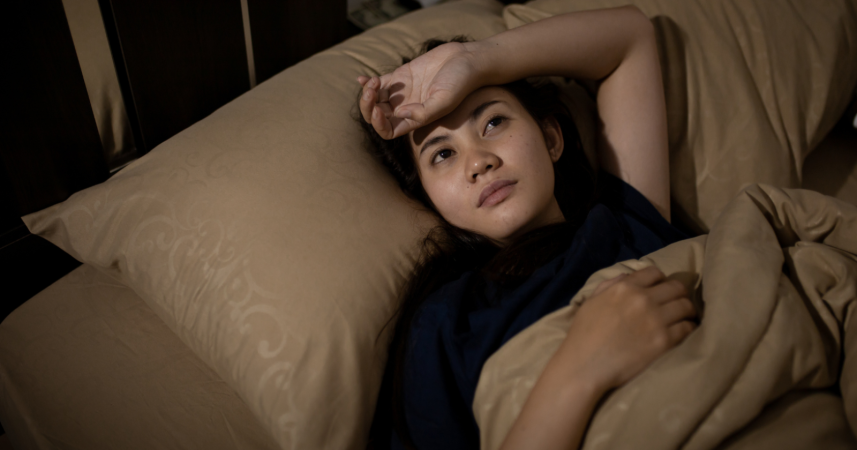
When I discovered that my 3am wake-ups weren't random insomnia but my nervous system desperately trying to process the emotions I'd been too busy to feel during the day, it transformed not just my sleep, but my entire understanding of how anxiety actually works.

Add VegOut to your Google News feed. 
For years, I thought those 3 AM wake-ups were just another sign that I was failing at something as basic as sleep.
There I'd be, wide awake in the darkness, my mind racing through tomorrow's to-do list, replaying conversations from last week, or catastrophizing about things that hadn't even happened yet.
I'd check the clock, calculate how many hours I had left before my alarm, and then spend the rest of the night in that special kind of panic that comes from desperately needing sleep while being completely unable to get it.
I tried everything. White noise machines, blackout curtains, no screens before bed, meditation apps.
Some nights I'd even resort to counting backwards from 1000 in threes, convinced that if I could just bore my brain into submission, sleep would finally come. It rarely did.
Then my therapist said something that completely shifted my perspective. She explained that these middle-of-the-night awakenings weren't actually insomnia in the traditional sense.
They were my nervous system's way of processing emotions and experiences that got pushed aside during my busy days. My body was literally waking me up to deal with what I'd been too distracted to face while awake.
The science behind your 3 AM alarm clock
Our bodies follow a natural rhythm when it comes to stress hormones.
According to Healthline, "Cortisol production drops to its lowest point around midnight. It peaks about an hour after you wake up. For many people, the peak is around 9 a.m."
But here's what happens when we're carrying unprocessed stress or anxiety: Our nervous system doesn't fully power down at night.
Instead of staying at that low cortisol point, our bodies might spike stress hormones in the early morning hours, jolting us awake with that familiar feeling of dread or urgency.
Think about it. During the day, we're masters of distraction. We've got work, conversations, tasks, screens, all keeping our conscious minds occupied.
But at night? That's when our nervous system finally gets a chance to say, "Hey, remember that uncomfortable conversation you glossed over? That deadline you're worried about? That boundary you didn't set? We need to talk about it."
For me, this realization was both terrifying and liberating. Terrifying because it meant those wake-ups weren't random. They were connected to real things I was avoiding.
Liberating because it meant they had a purpose, and more importantly, I could learn to work with them instead of against them.
Why fighting it makes everything worse
Remember how I mentioned trying to bore myself back to sleep? Turns out, that resistance was making everything worse.
When we treat these wake-ups as the enemy, we activate our fight-or-flight response even more. We're essentially telling our nervous system that being awake is dangerous, which only increases our anxiety.
I learned this the hard way after months of treating my 3 AM wake-ups like a battle to be won. I'd lie there, muscles tense, jaw clenched, mentally berating myself for being awake.
The more I fought, the more alert I became. It was like trying to force a beach ball underwater; the harder you push, the more forcefully it pops back up.
The shift came when I started treating these wake-ups as messages rather than malfunctions.
Instead of immediately reaching for my phone or trying to force sleep, I began to simply lie there and listen. What was my body trying to tell me? What emotions were surfacing?
Learning to listen changed everything
At first, listening felt impossible. My mind would race so fast I couldn't catch a single coherent thought. But gradually, patterns emerged.
I noticed that my 3 AM thoughts often centered around specific themes: Feeling overwhelmed at work, guilt about not calling a friend back, anxiety about an upcoming presentation.
These weren't random worries. They were unprocessed emotions from my day that needed acknowledgment.
During my corporate years, I'd become so good at compartmentalizing stress that I didn't even realize how much I was carrying until my body forced me to pay attention at 3 AM.
I started keeping a notebook by my bed. Not for elaborate journaling sessions, but just to jot down what was coming up. Sometimes it was a single word: "overwhelmed" or "angry."
Other times it was a question: "Why did that comment bother me so much?" The act of acknowledging what was there, without trying to fix it or push it away, was surprisingly calming.
Practical strategies that actually help
If you're nodding along because this sounds familiar, know that you're not broken and you're definitely not alone.
Research in a study on nocturnal cognitive arousal demonstrated that nighttime awakenings are often linked to unresolved cognitive processes from our waking hours. In other words, it's not just you. This is how our brains work.
Here's what I've learned works when that 3 AM visitor arrives:
First, resist the urge to check your phone or calculate how much sleep you're losing. Those actions only reinforce the anxiety cycle.
Instead, try what I call "body scanning." Start at your toes and slowly work your way up, noticing where you're holding tension. Often, I'd discover my shoulders were practically touching my ears or my fists were clenched without me realizing it.
Martamaria Hamilton, a licensed professional counselor, suggests that "Breathwork, including diaphragmatic (belly) breathing, is one of the most important and impactful ways to activate the vagus nerve and trigger relaxation in the body, and quickly."
I've found that placing one hand on my chest and one on my belly, then breathing slowly so only the belly hand moves, can shift my nervous system out of high alert.
It's not magic, and it doesn't always lead to immediate sleep, but it does calm that racing feeling.
Sometimes, getting up is actually the best option. I know that goes against everything we're told about sleep hygiene, but sitting in a dim room with a cup of herbal tea and my journal has become a surprisingly peaceful ritual.
I'm not trying to solve problems or make decisions. I'm just acknowledging what's there.
What this means for understanding anxiety
These middle-of-the-night sessions taught me something crucial about my anxiety that years of daytime analysis never could. My anxiety wasn't just about the future or catastrophic thinking.
It was about unprocessed experiences and emotions that I'd been too busy or too uncomfortable to feel during the day.
Before this understanding, I thought being productive and staying busy was the antidote to anxiety. Keep moving, keep achieving, keep the mind occupied.
But those 3 AM wake-ups were showing me that all that busyness was actually creating more anxiety. I was accumulating emotional debt that could only be paid back in the quiet hours of the night.
Now, I try to build processing time into my days. Five minutes after a difficult conversation to check in with how I'm feeling. A brief walk after a stressful meeting.
Evening journaling to capture the day's emotional highlights and lowlights. It's not perfect, and I still have those 3 AM visitors sometimes, but they're less frequent and less intense.
Final thoughts
If you're reading this at 3 AM because you searched "why can't I sleep" for the hundredth time, I want you to know something: Your body isn't betraying you. It's trying to help you process what your busy mind couldn't handle during the day.
These wake-ups aren't a sign of weakness or failure. They're your nervous system's way of saying, "We need to deal with this."
And while it's frustrating and exhausting, there's something oddly comforting about understanding that these moments serve a purpose.
The next time you find yourself wide awake in the early hours, try shifting from "Why is this happening to me?" to "What is this trying to tell me?" You might be surprised by what you discover when you stop fighting and start listening.
Your 3 AM self might just be your wisest teacher, showing you what needs attention when all the noise of the day finally fades away.
What’s Your Plant-Powered Archetype?
Ever wonder what your everyday habits say about your deeper purpose—and how they ripple out to impact the planet?
This 90-second quiz reveals the plant-powered role you’re here to play, and the tiny shift that makes it even more powerful.
12 fun questions. Instant results. Surprisingly accurate.