
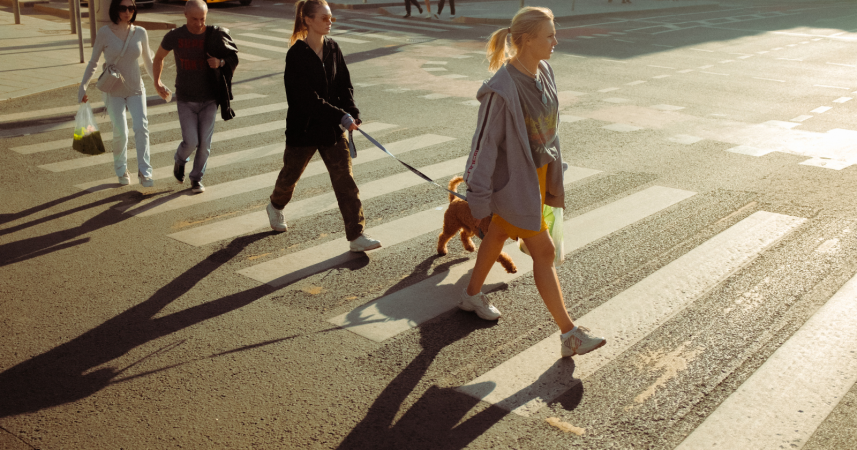
When was the last time you took a different route just to see what else was out there?

Add VegOut to your Google News feed. 
Weird question: when was the last time you intentionally took a different path to somewhere you go all the time—work, the grocery store, the coffee shop?
If you’re like most of us, you probably stick to one familiar track without thinking about it.
I catch myself doing it, too. For years, when I was a financial analyst, I walked the same six-block stretch to the train every morning. I could have drawn it with my eyes closed.
The routine felt efficient. Safe. Comforting. But it was also telling me something about my brain—and that’s what I want to unpack with you today.
Below, I’ll break down what your brain might be signaling when you keep choosing the same route, and how to work with that wiring (not against it).
I’ll also share a few tiny experiments to try this week—no dramatic lifestyle overhaul required.
1. You’re stuck in safety mode
The brain’s most basic job is to keep you alive, not to keep you entertained. Predictable paths lower perceived risk.
No surprises. No detours into alleys that feel too quiet. No intersections you haven’t learned yet. Your threat-detection system (hello, amygdala) relaxes when nothing feels unknown.
There’s nothing wrong with valuing safety. But if you notice that you always default to familiar—even when a new route is well-lit, populated, and perfectly sensible—your brain might be over-weighting safety cues and under-weighting curiosity.
Try this: add “safe novelty.” Choose a different sidewalk on the same street. Cross one block later than usual. Keep your guardrails (visibility, bustle, daylight) and change only one variable.
It’s amazing how small shifts can make your nervous system feel both secure and gently stretched.
2. Your habits are running the show
Our brains love to automate repeated actions into habits because it conserves energy.
You’ve walked this path before, your brain has the cue → routine → reward loop mapped, and—poof—autopilot activates. As psychologist Donald Hebb’s famous adage puts it, “Cells that fire together, wire together.” (Hebbian theory)
Once a route gets reinforced, it becomes the default.
You don’t need to bulldoze the entire habit loop to change it. Swap the cue or the reward. For example, if your cue is stepping out your front door at 7:45 a.m., insert a micro-cue: “What’s my one-block detour today?”
If your reward is hitting your favorite crosswalk, add a new reward to alternate with it—like a specific tree you enjoy or a window display on a neighboring street.
Habits care less about big intentions and more about reliable patterns. Start there.
3. Your attention budget is overdrawn
On mentally heavy days—too many decisions, too many tabs open—your brain takes the path of least resistance.
Repeating a known route costs fewer cognitive coins. It frees you from micro-choices (left or right at Pine? cross now or after the bus?). That’s not laziness; it’s resource management.
I notice this after a long writing day. If my brain feels like a cluttered desk, I’ll subconsciously choose the easiest path home. When I’m fresher, I’m more willing to explore.
One fix is to plan “low-brainpower novelty” into your week. Pre-pick two or three alternate turns for Monday/Wednesday/Friday.
You don’t have to decide on the fly; you’re just executing a pre-made option. Novelty, no extra mental math.
4. Your default mode network wants room to wander
There’s a compelling reason we gravitate toward familiar paths: a predictable environment frees the mind to roam.
When your feet know the way, your brain can slip into daydreaming and recombine ideas—what neuroscientists call the default mode network. That’s where a lot of creative dot-connecting and self-reflection happens.
I use this on purpose. If I’m chewing on a problem, I’ll take my most known route and let my thoughts drift. But when every walk becomes a trance walk, life gets narrow.
The key is alternating: schedule “thinking walks” on your usual route and “seeing walks” where your job is to notice five new things—a mural, a rooftop garden, a café you’ve never clocked.
5. You’re avoiding micro-discomfort
Humans are wired with the status quo bias: we prefer the current state simply because it’s the current state (status quo bias).
A new route introduces uncertainty—Will it be longer? Will I feel awkward crossing that busy road?—and the brain treats uncertainty like a tiny threat. Even a 60-second detour can feel disproportionately “costly.”
I use a simple slider in my head: comfort ←→ stretch ←→ panic. I aim my walking experiments squarely at “stretch.” If a change feels like panic (empty streets after dark, poor visibility), it’s a no.
If it feels like a 2-out-of-10 flutter—new block, different corner store—that’s the sweet spot. Over time, your brain recalibrates what “normal” includes.
6. You’re missing novelty nutrients
Novelty acts like fertilizer in the brain. Fresh inputs wake up attention, release a little dopamine, and make memories stickier.
That’s why the first time you navigate a neighborhood feels vivid, and the fifth time blurs. When you always pick the exact same path, you deprive yourself of these tiny sparks.
If that sounds too abstract, try “novelty bingo.” Make a 3×3 grid with simple prompts: “spot a new color door,” “hear a language I don’t speak,” “notice a scent besides coffee,” “find a new tree.”
Check off three squares on each walk. It turns your stroll into a game that feeds your brain without overwhelming it.
7. Your internal map could use an update
Your hippocampus builds cognitive maps—mental layouts you use to navigate the world. If you only ever trace one line through your neighborhood, your map stays thin.
The day your usual street is closed for construction or you’re walking a friend home who lives three blocks off your path, you feel weirdly disoriented.
Updating your map doesn’t require long adventures. Use a “compass challenge.” Pick north/south/east/west (or your city’s equivalent), and for one block at a time, honor that direction.
Stop after three blocks and return however you like. You’ll stitch in new threads without getting lost.
8. You’re craving a clearer identity cue
Sometimes the repeated route isn’t about fear or energy. It’s about identity.
“I’m an efficient person.” “I’m the kind of neighbor who waves to the same clerk each morning.” These are lovely stories—until they calcify. If you feel a tug to be someone who explores a little more, that’s a healthy nudge.
I think about identity as a dimmer, not a switch. You don’t flip from “Routine Person” to “Adventurer.” You edge the dial. Try a “two-degree turn.” Keep 98% of your path, and change the remaining 2%—one block, one crosswalk, one street on the return trip instead of the outbound. You’re still you. You’re just widening the definition.
9. You might be self-soothing (and that’s okay)
Repetition can be a form of regulation. If your day is chaotic, the last thing you want is more unpredictability.
A familiar route can be a walking meditation—a moving blanket you wrap around a frazzled nervous system. If that’s what you need, honor it.
But you can still add softness without breaking the spell. Wear a different hat. Carry a tiny notebook to jot one sentence you overhear.
Switch your podcast from information-dense to soothing music. Keep the calming rhythm and let in just a sliver of newness.
10. You’re ready for a small experiment
If you’ve read this far, your brain is already primed to try something different. Here are a few simple experiments I’ve used with clients—and on myself:
-
The one-minute rule. Once a week, add exactly one minute to your walk in a new direction. When the timer dings, head back. Your brain learns change doesn’t equal overwhelm.
-
Reverse day. Take your route backward. Same streets, different sequence. It’s surprising how new everything looks when the landmarks hit in reverse.
-
Senses spotlight. Pick one sense per walk—sight, sound, smell, touch. Let that sense lead you to micro-detours: a block with more trees, a street with buskers, a path where sunlight hits brick.
-
Named corners. Give cheeky names to intersections: “Sunflower Corner,” “Kind Dog Block,” “The Good Shadow.” Naming makes new places stick, and stickiness makes you more likely to return.
-
Buddy detours. Ask a friend or partner to choose the detour for you. Outsourcing the decision removes internal debate and adds a sprinkle of surprise.
Final thoughts
If you always find yourself tracing the same line on the map, it doesn’t mean you lack imagination.
It means your brain is doing its job: protecting you, conserving energy, and keeping your mind free to wander. The invitation isn’t to toss that wiring—it’s to nudge it.
Give yourself what you need (safety, simplicity, a little daydream time) and still let in small adventures. The city hasn’t changed, but your relationship to it can. One different turn at a time.
And if you try one of these experiments this week, let me know which one became your new favorite block.
You might discover that the “same old route” was never the story—you were.












