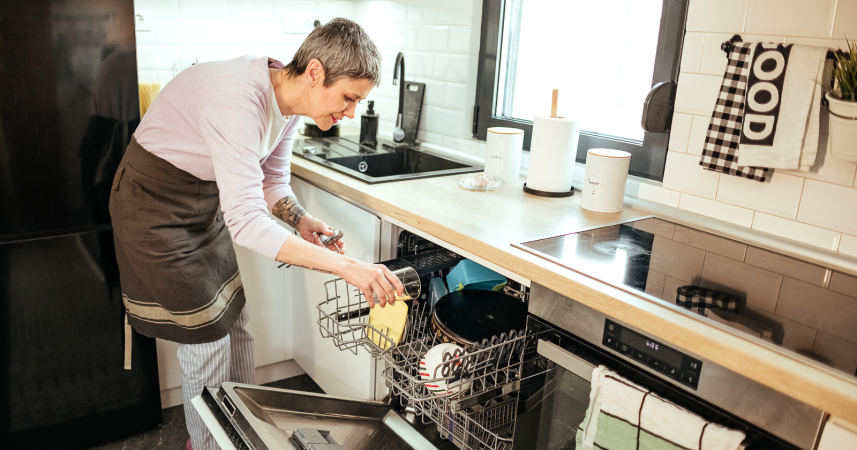
While the rest of us debate whether to tackle the dishes now or later, these individuals experience a visceral, almost primal need to restore order — a compulsion that has nothing to do with cleanliness and everything to do with survival mechanisms learned long before they could hold a sponge.

Add VegOut to your Google News feed. 
You know that friend who absolutely cannot sit down after dinner until every dish is washed, dried, and put away? I used to think they were just particular about cleanliness. But after years of observing human behavior and diving into psychology research, I've realized there's something much deeper at play here.
People who immediately wash dishes after eating aren't necessarily neat freaks. They're often processing complex emotional patterns that trace back to childhood experiences where leaving tasks unfinished created genuine psychological distress.
Growing up, I watched my mother clear the table before anyone had finished their last bite. Back then, I thought she was just efficient. Now I understand she was managing anxiety that had nothing to do with dirty dishes.
1. They need immediate closure to feel emotionally safe
Have you ever felt that gnawing sensation when something's left undone? For some people, dirty dishes trigger this feeling intensely. They learned early on that unfinished tasks meant potential criticism, disappointment, or chaos.
I remember visiting a friend whose kitchen was spotless within minutes of every meal. When I asked why the rush, she paused and said, "I guess I just can't relax knowing they're sitting there." That's when it clicked. The dishes weren't the issue. The open loop in her mind was.
These individuals often grew up in households where completion meant approval and incompletion meant anxiety. Now, washing dishes immediately provides the closure their nervous system craves.
2. They're managing inherited anxiety through action
When children grow up in anxious households, they absorb that energy like sponges. They learn that doing something, anything, helps manage the uncomfortable feelings floating around.
Think about it. If your childhood home felt tense when things were messy or undone, you probably developed coping mechanisms around maintaining order. Washing dishes becomes a way to control what you can control, to create calm in what might otherwise feel chaotic.
The ScienceDaily research team found that study participants who mindfully washed dishes "reported a 27% reduction in nervousness, along with a 25% increase in mental inspiration." The act itself becomes a form of anxiety management, a ritual that soothes the nervous system.
3. They struggle with transitions and need rituals
Immediate dish washing often serves as a transition ritual. It's the bridge between eating and whatever comes next. Without it, some people feel stuck, unable to fully shift gears.
I noticed this in myself during particularly stressful periods. The simple act of cleaning up became my way of closing one chapter of the day and opening another. It wasn't about the dishes. It was about creating psychological boundaries between activities.
4. They equate productivity with worthiness
This one hits close to home. Growing up in a household where both parents emphasized achievement above all else, I internalized the message that my value came from what I accomplished. Even small tasks like washing dishes became proof of my worth.
People who can't leave dishes in the sink often carry this same programming. They learned early that being "good" meant being productive, that rest without completion was somehow lazy or irresponsible. The clean kitchen becomes evidence of their value, a small but constant validation.
5. They're avoiding potential conflict or criticism
Remember being a kid and hearing footsteps approaching your room when you hadn't cleaned up? That spike of panic? Some people never stop feeling it.
Adults who immediately wash dishes might be unconsciously avoiding criticism that no longer exists. Their partner might not care about a few dishes in the sink, but their body remembers when someone did care, intensely. So they preemptively eliminate any chance of disappointment or conflict.
6. They have difficulty tolerating visual disorder
For some, dirty dishes create genuine sensory overwhelm. Their brains process visual clutter as chaos, making it impossible to relax or focus on anything else.
This often develops in childhood when external order was necessary for internal calm. Maybe their homework space needed to be clear to concentrate, or maybe a chaotic home environment made them hypersensitive to disorder. Now, those dirty dishes might as well be sirens going off in their peripheral vision.
7. They learned that love is earned through service
Washing dishes immediately after a meal might seem like a simple household task, but psychology suggests it reveals surprisingly rare personality traits.
One of these traits? The deep-seated belief that love and acceptance must be earned through acts of service. If you grew up in a home where affection followed completed chores, you might find yourself still performing for love that should be unconditional.
8. They're recreating familiar childhood patterns
Sometimes we recreate what we know, even when it no longer serves us. If immediate dish washing was the norm in your childhood home, you might continue the pattern simply because deviation feels wrong, even if you can't explain why.
I catch myself doing this with various household tasks. The discomfort of doing things differently from how I learned them as a child can be surprisingly intense. It feels like betrayal, though I couldn't tell you who I'm betraying.
9. They use completion as emotional regulation
Finishing tasks releases dopamine. For people who learned early that emotional regulation had to come from external sources rather than internal ones, completing dishes provides a reliable hit of feel-good chemicals.
When you grow up in an environment where emotions weren't discussed or validated, you find other ways to manage them. Action becomes emotion. Completion becomes calm. The dishes get done, and for a moment, everything feels manageable.
There's actually a whole thread of thinking around this — the way rituals and inherited patterns shape us more than we realize. VegOut's February issue touches on something similar, looking at burnout and the slow depletion of systems we never stop to question.
Final thoughts
If you recognize yourself in these patterns, you're not alone. And more importantly, you're not broken. These behaviors developed for good reasons, usually as creative solutions to challenging childhood circumstances.
The goal isn't necessarily to leave dishes in the sink if that genuinely bothers you. But understanding why you can't leave them might free you from the anxiety driving the behavior. Maybe you'll still wash them immediately, but from choice rather than compulsion.
Pay attention to how you feel next time you're faced with after-dinner cleanup. Is it preference or panic? Habit or anxiety? The dishes themselves don't matter nearly as much as understanding what they represent in your emotional landscape.
And if you're someone who can happily leave dishes until morning? Count yourself lucky. That kind of psychological flexibility is its own gift, one that many of us are still working to develop.