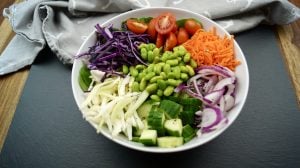
Photo: Carstenhag, CC BY-SA 4.0, via Wikimedia Commons. A vegan bowl with caramelised tofu at a restaurant in Barcelona. Illustrative image only, not from the trial.
Adults aged 65 and over who replaced their usual diet with a vegan diet of their own choosing lost an estimated 1.15 kg of lean mass in their arms and legs over 12 weeks, a randomised controlled trial in the Netherlands has found.
Volunteers assigned a self-selected vegan diet plus supervised resistance exercise twice a week lost less, an estimated 0.62 kg. Those who kept to their habitual omnivorous diet showed almost no change.
The paper, by Jacintha Domić and colleagues, appears in The American Journal of Clinical Nutrition and was published in September 2026. The authors work at Wageningen University's Division of Human Nutrition and Health, at the Institute of Nutrition and Translational Research in Metabolism (NUTRIM) at Maastricht University Medical Centre+, and at Gelderse Vallei Hospital in Ede. The trial is registered as NCT05809466, and the full text is openly available.
The researchers describe the roughly 5 per cent loss in the vegan group as "substantial" and "clinically important". They compare it with an average loss of about 1 per cent a year after age 50, and calculate that three months on the diet matched roughly five years of normal age-related decline.
How the trial worked
The volunteers were healthy adults living in the community, with a mean age of 72. About half were men. All had a body mass index (BMI) of 23 to 32 and habitually ate animal-based foods on at least five days a week.
The 72 participants were randomly assigned to a self-selected vegan diet (23 people), their habitual omnivorous diet (26 people) or a self-selected vegan diet plus supervised progressive resistance exercise twice a week (23 people). The trial was open-label, so participants knew which group they were in.
"Self-selected" means participants chose their own vegan foods. The diets were not controlled for energy or macronutrients, which the authors say was intentional. Monthly nutrition information meetings were part of the protocol for all three groups. In the vegan groups a research dietitian advised on plant-based replacements for animal-based foods, and the omnivorous group received information on the Dutch national dietary guidelines.
Attendance at the exercise sessions averaged 21 of 24. Two participants did not finish the intervention but returned for follow-up measurements and were included in the analysis.
Lean mass in the arms and legs was measured with dual x-ray absorptiometry (DXA), a body composition scan. Thigh muscle volume was measured separately with magnetic resonance imaging (MRI).
What changed
Over 12 weeks, the estimated mean change in arm and leg lean mass was a fall of 1.15 kg in the vegan group (n = 23, 95 per cent confidence interval minus 1.46 to minus 0.85). The omnivorous group (n = 26) had an estimated mean change of plus 0.05 kg (minus 0.23 to 0.32), essentially no change.
In the vegan plus exercise group (n = 23), the estimated mean fall was 0.62 kg (minus 0.93 to minus 0.32). Exercise cut the loss by about 46 per cent but did not prevent it. The authors describe the remaining loss of about 3 per cent as surprising.
Thigh muscle volume followed the same pattern. It fell by an estimated 0.61 litres in the vegan group (n = 23) and 0.35 litres in the vegan plus exercise group (n = 23). The omnivorous group (n = 26) was essentially unchanged, with an estimated change of minus 0.01 litres. The group sizes are the numbers randomly assigned.
Protein intake in the vegan group fell by 27.7 g a day in week 1, 22.0 g a day in week 6 and 19.3 g a day in week 12, the abstract reports. The vegan plus exercise group showed a similar fall. Protein intake in the omnivorous group did not change.
Muscle protein synthesis, the rate at which the body builds new muscle protein, was measured over the first 10 days with a deuterium oxide tracer that participants drank daily. It averaged 1.09 per cent a day in the vegan group, against 1.27 per cent in the omnivorous group and 1.24 per cent in the vegan plus exercise group.
The authors write that the lower synthesis rates and muscle losses were "presumably driven by the substantial change in dietary protein intake". They add that the vegan group was in negative energy balance, with body mass falling by about 2.9 kg.
They conclude that a self-selected vegan diet reduces protein intake, skeletal muscle mass and muscle protein synthesis in older adults. In the abstract they write that this negative impact "can be mitigated by RE", their abbreviation for resistance exercise.
The trial does not support firm claims about strength. Changes in dominant-leg knee strength did not differ significantly between the vegan and omnivorous groups. The authors report that initially significant treatment-by-time interactions in dominant-leg knee extension and flexion strength both became non-significant after correction for multiple comparisons.
The authors note that liver fat fraction fell in both vegan groups, from about 7.5 per cent to about 5 per cent on average.
Participants in the vegan group also spent about 3.5 percentage points more of the day sedentary, the authors' rounded figure, for reasons the researchers could not identify. The authors judge its influence on the findings to be minimal.
The authors describe the volunteers as generally healthy, not sarcopenic and recreationally active. The authors say more substantial reductions may occur in clinically compromised, inactive individuals who switch to a vegan diet without dietary guidance.
Earlier VegOut coverage looked at a trial of 108 adults aged 55 and over doing 12 weeks of resistance training with vegetarian or omnivorous diet counselling, a São Paulo trial of soy and whey protein with resistance training in young men and where the 0.8 g per kg protein RDA came from.