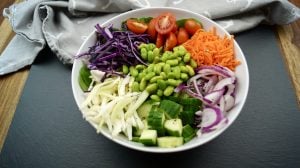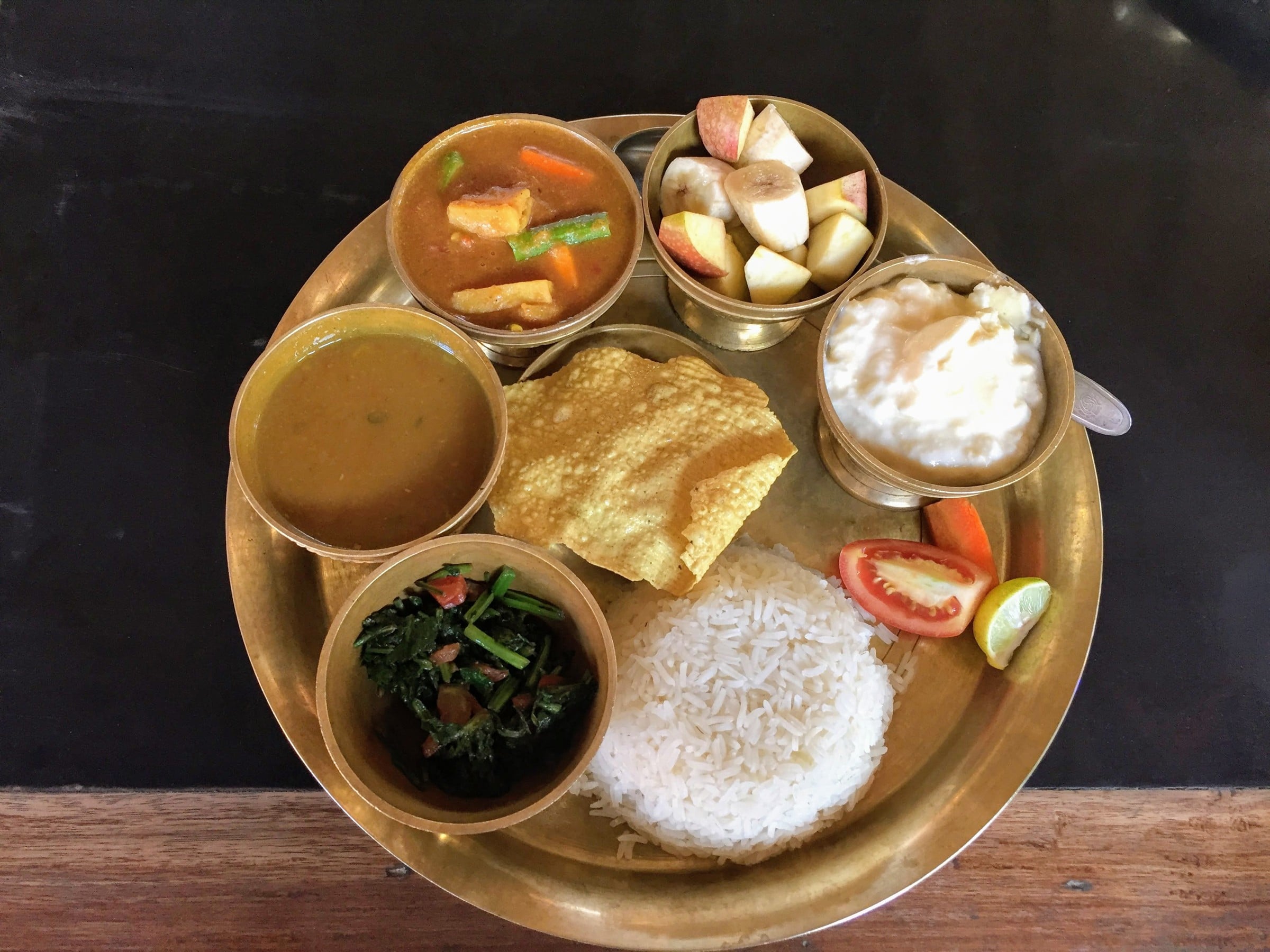
A Nepali meal of rice, lentil soup, vegetables and yogurt. Illustrative image only, not from the trial. Illustration: Subhashish Panigrahi, CC BY-SA 4.0, via Wikimedia Commons.
Adults aged 55 and over who were counselled to follow a lacto-ovo vegetarian diet during resistance training gained 0.38 kg of arm and leg muscle in 12 weeks, against 0.66 kg for those counselled to follow an omnivorous diet, according to a randomised trial of 108 people by researchers at two Amsterdam universities.
The PubMed record names Sophie L van Oppenraaij, Peter J M Weijs and Sjors Verlaan as the authors of the IMPACT trial. It lists Amsterdam University of Applied Sciences and Vrije Universiteit Amsterdam among the affiliations. The paper appears in the November 2026 issue of the American Journal of Clinical Nutrition, volume 124, issue 5, article 101533.
Both groups gained muscle, the paper reports. The trial could not show that the vegetarian result was no worse than the omnivorous result by more than a preset margin, though. The authors wrote in the abstract on PubMed that "noninferiority for appendicular muscle mass is not demonstrated".
VegOut has also published a video on building muscle on plant-based diets, which is separate from this trial.
How the trial worked
According to the abstract, the researchers started from the idea that a mainly plant-based diet may lead to lower protein intake. The trial compared counselling for a lacto-ovo vegetarian diet with counselling for an omnivorous diet.
According to the PubMed record, the 108 participants had a median age of 66, with the middle half of participants aged 62 to 69. Women made up 58 per cent of the group, and the reported body mass index (BMI) was 25.7.
Each person was randomly assigned to dietary counselling for either a lacto-ovo vegetarian or an omnivorous diet. Participants in both groups completed a 12-week resistance training programme, with three sessions a week, the abstract says.
Participants chose their own foods, according to the abstract. The aim was at least 1.2 grams of protein per kilogram of body weight a day (1.2 g/kg/day). In the vegetarian group, at least 60 per cent of that protein was to come from plants. In the omnivorous group, at least 60 per cent was to come from animal foods.
The paper names two main outcomes: protein intake, measured with a three-day food record, and appendicular muscle mass, meaning the muscle in the arms and legs. Muscle was measured with dual-energy x-ray absorptiometry (DXA).
The trial used a noninferiority design. This tests whether one approach is no worse than another by more than a preset margin. The margins were 0.12 g/kg/day for protein intake and 0.25 kg for muscle mass.
What the results showed
Both groups met their protein and plant-to-animal ratio targets, the paper reports. The vegetarian group took in 1.24 g/kg/day, with 76 per cent of it from plants. The omnivorous group took in 1.58 g/kg/day, with 67 per cent from animal sources.
The abstract reports a 0.33 g/kg/day gap in protein intake, lower in the vegetarian group, with a 95 per cent confidence interval of minus 0.49 to minus 0.17. Against the 0.12 margin, noninferiority was not established for protein intake.
According to the abstract, appendicular muscle mass rose by 0.38 kg in the vegetarian group (95 per cent confidence interval 0.12 to 0.64) and by 0.66 kg in the omnivorous group (0.40 to 0.93). Both rises were statistically significant, with P values of 0.004 and below 0.001.
The paper gives the between-group difference as a 0.33 kg gap, with a 95 per cent confidence interval from minus 0.69 to 0.03 kg. That range stretches past the 0.25 kg margin and also includes zero. On that result, the trial could not show noninferiority for muscle mass.
In the abstract, leg press strength and the chair stand test, a test of physical function, improved significantly in both groups. The paper reports no between-group differences on either measure.
In the abstract, the authors concluded that protein intake was lower in the vegetarian group and that noninferiority for muscle mass was not demonstrated. They added that both groups still reached at least 1.2 g/kg/day and improved their muscle mass and strength during resistance training, along with physical function.
This was one trial in older adults, as reported in the abstract. Its findings apply to the counselled lacto-ovo vegetarian and omnivorous diets it tested, alongside the resistance training both groups did. They say nothing about vegan diets or protein supplements. Related coverage: VegOut's earlier report on a São Paulo trial of soy and whey protein.
The study is registered on the clinicaltrials.gov registry as NCT06172725.
VegOut has also covered where the 0.8 g per kg protein RDA came from and why athletes are given 1.2 to 2.0.