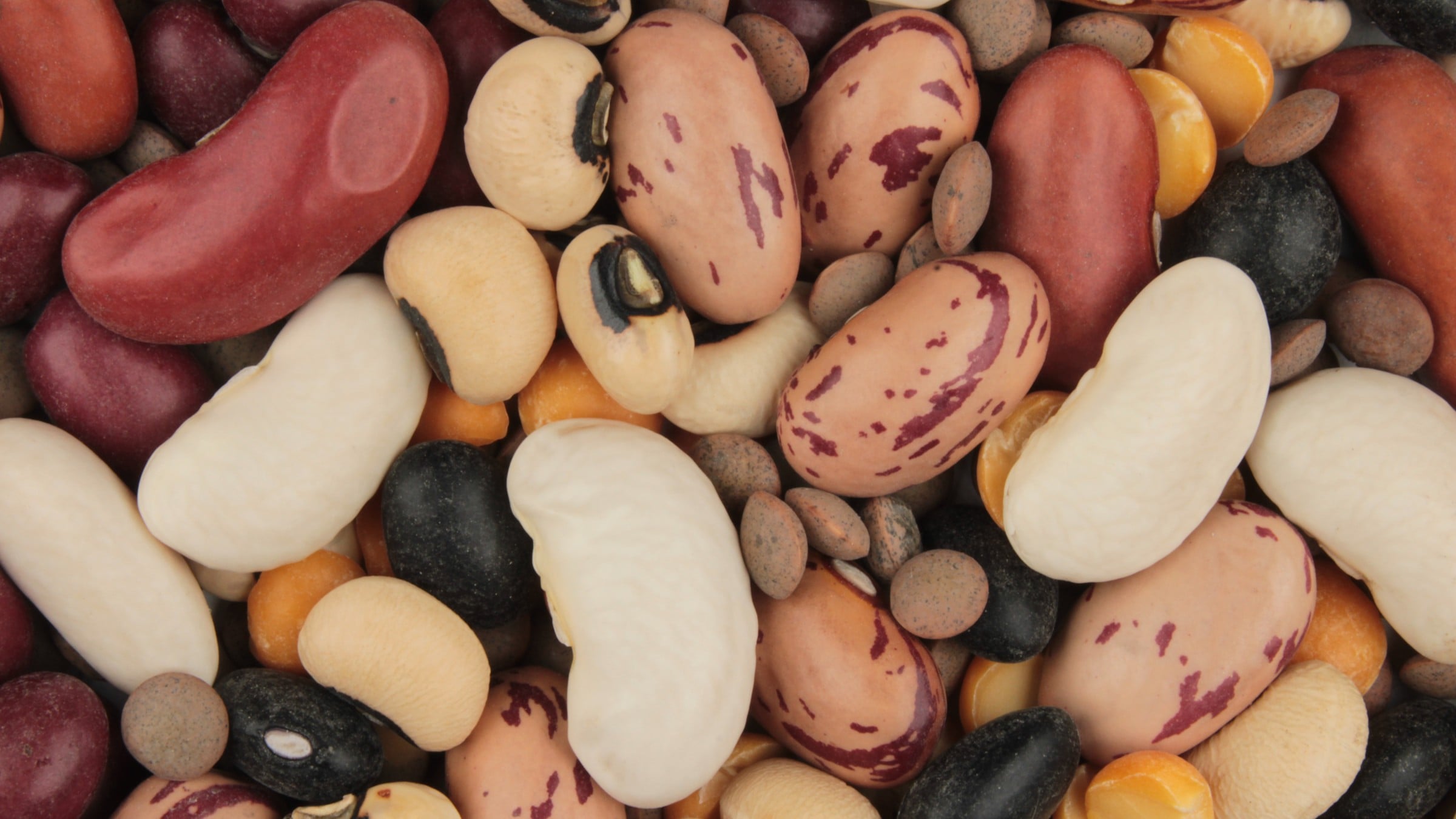
A mixture of dry beans, peas and lentils. Illustrative image only, not from the study. Illustration: Bean appreciator, CC0, via Wikimedia Commons. Cropped.
In 40 adults with stage 3 to 4 chronic kidney disease (CKD), a 15-day low-fat whole-food plant-based nutrition education programme differed from usual care in the change in median reported intake of several nutrients, according to a secondary analysis from the University of Rochester in New York. The difference in change was plus 72.62 mcg for folate and plus 96.92 mg for magnesium, while vitamin B12 fell by 2.67 mcg relative to usual care.
The first author is James J Rutowski, an assistant professor at the University of Rochester School of Medicine and Dentistry. The paper, titled "Impacts of a low fat whole food plant-based diet on vitamin and mineral intake in advanced CKD populations, a secondary analysis of a randomized control trial", was published online in the Journal of Renal Nutrition on 5 November 2026. The PubMed record describes it as a secondary analysis of a randomised pilot trial.
The study measured what participants reported eating in food records. It did not measure vitamin or mineral levels in the blood, and it did not assess whether any participant was deficient in any nutrient.
The trial enrolled adults with chronic kidney disease (CKD) at stages 3 to 4. Low-fat whole-food plant-based (LFWFPB) diets "are increasingly recommended for patients with chronic kidney disease (CKD) because of potential cardiometabolic benefits", the authors write.
They add in the abstract that the effects of these diets on vitamin and mineral intake in people with moderate to advanced CKD "remain incompletely characterized". The secondary analysis was designed to look at that question using data from an existing pilot trial.
According to the abstract, 40 adults took part. Twenty were assigned to a 15-day LFWFPB nutrition education programme and 20 to usual care. Three-day food records were collected at the start and on day 15. The team analysed the records with the Nutrition Data System for Research, a dietary analysis tool.
The figures below, from the abstract, are the between-group differences in change in median intake. Each one shows how much more, or less, the median intake changed in the plant-based group than in the usual care group between the start and day 15.
What rose and what fell
Compared with usual care, the paper reports these increases in the plant-based group:
- Vitamin A rose by 6759.2 IU (p = 0.0018)
- Vitamin C rose by 90.55 mg (p = 0.0008)
- Vitamin K rose by 135.38 mcg (p = 0.0155)
- Folate rose by 72.62 mcg (p = 0.0411)
- Magnesium rose by 96.92 mg (p = 0.0018)
- Manganese rose by 3.52 mg (p < 0.0001)
- Copper rose by 0.52 mg (p = 0.0013)
- Oxalate rose by 183.60 mg (p = 0.0036)
The paper reports these decreases in the plant-based group compared with usual care:
- Added sugars fell by 21.57 g (p < 0.0001)
- Vitamin D fell by 3.05 mcg (p < 0.0001)
- Vitamin E fell by 4.06 mg (p = 0.0385)
- Riboflavin fell by 0.75 mg (p = 0.0223)
- Niacin fell by 4.66 mg (p = 0.0144)
- Vitamin B12 fell by 2.67 mcg (p < 0.0001)
- Zinc fell by 2.78 mg (p = 0.0084)
- Selenium fell by 37.44 mcg (p < 0.0001)
- Calcium fell by 67.01 mg (p = 0.0275)
- Phosphorus fell by 72.40 mg (p = 0.0023)
Thiamin, pantothenic acid, vitamin B6 and iron did not differ between the groups, the abstract says.
Among the increases reported in the abstract, folate had the largest p value, at 0.0411. The fall in vitamin B12 was one of five results with a p value below 0.0001. The other four were manganese, added sugars, vitamin D and selenium.
What the authors conclude
The authors write that adopting the diet for a short period "resulted in substantial shifts in micronutrient intake". They say the increases in plant-derived nutrients "may support cardiometabolic health".
In the abstract, they say the reductions in vitamin B12 and vitamin D, along with selenium and zinc, show "the need for monitoring and possible supplementation". They conclude that the findings "emphasize the importance of structured nutritional guidance when recommending plant-predominant diets in CKD".
Vitamin B12 also featured in VegOut's earlier report on vitamin B12 in vegan men in the EPIC-Oxford study. The Rochester analysis looked at a different group, adults with stage 3 to 4 CKD, and at what they reported eating.
This article is not medical advice, and people with kidney disease should follow the guidance of their renal care team on diet and supplements.
VegOut has also covered what the Physicians’ Health Study II found for a daily multivitamin taken by US male doctors and the MIND diet of leafy greens, berries, beans and nuts.