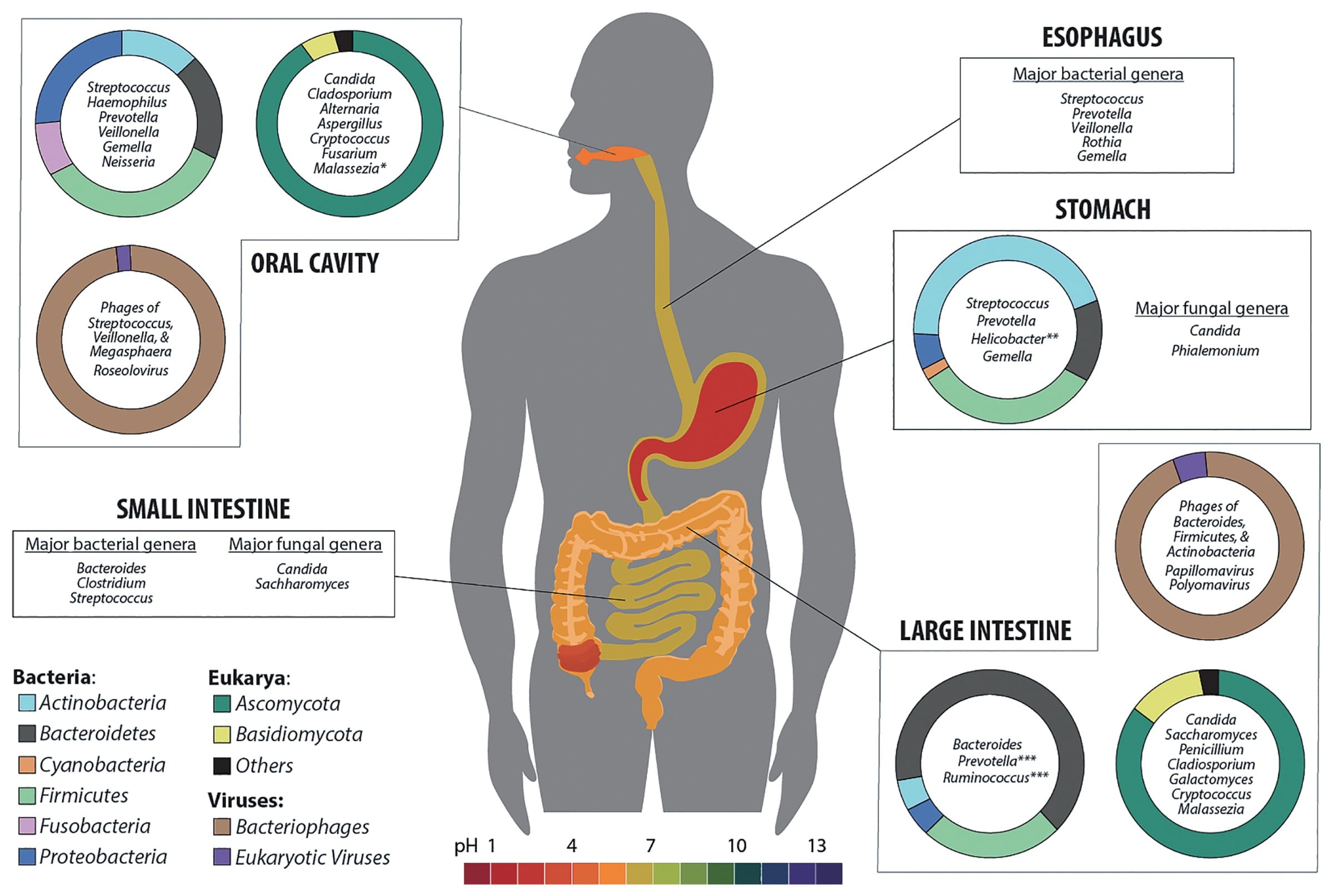
Photo: a diagram of the human gut microbiome. The MD Anderson study described here was in mice. Ethan Hillman et al / Wikimedia Commons, CC BY 4.0
A 24-hour fast increased levels of the gut bacterium Akkermansia muciniphila in the small intestines of mice and helped the animals' intestinal lining regenerate after radiation, researchers at The University of Texas MD Anderson Cancer Center, a US cancer centre, have reported.
The work was a preclinical study in mice only and has not been tested in patients. It was published online on 23 June 2026 in the Proceedings of the National Academy of Sciences (PNAS), and MD Anderson described it in a news release on 9 July 2026.
Helen Piwnica-Worms, professor of Experimental Radiation Oncology, and Kunal Rai, professor of Genomic Medicine, co-led the study. "Fasting helps prepare intestinal cells to respond more quickly and effectively after injury, almost like training the cells with an emergency preparedness plan," Piwnica-Worms said.
VegOut has also published a video on fasting and the gut, which is separate from this study.
Why radiation damage to the gut is a problem
Radiation therapy is a common treatment for abdominal cancers, including pancreatic and colorectal cancers, MD Anderson said. The small intestine is highly sensitive to radiation, and damage to its lining can cause nausea, diarrhoea, infection and, in severe cases, life-threatening complications.
According to the release, those side effects often limit how much radiation can be safely delivered. Earlier preclinical work from the Piwnica-Worms Laboratory showed that fasting before treatment improved intestinal recovery after radiation, but the biological mechanisms behind the effect were not fully understood.
What the fast changed in the mice
The new paper, by Barrodia and colleagues, is titled "Fasting primes small intestinal regeneration after damage via a microbiome-metabolite-chromatin axis". It appears in volume 123, issue 26 of PNAS as article e2529215123.
In the mice, fasting for 24 hours raised levels of the bacterium, known as AKK for short, in the small intestine. AKK makes a small molecule called propionate. The release said propionate works with other metabolic changes triggered by fasting to add small chemical tags to histones, the proteins DNA is wrapped around inside cells.
This tagging, known as histone acetylation, changes how genes are read without altering the genetic code itself. The release describes it as a kind of advance warning system that unwraps DNA to allow gene activity in a group of intestinal cells that build up during fasting.
Those cells carry genetic programmes associated with regeneration, and the paper calls them primed persister cells. After radiation, they expanded and contributed to regeneration of the intestinal lining, the researchers reported.
The team also tested whether AKK was needed. The benefits of fasting were lost when AKK was selectively removed and returned only when it was reintroduced alongside fasting. The paper's abstract says antibiotic depletion of AKK abrogated radioprotection, while reintroduction restored both survival and intestinal integrity.
In laboratory cultures of intestinal stem cells, both medium conditioned by AKK and propionate itself induced histone acetylation, the abstract adds. Fasting also raised levels of propionic acid, which the authors describe as consistent with the bacterium's metabolic output.
Piwnica-Worms said the study "helps explain how that plan is organized and identifies a key bacterium involved in coordinating the response." The research was supported by the National Cancer Institute, part of the US National Institutes of Health, and by the Cancer Prevention and Research Institute of Texas.
The release said future research could look at whether the pathway might support recovery in other healthy tissues affected by cancer treatment, and whether rapidly dividing tissues such as bone marrow could also benefit. If results are consistent, the approach could potentially be tested in clinical trials for patients receiving abdominal radiation.
The release said the findings suggest possible strategies that may not require patients to fast before treatment, such as microbial therapies or approaches based on metabolites. "Fasting is not always practical for cancer patients, and this work supports several other potential ways to enhance recovery after treatment," Rai said.
"Whether through dietary interventions, targeted microbes or their metabolites, the goal is to help repair healthy tissue more effectively while patients receive the cancer therapies they need," Rai added.
VegOut has also covered what the research on early eating windows does and doesn't show, how a Mayo Clinic doctor's 1921 epilepsy diet began with fasting, and the fibre research that grew out of Denis Burkitt's 1971 colon cancer paper.