How do vegan families handle birthday cake, candy swaps, and classroom cupcakes without missing the fun—or the bigger picture?

Add VegOut to your Google News feed. 
The first time our son came home from a birthday party with a goodie bag full of milk chocolate, marshmallow treats, and gummy bears dyed with carmine (yes, crushed beetles), he looked up with a mix of excitement and confusion.
“Can I eat these?” he asked. And just like that, we realized: vegan parenting isn’t just about what we serve at the dinner table—it’s about how we show up in spaces that aren’t designed with us in mind.
Sugar-fueled celebrations—birthday parties, Halloween, school bake sales—are cultural staples. They’re joyful, messy, and often built around foods that don’t align with plant-based values.
As a vegan family, navigating these events means more than just reading ingredient labels; it means balancing inclusion with intention, advocacy with flexibility, and the sweet memories with the sweet treats.
Here’s how we do it—and why it matters.
Why navigating parties as a vegan family isn’t just about the food
Let’s zoom out for a second.
A 2024 study published in the Journal of Nutrition Education and Behavior found that children who participated in early food education programs—like gardening, cooking, and tasting activities—developed a long-term appreciation for fresh foods and healthier eating habits that lasted into adolescence and young adulthood.
That kind of impact reinforces what many parents intuitively know: early food experiences don’t just shape palates—they shape values and decision-making.
Meanwhile, climate reports from organizations like the Environmental Health Perspectives keep underscoring the outsized impact of animal agriculture.
Teaching kids to make compassionate, climate-smart food choices matters—but so does helping them feel confident and included while doing it.
Birthday parties and holidays can become microcosms of those bigger tensions. Do we pack our own cupcake and risk singling them out? Do we let it slide “just this once”? Do we talk to the host? To the teacher? What about when it’s a drop-off party?
In short, it’s a lot. But with some strategy and compassion, it’s totally doable.
Step 1: Set expectations early—with your kids and with yourself
Before you RSVP to anything, have the conversation.
For our family, we started with age-appropriate honesty: “Some candy has things in it that aren’t good for animals or the planet. But the good news? There’s lots of candy that is.”
We made it a game—spotting gelatin on labels, Googling whether red dye was vegan, celebrating discoveries like Sour Patch Kids and Unreal peanut gems.
We also had to get real with ourselves. Kids don’t need us to be perfect—they need us to be calm, consistent, and confident.
If you’re still figuring out where your boundaries are (e.g., are you OK with palm oil? artificial colors?), that’s fine. The goal is clarity, not rigidity.
Step 2: Build your vegan “party toolkit”
There’s no one-size-fits-all solution, but here’s what’s in our family’s toolkit:
The candy swap
For Halloween and Valentine’s Day, we let our kids trade non-vegan candy for a stash of their favorites at home. This keeps the fun of collecting and trading without the dietary conflict.
We include brands like YumEarth, SmartSweets, and Cocomels—ones with short ingredient lists and clear sourcing.
Pro tip: Keep extras on hand for when friends visit. It normalizes the swap and turns it into a shareable moment.
The personal party pack
For birthday parties, we pack a “just-in-case” cupcake or cookie in a small, leakproof container. We’ve gotten better at baking in bulk and freezing single portions—saves time and reduces stress.
Some parents text us before parties to ask what our kid can eat. When they do, we keep the answer simple: “He’s vegan, so no dairy or eggs, but don’t stress! We’ll send a treat along.” No guilt-tripping. No drama. Just logistics.
The school script
We emailed our child’s teacher at the start of the year: “We’re a vegan family. If there’s ever a food-related activity, we’re happy to send alternatives.” That one sentence has saved us dozens of surprises.
We also offered a list of shelf-stable snacks the teacher could keep on hand: fig bars, fruit leather, pretzels, vegan chocolate chips.
Step 3: Focus on the “why,” not the “can’t”
Language matters. Instead of saying “We can’t have that,” we reframe with “We choose foods that are kind to animals,” or “We pick candy that doesn’t use gelatin or bugs.”
Over time, our kids started leading the conversation. I’ll never forget the moment at a class birthday when our daughter turned down a slice of cake and casually said, “It’s not vegan, but that’s OK—I brought my own.”
They weren’t left out. They were leading by example.
Step 4: Make room for the gray areas
Let’s talk about those moments. The neighbor who surprises your kid with a non-vegan treat. The bake sale with unlabeled cookies. The cousin who insists their gummies are “totally fine.”
We’ve learned to triage with three quick questions:
-
Is it a one-time moment or an ongoing pattern?
-
Is the ingredient animal-derived, or just processed?
-
What matters most: the food or the feeling?
Sometimes we say, “Go ahead—it’s not perfect, but it’s close.” Other times we say, “Let’s save that for later and check it together.” And sometimes, when in doubt, we let it go.
Because mental health, social belonging, and family harmony are also part of a sustainable life.
Step 5: Celebrate the wins—big and small
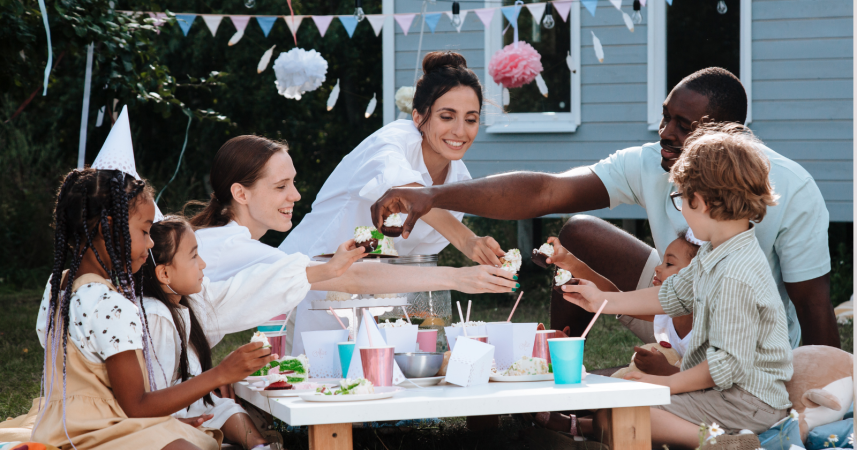
Last year, our son hosted his first birthday party with a fully vegan snack table.
The pizza was from a local spot that does cashew mozzarella. The cupcakes were oat milk-based with coconut whip frosting. And not one kid complained.
In fact, two parents texted afterward to ask for the cookie recipe. Victory.
But the real win wasn’t the food. It was that our son felt proud of his choices. He felt seen. And he felt like the party was truly his—not an awkward compromise.
The takeaway? It’s not about perfection—it’s about participation
Vegan families can absolutely thrive in the swirl of sugar-fueled, tradition-heavy events. It just takes a bit of prep, a lot of empathy, and a dash of creativity.
By teaching our kids how to navigate these moments with confidence and kindness, we’re giving them more than a food philosophy—we’re giving them tools for life.
Because the real magic of childhood isn’t in the cupcake. It’s in the joy of sharing it.