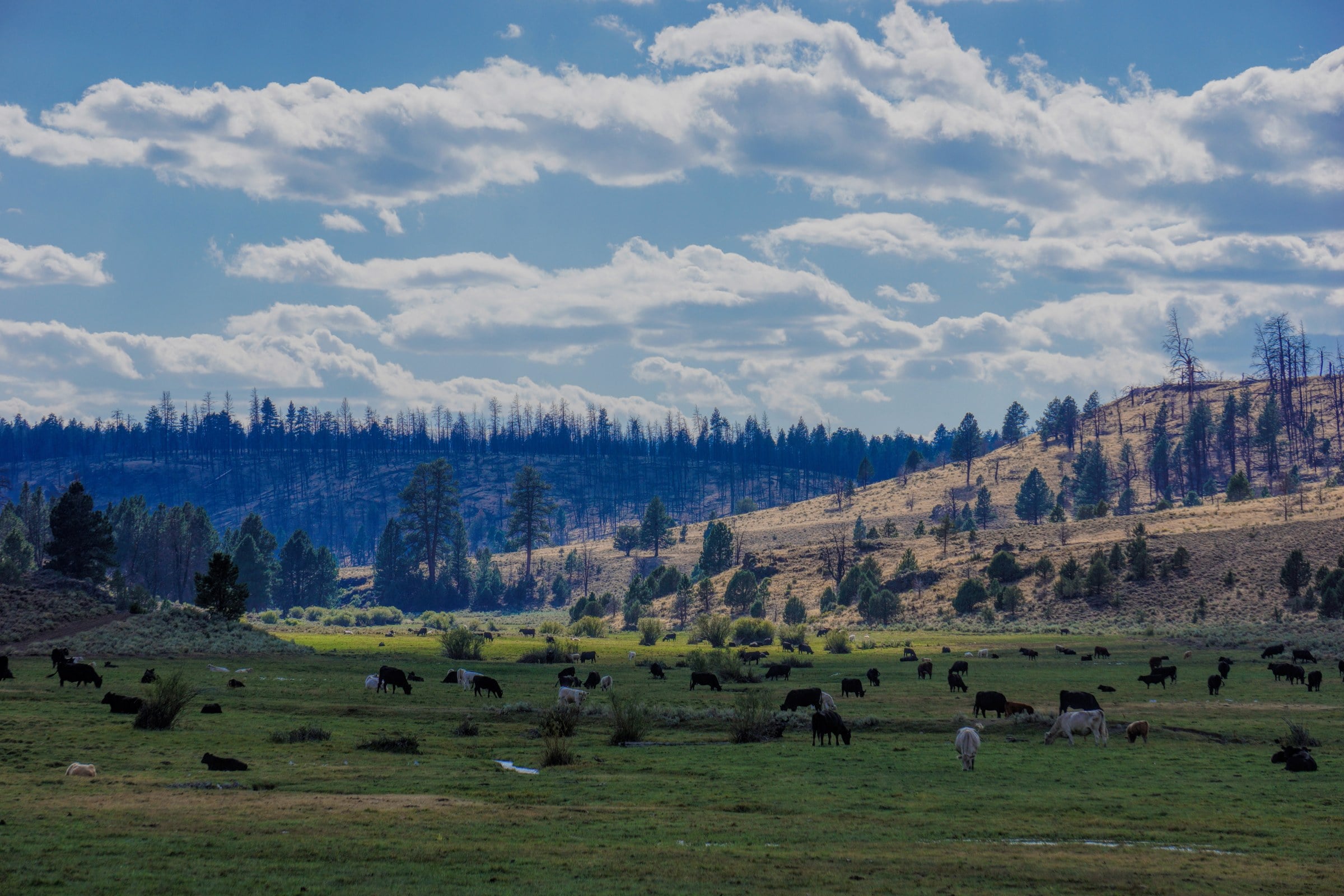
Photo: cattle grazing in a grassy valley in eastern Oregon, illustrating pasture, not Davis's calculated sample. Garytmarsh / Wikimedia Commons, CC BY-SA 4.0. Share-alike licence.
Steven Davis, an animal scientist at Oregon State University, argued in 2003 that a diet of crops plus meat from large pasture-raised herbivores would kill fewer animals than a vegan diet. Ploughing, disking, planting, spraying and harvesting kill mice, rabbits, amphibians and birds, and Davis put the death rate on cropland at twice the rate he estimated for ruminant pasture. His paper, The Least Harm Principle May Require that Humans Consume a Diet Containing Large Herbivores, Not a Vegan Diet, ran in the Journal of Agricultural and Environmental Ethics.
A reply in the same journal that year disagreed on the arithmetic rather than the ethics. Gaverick Matheny, then at the Johns Hopkins School of Public Health, wrote that Davis had compared the two diets over a fixed area of land instead of counting the animals killed to feed the same number of people. Davis had made "a mathematical error in using total rather than per capita estimates of animals killed", the reply said. It ran at volume 16, pages 505 to 511, and was accepted in revised form on 30 January 2003.
Whether vegans actually kill more animals, the question put in the video below, is what the two papers set out to settle, and the answer depends on what the deaths are divided by.
What Davis proposed
Davis started from a principle the vegetarian arguments he was addressing also accept: cause the least harm. What he challenged was the empirical half of the vegan case, that a plant-based diet causes the fewest animal deaths. The deaths he wanted counted were those of what he called animals of the field, killed by farm machinery, pesticides and the loss of cover at harvest.
The sums, as quoted in Matheny's reply, run like this. The United States harvests about 120 million hectares of cropland a year. If 15 animals of the field are killed per hectare a year, then "15 × 120 million = 1800 million or 1.8 billion animals would be killed annually to produce a vegan diet for the USA". Davis estimated that 7.5 animals of the field per hectare die in ruminant pasture, half the cropland rate. On his reckoning, as Matheny summarised it, turning half of that 120 million hectares over to pasture and keeping the rest in crops would feed the country while killing 1.35 billion animals a year, a saving of 450 million lives.
The proposal was not a defence of the meat counter as it exists. As Matheny pointed out in a footnote, Davis's system "calls for the complete abolition of intensive confinement and an end to poultry and pork production", leaving a diet of crops and grazed ruminants, with grass-fed beef the shorthand for the meat part. The Davis paper itself sits behind a publisher challenge that did not open, so the figures used here are the ones Matheny quoted.
Why the reply changed the answer
Matheny's first objection was that the two systems do not feed the same number of people from the same land. Crop and ruminant systems "produce different amounts of food per hectare", he wrote, so the comparison that counts is "the number of animals killed per consumer".
He took protein yields from a 1998 dairy science paper by Vandehaar and a 1996 UN Food and Agriculture Organization assessment. In one year, he wrote, "1,000 kilograms of protein can be produced on as few as 1.0 hectares planted with soy and corn, 2.6 hectares used as pasture for grass-fed dairy cows, or 10 hectares used as pasture for grass-fed beef cattle". If pasture kills half as many animals of the field per hectare but needs ten times the hectares for the same protein, the per-hectare advantage does not survive the scaling.
Running Davis's death rates through that scaling, and taking the 20 kilograms of protein a year recommended for adults, Matheny set out his own figures: "a vegan-vegetarian would kill 0.3 wild animals annually, a lacto-vegetarian would kill 0.39 wild animals, while a Davis-style omnivore would kill 1.5 wild animals". Correcting the maths, he wrote, shows that "a vegan-vegetarian population would kill the fewest number of wild animals, followed closely by a lacto-vegetarian population".
Both sets of numbers rest on estimates rather than counts. The 15 and 7.5 deaths per hectare are Davis's approximations, and the protein yields are figures from two sources covering very different farms and climates. What separates the papers is not the death rates, which Matheny accepted for the sake of argument, but whether the comparison is made per hectare or per person fed.
The parts of the argument that are not arithmetic
Matheny listed two further objections. The second was welfare. Counting deaths alone, he wrote, ignores everything that happens before them: "I cannot think of an ethical theory that equates 'harm' with 'number of deaths.'" He set the life of a wild mouse killed in a harvester against that of a grass-fed cow branded, tagged, castrated, dehorned, transported up to several hundred miles and killed in a conventional slaughterhouse.
The third was population. American beef cattle already graze on 160 million hectares, about three times the area growing crops for people, and multiplying grazed animals tenfold, as Davis proposed, would mean converting more forest and grassland to pasture. On Matheny's reading, that leaves fewer wild animals in existence at any one time.
Land is one measure among several now applied to beef. A kilogram also carries a water footprint of about 15,400 litres, most of it rainwater falling on pasture and feed crops. Newer routes to protein, among them precision-fermentation whey protein made by microbes, were not part of the comparison either paper ran.
Matheny closed by defending Davis from his own readers. The argument had been cited in Time in 2002 as a justification for conventional meat eating, which he called "a misreading Davis did not intend and one that any faithful reading of his paper should prevent". He added that he, for one, would be delighted if US animal agriculture shifted towards Davis's proposed system, as it would greatly improve the lives of farmed animals now intensively confined; nevertheless, in the end, he held the case for vegetarianism to be still stronger.