Your confidence doesn’t just come from what you wear—it comes from understanding why certain outfits make you feel more like yourself than others.
We’ve all been there, standing in front of the mirror thinking, Something about this outfit just feels off. Maybe the colors are great. Maybe the fabric feels nice. But somehow, the whole thing just doesn’t work.
It’s not that you don’t have style. It’s that your style isn’t syncing up with your body’s natural rhythm.
Most of us learned about trends before we ever learned about proportion. We know what’s “in,” but not what actually flatters. So we end up wearing things that technically look fine, but don’t make us feel grounded, confident, or even like ourselves.
Here’s the thing: your body already has its own architecture, lines, curves, symmetry, structure. When your clothes complement that design, everything clicks. You stand taller. You fidget less. You feel more you.
And the best part? You don’t need a shopping spree to get there. You just need to look at what’s already in your closet with fresh eyes.
So, let’s break down eight telltale signs your wardrobe might be working against your body shape and how to fix each one with what you already have.
1) You constantly tug, adjust, or fidget with your clothes
If you find yourself pulling at a hemline, yanking up your jeans, or shifting your neckline every five minutes, that’s your body trying to tell you something.
Clothes that truly suit you don’t demand constant maintenance. They stay in place because they’re aligned with your natural shape and movement.
When something isn’t cut for your proportions, it’s like wearing someone else’s shoes, they might technically fit, but they’ll never feel right.
I used to have this one wrap dress I loved in theory. But I spent every dinner tugging it into place and retying the belt. One day, I tried pinning it slightly higher at the waist and suddenly, it stopped moving. Turns out the problem wasn’t the dress, it was the proportion.
Before you give up on a piece, try playing with it. Tuck it differently, cuff it, or add a belt in a new spot. Adjusting the placement of a waistband or rolling a sleeve can completely change how something sits on your frame. Sometimes a one-inch shift makes all the difference.
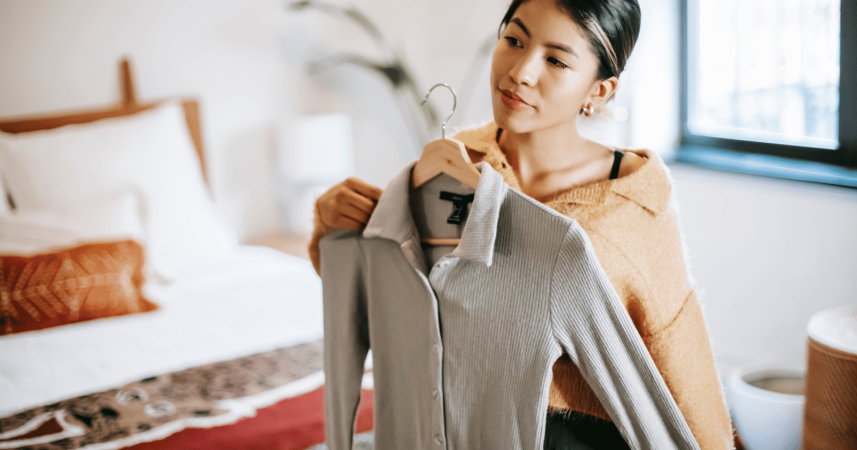
2) Your outfits look great on the hanger but not on you
Raise your hand if you’ve ever fallen in love with an outfit on a mannequin or influencer, only to try it on and feel instantly deflated.
I’ve been there more times than I can count. I used to think, Maybe I just don’t have the right body for clothes like that. But that’s not the truth. The real issue? I was dressing for someone else’s shape, not mine.
For example, if your shoulders are narrower than your hips, wide-leg pants with a cropped jacket will emphasize that imbalance. If you’re more rectangular, flowy tunics might erase your natural structure entirely.
Understanding your body’s geometry changes everything. Are you more curved (hourglass or pear)? More angular (rectangle or inverted triangle)? Or balanced (apple or oval)? When you use clothes to highlight your natural lines instead of fighting them, you look instantly more at ease.
You don’t need to obsess over categories, but knowing your proportions gives you a cheat sheet for what shapes feel right. Try snapping photos of yourself in different silhouettes and notice which ones echo your body’s rhythm.
3) You’re hiding behind oversized clothes (or squeezing into ones that don’t breathe)
This one’s tricky, because both extremes often come from the same place: discomfort with visibility.
When we wear oversized clothes, we’re usually trying to blend in or feel safe. When we wear overly tight ones, we’re often trying to prove something, to look smaller, neater, or more “in control.”
I’ve gone through both phases. My “comfort cocoon” era featured endless oversized sweaters. Later, I swung to the other extreme: tailored blazers and jeans so tight they left marks. Neither version felt authentic.
The key is finding balance. If you love roomy tops, pair them with structured bottoms that define your shape. If you prefer fitted jeans, offset them with a relaxed blouse or longer jacket.
A well-balanced outfit mirrors the natural give-and-take of your body, movement and containment, structure and softness. It’s not about size. It’s about harmony.
4) Your proportions feel “off” in photos
We’ve all had that moment: you glance at a picture of yourself and think, Wait, I didn’t look like that in the mirror!
Photos are ruthless about proportion. The camera flattens three dimensions into two, exaggerating imbalance between lengths, lines, or hemlines.
If your outfit visually cuts you in half, like long tops over long pants with no waist definition, it can make your figure look shorter or wider than it really is.
Try creating balance through simple styling tweaks. Tuck your shirt just in the front, roll cuffs, or use layers that break up long vertical lines. Add contrast between textures, like pairing a structured denim jacket with flowy pants, or create an elongated effect with matching tones from top to bottom.
I sometimes use a mirror trick: if my reflection looks best when I tilt my head or change posture, it usually means the outfit’s proportion, not my body, is off balance.
5) You wear colors or fabrics that overpower your natural features
Sometimes, the issue isn’t shape, it’s energy. If your clothes enter the room before you do, it might mean they’re overpowering your natural coloring or vibe.
I once owned a neon-green sweater I adored in the store mirror. But every time I wore it, I felt oddly tense. People complimented the sweater, not me. That’s when I realized: the best clothes don’t shout, they amplify.
Notice how certain colors or fabrics affect your presence. When you wear tones that complement your features, people tend to compliment you, not just your outfit. You don’t need a formal color analysis to figure this out.
Try pairing bright or bold items with neutral pieces near your face, or mix statement fabrics like satin or leather with softer textures to let your personality stand out instead of your clothes.
6) You have a closet full of clothes but “nothing to wear”
If your closet is packed but you’re still stuck every morning, this isn’t a style issue, it’s a connection issue.
When our wardrobe doesn’t match our body’s proportions or lifestyle, we feel detached from it. We’re surrounded by options but can’t visualize what actually works.
Every body has a natural “shape language,” the way fabric wants to fall on you. If you’ve got soft curves, sharp tailoring might feel restrictive. If you’re naturally straight-lined, too much draping can drown you out. When your clothes fight that language, everything feels off.
Try on five random items from your closet and take photos of each outfit. You’ll quickly start seeing patterns. Maybe you love open necklines but dislike crew necks, or cropped jackets make your legs look longer.
These small discoveries show you that you don’t need more clothes, you just need to remix what already resonates with your body’s rhythm.
7) You ignore balance between your top and bottom halves
Stylists always talk about balance for a reason, it’s visual psychology. Our brains are drawn to symmetry, and when one half of your outfit feels heavier or brighter than the other, something feels off even if you can’t pinpoint why.
Let’s say you have broader shoulders. If you pair that with ruffled sleeves or high necklines, your top half can dominate. On the other hand, if you’re curvier on the bottom and wear wide-leg pants with long tunics, your frame might look weighed down.
Playing with visual weight can change everything. If your lower half feels dominant, add interest up top with a bold necklace, patterned scarf, or textured jacket. If your upper body feels heavy, go for V-necks, vertical stripes, or sleek silhouettes below.
Balance isn’t about disguising your body, it’s about framing it. When both halves of your body feel seen, the whole picture works.
8) You feel “not like yourself” in your clothes
This one goes beyond style, it’s about self-connection. Sometimes, you can tell an outfit doesn’t work not because it’s unflattering, but because it just doesn’t feel like you.
I once spent months dressing in neutral tones because I thought they made me look more “sophisticated.” And sure, they photographed well. But every time I caught my reflection, I felt like I’d muted my own spark.
Clothes are an extension of identity. If something feels performative or out of sync with your personality, tweak it. Mix something playful or sentimental into your look, a vintage pin, a bright scarf, a bold lip color.
The goal isn’t to fit a category like “boho” or “minimalist.” It’s to align with your energy. When your outer expression mirrors your inner sense of self, confidence stops being something you fake, it becomes something you wear.
Final thoughts
Learning to dress for your body shape isn’t about conforming, it’s about collaboration. Your body has spent years learning how to support you. Dressing with intention is your way of saying, I see you, and I appreciate you.
Once you understand your proportions, you start to notice that style isn’t about hiding or fixing, it’s about harmonizing. A slightly tucked shirt, a belt in the right place, or a balanced fabric can shift how you feel instantly.
And the beauty of it all? You don’t need to buy anything new. You just need to see what’s already hanging in your closet with more compassion and curiosity.
When your clothes work with your body instead of against it, something magical happens, you stop thinking about your outfit altogether. You just show up.
And that’s when you know: you’re dressing in alignment with your shape, your energy, and your truth.