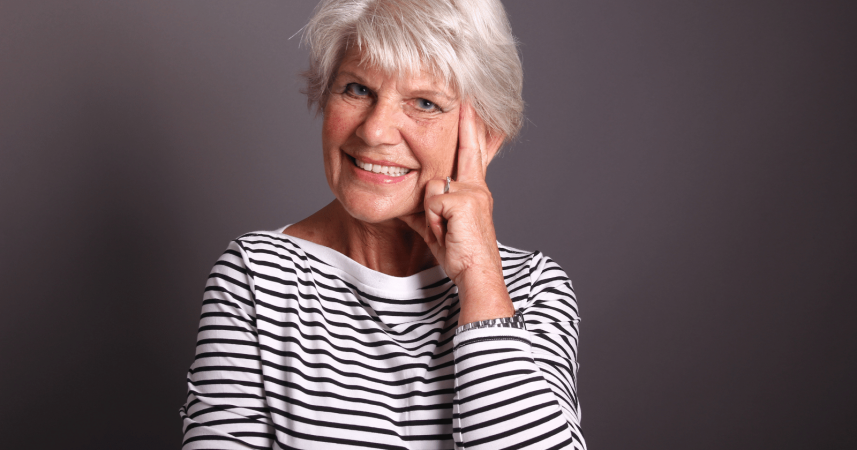
What we've been told makes us look smaller often does the opposite, and the cuts designed to hide our bodies are actually adding bulk where we least want it.

Add VegOut to your Google News feed. 
I was volunteering at the farmers' market last Saturday when I noticed something. A woman in her sixties walked by wearing a beautiful silk scarf and statement earrings, but her outfit was completely swallowed by oversized, shapeless clothing. She had this confident energy about her, but her clothes were working against her, not with her.
It got me thinking about all the fashion advice that's been handed down through generations, particularly to women in the Boomer generation. So much of it was meant to be helpful, to create a "flattering" silhouette.
But here's what I've learned through my own style evolution and conversations with women at the market: sometimes what we're told is flattering is actually hiding our best features.
For years during my finance career, I dressed in what I thought were "safe" professional cuts. High necklines, boxy blazers, loose trousers. I thought I was dressing appropriately, but I was really just hiding.
When I transitioned to writing and started reassessing everything in my life, including my wardrobe, I realized that many of these supposedly flattering cuts were doing the opposite of what they promised.
Let's talk about eight clothing cuts that might be working against you.
1) Empire waist dresses and tops
The empire waist has been marketed as universally flattering for decades. The idea is simple: cinch right under the bust and let everything flow from there, hiding the midsection and creating an elongated silhouette.
But here's what actually happens. That high waistline eliminates your natural waist entirely. If you have any definition there at all, and most of us do even if we don't think so, you're hiding it. The flowing fabric from bust to hem creates a triangular shape that can add visual bulk rather than minimize it.
I learned this the hard way when I found an old photo of myself at a work event in my early thirties, wearing what I thought was a flattering empire waist dress. I looked pregnant. I wasn't.
The cut works on exactly one body type, and it's not most of ours. Instead, dresses that gently define your natural waist, even if it's not where it used to be, create a much more balanced and genuinely flattering silhouette.
Your waist is still there. Why hide it under a tent?
2) Elastic waistband pull-on pants
I get it. Comfort matters. As someone who runs trails almost every morning and values movement, I understand the appeal of clothing that doesn't dig in or restrict.
But there's a difference between comfortable and shapeless. Pull-on pants with full elastic waistbands often lack any structure in the hip and thigh area. They create a straight line from waist to ankle that doesn't acknowledge your body's natural curves.
What happens? You end up looking wider through the middle than you actually are. The elastic creates a gathered, bunched effect at the waistline that adds bulk exactly where most of us are trying to minimize it.
The solution isn't going back to uncomfortable, rigid waistbands. Modern pants with partial elastic backs or stretch fabrics give you comfort without sacrificing shape. They skim your body rather than hanging off it.
When I finally invested in a few pairs of well-cut pants with just enough stretch, I couldn't believe the difference. Same size, completely different silhouette. I could move freely on my morning runs and still look put-together when I sat down to write.
3) Boxy, oversized tunics
Walk into any store catering to women over fifty and you'll find racks of oversized tunics. Long, rectangular shapes that promise to "skim over problem areas" and provide comfort.
The reality is less flattering. These shapeless tops eliminate any definition your body has. They create a rectangular silhouette that makes you look larger than you are. The longer length is supposed to be slimming, but without any shaping, it just adds visual weight.
I used to own several of these. I thought I was being smart, hiding what I didn't like about my body. But hiding isn't the same as flattering. When I started choosing tops that gently followed my body's lines, even loosely, I looked more polished and, ironically, slimmer.
This doesn't mean wearing tight, clingy clothing. It means choosing pieces with some subtle shaping. A gentle curve in at the waist, even if it's just suggested rather than defined, makes all the difference. Fabric that drapes rather than boxes creates movement and elegance.
Your body has shape. Let your clothes acknowledge that.
4) High, crew necklines
For years, we've been told that high necklines are more age-appropriate, more modest, more flattering for mature women. Cover up that décolletage, hide any signs of aging in the neck and chest area.
But high crew necks actually draw attention to the very things they're trying to hide. They cut across one of the narrowest parts of your body, your neck, making it appear shorter and thicker. They create a visual barrier that makes your upper body look compressed.
A slightly open neckline, whether it's a modest V-neck, scoop neck, or even a collar worn with the top button undone, creates vertical lines that lengthen your neck and draw the eye down. This is flattering. This creates elegance.
I noticed this during a video call last year. I was wearing a high crew neck sweater and looked completely different than I do in my usual V-neck tops. My face looked rounder, my neck disappeared, and I seemed to have no collarbone at all. It was the clothing, not my body.
You don't need to show cleavage to look good. You just need to not cut your neck off at its base.
5) Long, straight cardigan dusters
The long cardigan duster has become a staple in many wardrobes. Worn open, hitting mid-thigh or lower, often in neutral colors. They're marketed as the perfect layering piece, the thing that pulls an outfit together and creates a long, lean line.
In reality, they often create the opposite effect. That long, straight line with no shaping creates a column that makes your body look wider. If you're petite, they can overwhelm your frame entirely. The lack of definition at the waist means you lose your proportions under all that fabric.
What works better? Cardigans that hit at the hip bone or just below, or longer styles that have some subtle shaping through the torso. Even something as simple as wearing a long cardigan closed with a belt at the waist changes the entire silhouette.
During my years analyzing numbers, I learned to pay attention to ratios and proportions. The same principle applies to clothing. When the proportions are off, the whole picture suffers.
6) Cropped pants and capris
This one surprises people. Cropped pants and capris have been pushed as flattering for years, especially for warmer weather. The idea is that they're a compromise between full-length pants and shorts, offering coverage while staying cool.
But that mid-calf length cuts your leg line at its widest point. It makes your legs look shorter and, often, thicker than they actually are. It creates a visual stopping point right where you don't want one.
The most flattering pant lengths are either full length, hitting at or just above the ankle bone, or true shorts that end at the knee or above. Both of these lengths create a longer, cleaner line.
I used to wear capris constantly during my running errands days. When I switched to ankle-length pants, even casual ones, I was shocked at how much more pulled-together I looked. Same body, different proportions.
Your legs have a natural line to them. Why interrupt it?
7) Dropped shoulder seams and raglan sleeves
Clothing with dropped shoulder seams or raglan sleeves is everywhere. These styles put the shoulder seam several inches down the arm rather than at the natural shoulder point. They're comfortable, they're casual, they're easy.
They're also widening. When the shoulder seam drops down your arm, it makes your shoulders and upper body look broader than they are. It eliminates the definition at your natural shoulder line, creating a slumped, droopy appearance.
Proper shoulder fit, with the seam sitting right at your shoulder point, creates structure and definition. It makes you look more confident and put-together. This applies to everything from t-shirts to blazers.
I learned this from a mentor early in my finance career. She told me that the difference between looking professional and looking sloppy often came down to where the shoulder seam hit. It was one of the best pieces of advice I ever received.
Your shoulders define your upper body structure. Don't blur that line.
8) A-line skirts with too much volume
A-line skirts are classic for a reason. The gentle flare from waist or hips to hem can be very flattering. But there's a line between a subtle A-line and a skirt with so much volume that it overwhelms your frame.
When an A-line skirt has too much fabric, it creates a bell shape that makes your hips look wider than they are. The contrast between your actual body and all that fabric draws attention to exactly what you're trying to minimize.
A skirt that has just enough flare to skim over your hips without clinging, but doesn't balloon out, creates a much more balanced silhouette. The key is proportion. Too much fabric works against you.
I used to think more fabric meant more camouflage. Through trial and error, and yes, some unflattering photos, I learned that less is often more. Clothes that follow your body's general shape, without clinging or billowing, are what actually look good.
Conclusion
Looking back at my corporate years, I realize how much time I spent trying to hide behind my clothing. I thought "flattering" meant concealing, covering, and creating the illusion of a different body than the one I had.
The truth is, flattering means acknowledging your body as it is and choosing cuts that work with your proportions, not against them. It means structure without restriction, shape without tightness, and definition without discomfort.
This shift in thinking didn't happen overnight. It came gradually, as I started questioning other assumptions I'd made about success, achievement, and self-worth. When I left my six-figure finance job to pursue writing, I also started rethinking the uniform I'd worn for nearly two decades.
These eight cuts are still everywhere. They're still marketed as flattering, safe, and appropriate. But appropriate for what? For hiding? For disappearing?
You've lived long enough to know who you are. Your clothing should reflect that confidence, not undermine it. The best features you have aren't the ones that fit some external standard. They're the ones that make you uniquely you.
And those deserve to be seen.
What’s Your Plant-Powered Archetype?
Ever wonder what your everyday habits say about your deeper purpose—and how they ripple out to impact the planet?
This 90-second quiz reveals the plant-powered role you’re here to play, and the tiny shift that makes it even more powerful.
12 fun questions. Instant results. Surprisingly accurate.