
So tomorrow, try this: pick one neutral, build a tonal look, add a third piece, align your metals, and do the doorway check. No fanfare. Just the quiet satisfaction of getting the details right.

Add VegOut to your Google News feed. 
Quiet luxury isn’t about spending more. It’s about subtracting—noise, fuss, logos—and letting intention do the talking. Think of it like compound interest for your closet: small, smart choices that pay off every time you get dressed.
I came to this the long way. Years ago, as a financial analyst, I thought value lived in price tags and trend reports. Now, on most mornings, I’m tossing on a crisp tee, tailored trousers, and taking my coffee out to the garden before a trail run. I notice what actually gets worn, what holds up, and what makes me feel grounded. That’s the quiet part—it’s psychological, not performative. When you dress with ease, your brain stops negotiating with your closet and starts focusing on your day.
Here are the nine styling rules I rely on to elevate any outfit—no shouting, just signals.
1) Fit first, always
You can’t “style” your way out of a poor fit. If one rule lived on a Post-it inside my closet, it would be this. Clothing that skims the body (not clings, not billows) reads expensive, even when it isn’t.
I do a quick three-point check in the mirror:
- Shoulders: seams sit right at the edge, not drooping and not pinching.
- Waist/seat: fabric glides; no pulling across zippers or buttons.
- Length: sleeves meet the wrist bone; pants break once on the shoe.
If you’re between sizes, choose the one that fits your widest point and tailor the rest. It’s the simplest upgrade in the world. I’ve spent $20 on hems that made $60 trousers look like $260 trousers. Fit is the quietest flex.
2) Build a calm palette (then play with tone)
Color can be bold without being loud. The trick is a calm base: think oatmeal, stone, navy, charcoal, soft black, cream. From there, create depth with tonal layers—three shades of the same color family in one look. A dove-grey tee, pewter trouser, slate jacket. Or sand, camel, and caramel.
Tonal outfits work like a dimmer switch for polish. You look cohesive at a glance, and the eye reads “intentional” instead of “busy.” When I want a lift, I add one harmonious accent—a muted olive bag, a wine-toned lip, a soft gold hoop. If the palette is quiet, the accent sings.
A good home test: lay your outfit on the bed and squint. If you see one gentle gradient rather than competing blocks, you’re there.
3) Let texture do the talking
If logos shout, texture whispers. That whisper is what people register as “expensive.” You can get it at every price point if you choose the right surfaces: brushed twill, tightly knit jersey, matte crepe, ribbed tanks, vegan microsuede, plant-based “leather” that feels soft, not plastic.
Mixing two or three textures is my favorite hack. A crisp poplin shirt under a softly structured blazer. A ribbed tank with fluid trousers. A matte bag against a slightly lustrous shoe. Each texture catches the light differently, giving even a simple outfit dimension.
I’m vegan, so I reach for high-quality alternatives: apple- or cactus-based leather for bags, and microfiber or cork for shoes. The key is finish—look for smooth grain, clean edges, and hardware that feels substantial when you touch it.
4) Mind your proportions like a sculptor
Quiet luxury is a study in balance. Slim with relaxed, long with cropped, structure with drape. If your top is oversized, anchor it with a tapered trouser. If your pants are wide and fluid, choose a closer-fitting tee or a neatly tucked shirt.
A simple ratio I use is 2:1—two fitted elements, one relaxed (or the reverse) in every look. Example: fitted tee + relaxed trousers + streamlined sneaker. Or relaxed sweater + straight-leg jean + sleek loafer. Proportion is how you tell the eye where to settle. Get that right and everything else feels composed.
The unsung hero here is the third piece: cardigan, blazer, vest, chore jacket. It frames your base and instantly pulls a look together. If you’re new to layering, start with a lightweight, unlined blazer in a neutral. You’ll be shocked how often you reach for it.
5) Edit your hardware and keep it cohesive
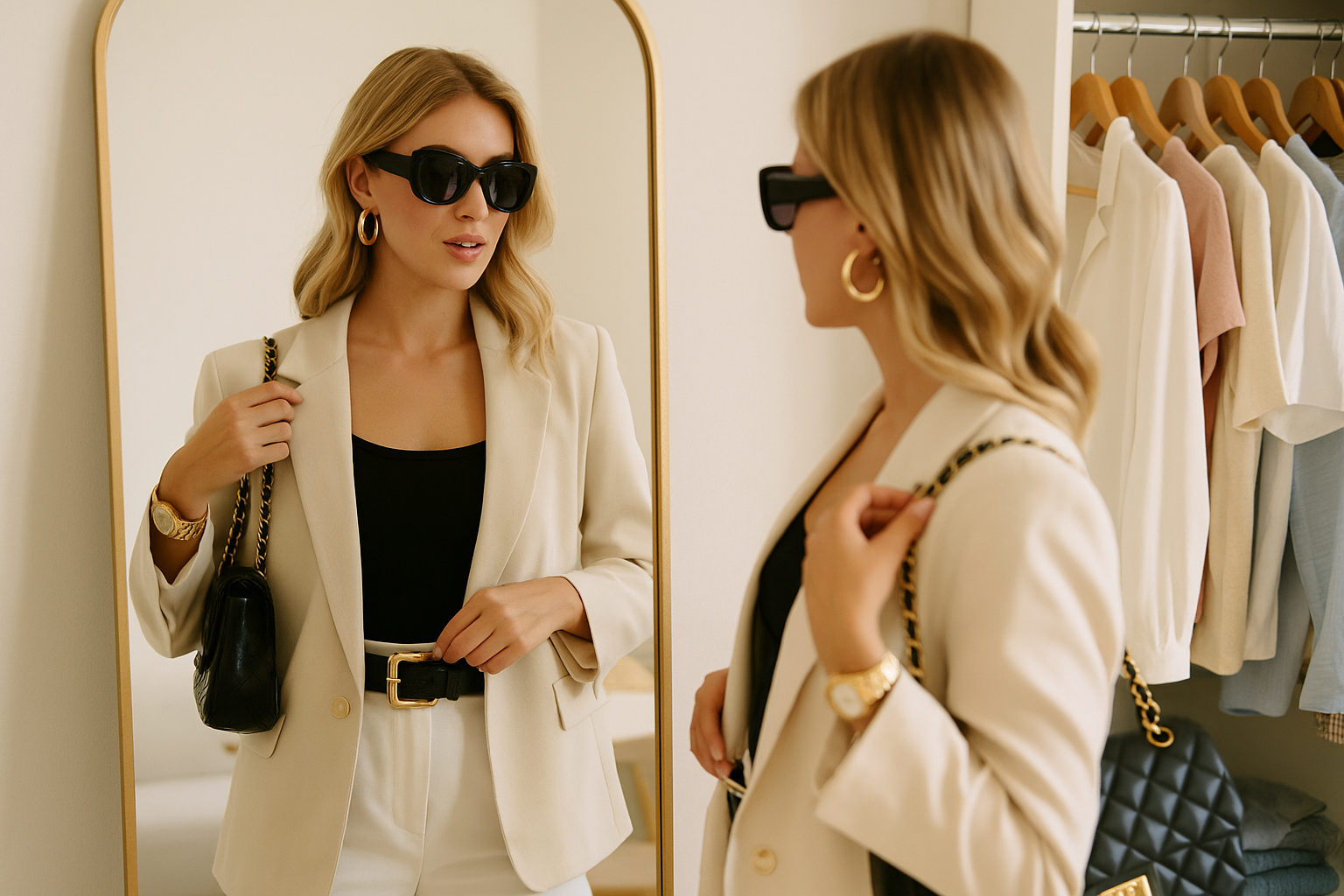
Metals matter more than we admit. Mismatched hardware can make an outfit feel chaotic, even when the clothes are spot-on. I choose one metal family for the day—soft gold, brushed silver, gunmetal—and echo it lightly across jewelry, belt buckles, bag clasps, and even eyewear.
As for jewelry, think punctuation, not paragraph. One quiet signature beats a pile: small hoops, a slim cuff, a single signet ring. If I stack, I keep scale consistent and surfaces matte or brushed. The finish reads modern and under-the-radar, which is the entire mood.
Belts deserve a shoutout, too. A clean, unbranded belt with a modest buckle can stealthily “finish the sentence” of an outfit. If your top is tucked, a belt is your focal point. Let it be intentional, not loud.
6) Choose better fabrics—and care for them well
Fabric selection is where style meets lifespan. Dense knits resist clinging and look refined. Tightly woven cotton poplin holds its shape. Linen blends wrinkle in a charming, not sloppy, way. When I shop, I do the squeeze test: compress the fabric in my fist for five seconds. If the creases fall out quickly, it’s a win.
Because I’m plant-based, I bias toward organic cotton, Tencel/lyocell, linen, and quality vegan suedes. They breathe, they hang beautifully, and they’re kinder to skin. The real “luxury,” though, is maintenance. I wash cool, skip the dryer for anything I love, and use a handheld steamer. Ten minutes of care changes how expensive your clothes look—no matter what you paid.
One small ritual that makes a big difference: a lint brush and fabric shaver live on my dresser. Pilling and lint read as cheap from six feet away. Smooth surfaces read as serene.
7) Tailor your basics and log the ROI
Here’s my finance brain at work: cost-per-wear beats sticker price. A $40 tee tailored to your shoulder slope that you wear twice a week for two years crushes the ROI of a $140 shirt that never fit right. Quiet luxury is pragmatic.
I keep a simple note on my phone: item, alteration, cost, wears per month. If something gets three or more wears monthly, it earns a slot for tailoring—hems, darts, taking in a waist, narrowing a sleeve. Even small tweaks—a cleaner sleeve length or a crisper ankle break—telegraph polish.
Start with the workhorses: trousers, blazers, jeans. If your tailor becomes your stylist, you’re doing it right. Bring the shoes you’ll wear with the pants and decide the exact break together. Precision is the difference between “nice” and “nailed.”
8) Elevate your “base layer” grooming
The clean, quiet foundation—hair, skin, nails—carries more weight than most outfits. It’s not about glam; it’s about edges and texture looking intentional. A blunt trim that skims your collarbone. Moisturized skin with a soft, non-greasy finish. Neutral nails—short, buffed, or a sheer wash.
Fragrance? If you wear it, keep it intimate: one spritz of something skin-like and plant-forward, nothing that enters the room before you do. Bags and shoes get the same treatment: wiped down, soles intact, corners unscuffed. Imagine your whole look on mute. What still reads “put-together”? That’s your base layer doing the heavy lifting.
If you love a bolder lip or eye, make it the soloist. The rest of the face stays minimal so the overall effect remains composed, not competitive.
9) Repeat on purpose
Quiet luxury isn’t a new outfit every day; it’s a strong uniform you remix without apology.
Wearing your best formula on repeat is a power move because it frees your attention for things that matter more. My personal trifecta: tailored trouser + high-quality tee + third piece. In winter, swap the tee for a ribbed knit; in summer, the third piece becomes a linen shirt left open.
To avoid boredom, I rotate by texture and tone, not silhouette. Stone trousers instead of black. A ribbed tank instead of a jersey tee. A vegan microsuede belt instead of leather. People read the consistency as confidence. You read it as fewer decisions at 7 a.m.
A quick closet rhythm keeps the cycle clean: at the end of the week, I return each piece to its “family”—tees folded edge-out by shade, trousers on identical hangers, third pieces together. Order is its own kind of luxury, and it makes your best choices the easiest ones to grab.
Conclusion
A few practical micro-habits that tie it all together:
- Do a doorway check. Before you leave, pause in good light. Smooth a seam, roll a sleeve once, or swap one item. One 30-second adjustment can change the whole signal.
- Avoid outfit clutter. If you put something on and immediately want to add two more things to “fix” it, start over. The best looks often lose an element, not gain one.
- Create a go-to column. A matching top and bottom in the same tone (black, navy, taupe) with a contrasting third piece is a plug-and-play formula that never fails.
- Let comfort be a constraint. Shoes you can actually walk in, waistbands that move with you, fabrics that breathe. Ease looks like luxury from the outside.
- Honor your life. If you’re commuting, chasing kids, volunteering at a farmers’ market (hi, yes), your clothes should track your reality. A quiet wardrobe serves your day; it doesn’t demand one.
In the end, the art isn’t about labels. It’s about clarity. You’re editing your outfit the way you’d edit a paragraph—remove what’s unnecessary, keep what strengthens the message, and trust white space. When you do, you’ll notice something subtle but powerful: people listen differently when your style isn’t asking for attention. It’s granting it—to you, to your work, to your life.
So tomorrow, try this: pick one neutral, build a tonal look, add a third piece, align your metals, and do the doorway check. No fanfare. Just the quiet satisfaction of getting the details right. That’s luxury you can wear on a Tuesday—and every day after.
If You Were a Healing Herb, Which Would You Be?
Each herb holds a unique kind of magic — soothing, awakening, grounding, or clarifying.
This 9-question quiz reveals the healing plant that mirrors your energy right now and what it says about your natural rhythm.
✨ Instant results. Deeply insightful.

Avery White
Formerly a financial analyst, Avery translates complex research into clear, informative narratives. Her evidence-based approach provides readers with reliable insights, presented with clarity and warmth. Outside of work, Avery enjoys trail running, gardening, and volunteering at local farmers’ markets.
More Articles by Avery