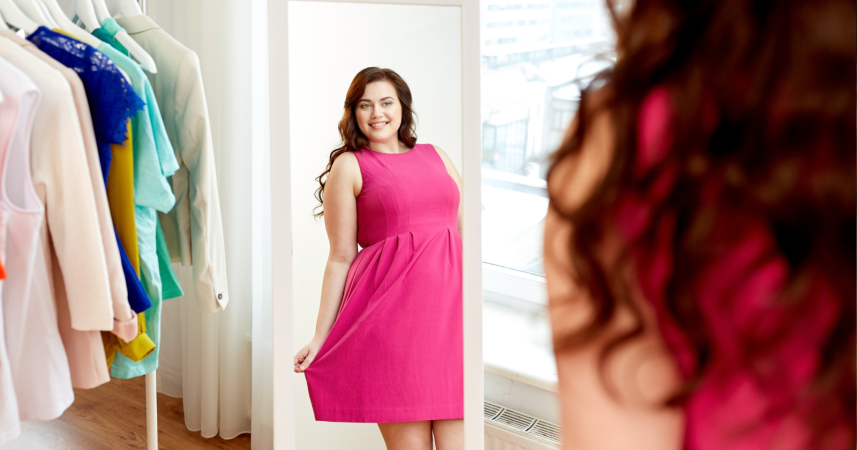
The most flattering thing you can wear isn’t a trick stitch or a strategic ruffle—it's intention.
We’ve all been sold the same promise: “Wear this and you’ll look slimmer/younger/taller.”
I get it—clothes can be little confidence boosters, and there’s nothing wrong with wanting to feel polished.
However, after years of writing about behavior and perception—and more than a few questionable outfits—I’ve realized something: A lot of so-called “flattering” pieces actually do the opposite.
They hide shape, warp proportions, and send a low-energy signal that we’d rather disappear than be seen.
Why does this happen? Psychologically, many of us dress for safety—not impact.
We reach for extra coverage when we’re tired, anxious, or short on time.
We fall for loss aversion (“as long as nothing looks ‘bad,’ I’ll be fine”) and forget that “not bad” rarely reads as “confident.”
The result? Outfits that blur our outline, shorten our legs, and age us visually (aka, frump territory).
If you’ve ever stood in front of the mirror wondering why an outfit that “should” work… doesn’t—this is for you:
1) Shapeless tunics that “cover everything”
We’re told a drapey tunic is universally forgiving—covers the bum, skims the tummy, done.
But when a top hangs like a curtain, the eye has no anchor.
With no defined shoulder line, waist hint, or vertical seam, the body becomes a single block.
That block looks wider and, yes, frumpier than you actually are.
Ask yourself: Does this tunic create a shape, or hide one?
If your answer is “hide,” your outfit is working against you.
2) Mid-calf capris that “slim the leg”
Capris promise cool comfort and “slimming coverage,” but the mid-calf chop is brutal on leg line.
It hits at the widest part of the lower leg and visually shortens you.
Pair them with a chunky sneaker or a flat with a high vamp and suddenly your proportions skew squat, even if you’re not.
Here’s the visual math: Every horizontal line (hemlines, straps, cuffs) cuts the body.
The more lines at awkward spots, the stubbier the effect.
Mid-calf is one of the worst offenders.
If you absolutely adore your capris, balance them with a more fitted top and visible waist.
Think clean T-shirt tucked in, or a cropped knit that meets the top of your waistband.
Proportions are a game—play to win.
3) Waterfall and extra-long cardigans that “elongate”
You know the ones: miles of fabric, draping waterfalls, maybe some flutter panels.
These are marketed as “lengthening,” but all those folds create bulk at the hips and thighs, exactly where many of us don’t want extra volume.
Add a hem that hits below the fullest part of your leg and the cardigan swallows you whole.
A long cardigan can work—if it respects your architecture.
I once wore an open waterfall cardigan to a casual dinner, thinking it would “dress up” leggings.
A friend snapped a photo and I looked like the cardigan was wearing me.
I swapped it later for a blazer-style knit with a defined shoulder, and suddenly the same leggings and tank turned into an outfit.
4) Empire-waist and baby-doll tops that “hide the tummy”
This silhouette gets praise for being “forgiving,” but it often reads as maternity-adjacent.
The high seam plus gathered fabric can add volume right under the bust and blur the natural waist—both fast tracks to dowdy.
If the fabric is flimsy, every breeze rounds the front like a sail.
Instead of erasing your midsection, consider framing it cleverly.
If you own a beloved empire dress, layer a short, structured denim or chore jacket over it and add a belt just below the natural waist.
The jacket creates vertical edges; the belt reintroduces shape.
Suddenly, it’s romantic—not frumpy.
5) Cold-shoulder tops that “focus on your best feature”
Cold-shoulder tops promised a peek-a-boo solution: cover the arms while highlighting the shoulders.
Trendy once; dated now.
The cut-outs interrupt your lines and widen the frame, especially when combined with ruffles or elasticated sleeves.
On camera (and in real life), they add visual noise without offering structure.
Trends pass; proportion is forever.
6) Busy tiny prints and “slimming” micro-patterns
We’re taught that small prints are “safe,” but dense ditsy florals and micro-geometrics can read childlike or fussy.
They also flatten your figure into wallpaper—there’s no place for the eye to rest, and no clear outline for your body.
On video calls or in photos, these prints moiré (ripple) and muddy your presence.
That’s not the vibe, so simplify to amplify.
If you love prints (same), pick one that stands out.
Let it shine and keep everything else simple—shoes, bag, jewelry.
This is how you look elevated rather than overwhelmed.
Final thoughts
If any of the pieces above are your ride-or-die, keep them.
Clothes are personal.
The goal isn’t to police your closet; it’s to understand the optical illusions at play so you get the result you want on purpose.
But if you’ve been stuck in “flattering” purgatory—capris cutting your legs in half, tunics swallowing your shape, cardigans doing the most—consider it your permission slip to experiment.
Try cleaner lines, clearer hemlines, and small hints of structure.
Create verticals, give your body an outline, and let your face be the focus because the most flattering thing you can wear isn’t a trick stitch or a strategic ruffle.
It’s intention—and that never looks frumpy!
If You Were a Healing Herb, Which Would You Be?
Each herb holds a unique kind of magic — soothing, awakening, grounding, or clarifying.
This 9-question quiz reveals the healing plant that mirrors your energy right now and what it says about your natural rhythm.
✨ Instant results. Deeply insightful.