The subtle signals we send through our wardrobes—and why they matter less than we think.

Add VegOut to your Google News feed. 
I learned about clothing as class signifier the hard way, wearing my best outfit to a job interview at a Manhattan PR firm. The interviewer's eyes flickered over my polyester blazer—the one I'd saved for, the one that looked "just like" designer versions—and I knew instantly that I'd gotten something wrong. Not wrong enough to mention, but wrong enough to notice.
Fashion has always been a language of belonging, but for those of us straddling economic lines, it's a dialect we're constantly trying to master with an incomplete dictionary. The items below aren't inherently bad choices. They're practical, often attractive, and serve their purpose well. But in certain spaces, they whisper stories about our backgrounds that we might not intend to tell.
1. The Michael Kors bag that's trying too hard
There's a particular weight to carrying a Michael Kors bag with the MK logo repeated across its surface. It's the accessible luxury trap—expensive enough to strain a budget, not quite expensive enough to gain entry to the club it's trying to join.
I had one in cognac brown, purchased with overtime pay from my retail job. The gold hardware felt substantial, important. But at industry events, surrounded by understated leather totes and vintage finds, it marked me as someone trying to buy my way into a conversation about taste. The cruel irony? True luxury whispers; it's the aspirational brands that shout.
2. Those cap-sleeve shells from department stores
Walk through any office building's lobby at lunch, and you'll spot them: those cap-sleeve shells in jewel tones, usually polyester, often from Macy's or JCPenney. They're the uniform of administrative assistants and bank tellers, women who need to look "professional" on a budget that laughs at the word "investment" piece.
The problem isn't the shirts themselves—they're perfectly serviceable. It's that they've become visual shorthand for a certain tier of office work, the kind where you're essential but invisible. Women higher up the economic ladder learned long ago that a simple cotton t-shirt under a blazer reads as more "effortless" than trying.
3. Pandora charm bracelets still jangling
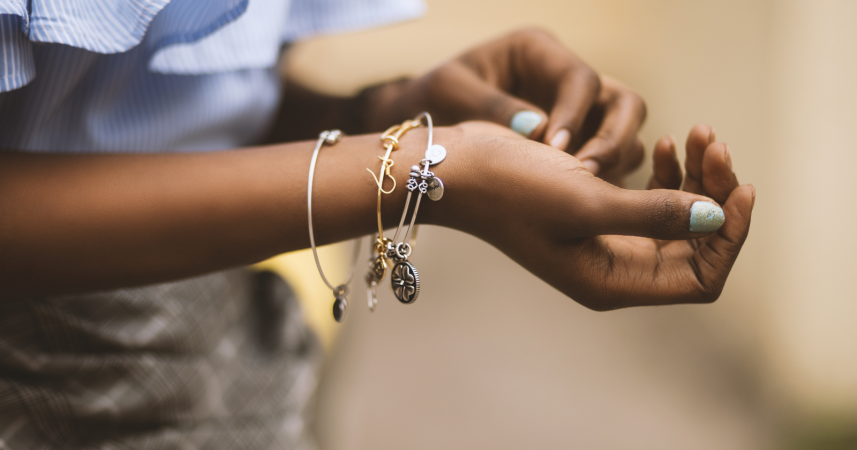
The Pandora bracelet was democratic luxury—everyone could afford to start one, adding charms for birthdays and holidays. But somewhere around 2015, the cultural tide shifted, and those jangling bracelets became markers of a particular earnestness that sophisticated circles had moved past.
My sister still wears hers, each charm a tiny monument to a life event. There's something beautiful about that transparency, that willingness to carry your story on your wrist. But in certain rooms, that bracelet marks you as someone who hasn't gotten the memo that we're all supposed to be wearing delicate gold chains now, nothing that announces itself when you reach for your coffee.
4. Workout wear as real clothes
The yoga pants at Target are comfortable, affordable, and come in forgiving cuts. They become Saturday's grocery store outfit, Sunday's brunch attire, sometimes Monday's work-from-home uniform. This isn't about athleisure as fashion—it's about the difference between choosing to wear leggings and having them become your default because everything else requires more thought, more money, more effort than you have to spare.
Upper-middle-class women wear workout clothes too, but theirs whisper different stories: boutique fitness memberships, the luxury of time for self-care, the choice to dress down rather than the exhaustion that makes dressing up feel impossible.
5. The wrong kind of designer sunglasses
Those oversized sunglasses with logos on the temples—usually Coach or Michael Kors, sometimes Kate Spade—purchased at outlet malls or with careful saving. They're real designer goods, technically, but they're the "accessible" lines, the ones meant to let everyone feel included.
The tell isn't the brand itself but the obvious branding, the need to announce the designer. Quiet luxury chooses anonymous excellence; accessible luxury needs you to know what was sacrificed for this small symbol of arrival.
6. Costume jewelry that's doing too much
Statement necklaces from Charming Charlie (RIP) or Target, cocktail rings from outlet stores, pieces that aim for bold but land at loud. There's a particular kind of costume jewelry that tries to compensate for being costume—more rhinestones, bigger pendants, anything to distract from what it's not.
I remember choosing earrings for my cousin's wedding, standing in Nordstrom Rack, convinced that bigger meant better, that more sparkle meant more special. Now I know that women with money often wear less jewelry, or better fakes, or their grandmother's small gold hoops—anything but the anxiety of trying to look like you belong.
7. Those quilted vests in fall
The quilted vest—often in navy or black, sometimes with a small logo, usually from Old Navy or TJ Maxx—has become the suburban uniform of a particular economic bracket. Practical, yes. Flattering, often. But also a signal of priorities: warmth over style, function over form, the sensible choice over the surprising one.
It's not that wealthy women don't wear vests. They do. But theirs are likely vintage, or from brands you've never heard of, or worn in ways that suggest choice rather than compromise.
8. Knockoff designer prints
The paisley that's almost Vera Bradley, the monogram that's nearly Louis Vuitton, the print that suggests Burberry without the lawsuit. These pieces exist in a uncanny valley of fashion—close enough to reference the original, different enough to be legal, obvious enough to anyone who knows the real thing.
They represent something poignant: the desire to participate in fashion's conversation without having the vocabulary or resources to do so authentically. It's not deception, exactly—it's translation, trying to speak a language you've only heard from across the room.
Final thoughts
Years after that interview, I've learned the secret: the people who matter don't care about these tells. The people who care? They're usually fighting their own battles with belonging, policing others because they're scared of being policed themselves.
The real violence of fashion's class system isn't the existence of these markers—it's how they teach us to see ourselves through hostile eyes. We pre-reject ourselves from opportunities, certain our blazers have already told stories we can't overcome. We learn to read these signals so well that we become our own harshest critics, finding failure in every functional choice.
Maybe the most radical act isn't to dress better or differently, but to refuse the game entirely. To wear what serves us without apology. Because fashion's cruelest trick isn't making us feel watched—it's teaching us to surveil ourselves, to find shame in the gap between what we can afford and what we're told we need to belong.
That polyester blazer? I still have it. Sometimes I wear it just to remember that the story it tells is mine to write.