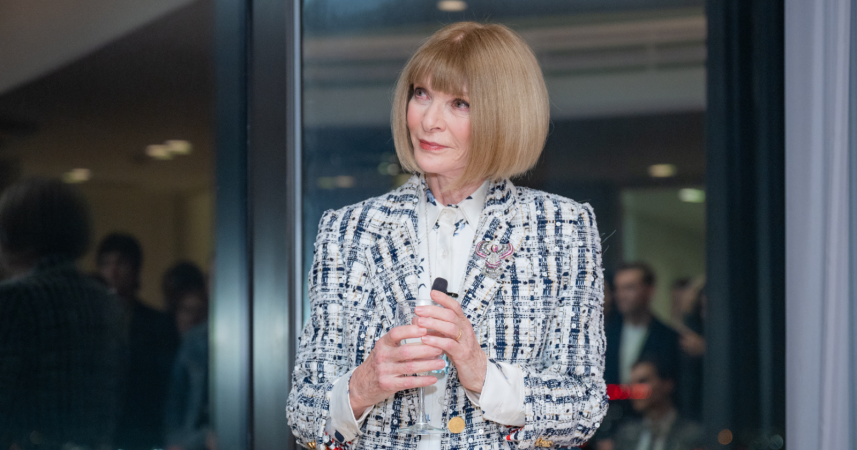
Wintour's decades-long commitment to the same silhouette reveals something most of us miss about getting dressed.

Add VegOut to your Google News feed. 
You can't have a conversation about style without Anna Wintour's name coming up at some point.
For over three decades, she's shaped not just what appears in Vogue, but how entire generations think about fashion, personal presentation, and the relationship between clothes and identity.
What makes her influence so interesting isn't that she's told us what to wear. It's that she's demonstrated something more valuable: what it looks like to have absolute clarity about your own aesthetic and stick with it regardless of trends, criticism, or the pressure to constantly reinvent yourself.
She's worn essentially the same uniform for decades. Floral dresses, statement necklaces, that signature bob, those sunglasses.
On paper, it sounds repetitive. In practice, it's brilliant. While the rest of the fashion world cycles through trends at breakneck speed, Wintour shows up as exactly herself, every single time.
There's something powerful about watching someone operate with that level of self-knowledge. Her wardrobe choices aren't about following rules or chasing approval. They're about understanding what works and having the confidence to commit to it fully.
The lessons here go way beyond fashion. They're about knowing yourself well enough to make intentional choices and trusting those choices enough to stick with them. Here's what we can all learn from one of the most influential style icons of our time.
1) Consistency builds recognition
Wintour has worn variations of the same outfit for over thirty years. Knee-length dresses, statement jewelry, classic coats. She's created a visual signature so strong that you could spot her silhouette from across a room.
This goes against everything fashion magazines typically tell us about constantly reinventing ourselves and chasing trends. But here's what I discovered when I stopped buying clothes impulsively and started building a more intentional wardrobe: consistency is liberating, not limiting.
After I transitioned from finance to writing, I went through this phase of trying to figure out who I was through my clothes. Bohemian writer? Polished professional? Outdoorsy minimalist? I was exhausting myself with costume changes.
Then I realized the people I most admired dressed pretty much the same way every day. They'd found their formula and committed to it.
Now I essentially rotate through the same pieces. Dark jeans, simple tops, my trail running jacket even when I'm not running. People recognize me. More importantly, I recognize myself. There's power in that kind of visual coherence.
2) Quality over quantity actually matters
When you wear the same silhouettes repeatedly like Wintour does, quality becomes non-negotiable. You can't hide behind variety. Each piece needs to hold up under scrutiny because it's going to be seen again and again.
I learned this the expensive way during my first year of writing. I was making a fraction of my finance salary and thought I'd compensate by buying cheaper clothes more frequently. Those pieces fell apart, pilled after two washes, lost their shape. I was constantly shopping but never felt well-dressed.
Then I took a page from Wintour's playbook and flipped the script. I saved up and bought one really good pair of boots instead of three mediocre pairs.
I invested in two well-made dresses instead of six flimsy ones. The cost per wear plummeted because these pieces lasted. More importantly, I felt different wearing them. More intentional. More myself.
You don't need Chanel money to apply this principle. It's about being selective and patient. Buying fewer things that are made to last rather than constantly replacing disposable fashion.
3) Signature pieces create instant polish
Those sunglasses. That necklace. Wintour's signature accessories do heavy lifting. They elevate even simple outfits into something that looks considered and complete.
The beauty of signature pieces is they remove decisions. You know what works because you've established your own visual language.
Whether it's a specific watch, a certain style of earrings, or yes, even sunglasses worn indoors, these anchors create consistency.
Find one or two pieces that feel unmistakably you and wear them into the ground. Let them become part of your identity.
4) Formality doesn't require uncomfortable
Here's something I appreciate about Wintour's approach: she maintains a formal aesthetic without apparent suffering. Those dresses look elegant but they're not restrictive. She's not wobbling around in stilettos she can barely walk in.
Wintour seems to instinctively understand that you can look put-together without sacrificing comfort. Her aesthetic reads as formal and fashion-forward, but I'd bet money those dresses move well and those shoes don't torture her feet.
Stop punishing yourself in the name of looking good. Find the sweet spot where you can inhabit your clothes confidently because you're not constantly aware of physical discomfort.
5) Your uniform should work for your actual life
Wintour's wardrobe makes sense for someone who attends fashion shows, sits front row, gets photographed constantly, and runs a global media empire. She's dressed for her reality.
This seems obvious until you look at your own closet and realize how many items exist for some imaginary version of your life. When I cleaned out my wardrobe after leaving finance, I found cocktail dresses I'd worn once, business suits for meetings that never happened, workout clothes for a gym routine I'd never established.
I was dressing for a life I thought I should have rather than the one I was actually living. Meanwhile, my real life involved trail running before dawn, working from home in quiet focus, and volunteering at farmers' markets on weekends. So why was my closet full of clothes for someone else's reality?
Take an honest inventory. What do you actually do with your days? Where do you actually go? Build a wardrobe for that person, not the one you imagine you should be. Wintour's style works because it's authentic to her context. Yours should be too.
6) Age-appropriate doesn't mean invisible
Wintour is in her seventies and hasn't dimmed her aesthetic one bit. She hasn't started wearing shapeless neutrals or hiding her body in the name of being "age-appropriate." She's just continued being exactly herself.
This resonates with me as someone in her forties watching friends struggle with this invisible pressure to dress down, tone down, disappear a little bit as we age. Like there's some arbitrary point where bold jewelry becomes too much or bright colors are no longer for us.
Who made these rules? Because I'd like to have a word with them.
Getting older should mean getting clearer about who you are, not diluting yourself to meet someone else's expectations.
Wintour demonstrates that you can maintain a strong point of view about your appearance at any age. Actually, the clarity of knowing what you like and what works for you only gets stronger with time and experience.
Dress like yourself at every age. Let younger people dress like themselves too. There's room for everyone to take up visual space without apology.
7) Confidence is the actual outfit
Here's the uncomfortable truth: Wintour could wear the exact same outfit as someone else and it would read completely differently. The difference isn't the clothes. It's the certainty with which she wears them.
I spent years thinking I needed the right outfit to feel confident. Better clothes would make me feel more capable, more professional, more worthy of taking up space. But I had the equation backward. The confidence had to come first. The clothes just reflected what was already there.
Wintour's style works because she inhabits it fully. There's no apology, no second-guessing. She shows up as exactly who she is and trusts that's enough. We can all learn from that kind of self-possession, regardless of what we're actually wearing.
8) Rules are meant to be personalized
The fashion world loves rules. Don't wear white after Labor Day. Always match your metals. Horizontal stripes are unflattering. Wintour seems to have decided which rules serve her and abandoned the rest without fanfare.
Her sunglasses indoors thing? Technically rude by traditional etiquette standards.
Her refusal to follow seasonal color trends? Goes against the entire fashion cycle she helps create.
But she's clear about what works for her and that clarity trumps arbitrary rules every time.
I think about this when people ask why I wear my trail running jacket to non-running activities or why I don't own any high heels anymore. Because these choices work for my life and my values. I'm not trying to win fashion points, I'm trying to move through the world as authentically as possible.
Figure out which style rules actually serve you and which ones you've been following out of habit or fear of judgment. Keep the ones that make sense. Discard the rest. Wintour's taught us that personal style is exactly that: personal.
Conclusion
The real lesson from Anna Wintour's wardrobe isn't about the specific pieces she wears or even how she wears them. It's about the relationship she has with her own presentation. There's no apology, no second-guessing, no performing someone else's idea of what she should look like.
That kind of clarity doesn't come from shopping or following fashion blogs. It comes from doing the harder work of figuring out who you are and what you want to communicate about yourself to the world. The clothes are just the visible result of that internal work.
I'm still working on this, probably always will be. Some days I nail it and feel completely aligned between who I am internally and how I show up externally. Other days I miss the mark and catch myself performing some version of myself I think I should be.
But the goal isn't perfection. It's progression toward more authenticity, more clarity, more confidence in your own choices. Wintour's been demonstrating this for decades. Maybe it's time we all took notes.
Your style should feel like you, not like a costume or a set of rules you're dutifully following. Start there. Everything else is just details.
What’s Your Plant-Powered Archetype?
Ever wonder what your everyday habits say about your deeper purpose—and how they ripple out to impact the planet?
This 90-second quiz reveals the plant-powered role you’re here to play, and the tiny shift that makes it even more powerful.
12 fun questions. Instant results. Surprisingly accurate.