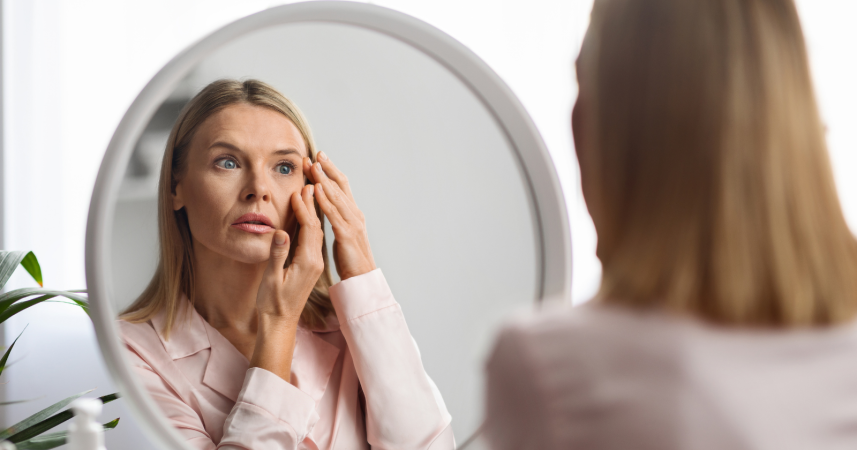
Some of the shortcuts we take to save money end up costing us more than we realize, especially when it shows up on our faces.

Add VegOut to your Google News feed. 
I used to think aging was just about genetics and sunscreen. Then I turned 40 and realized how much my daily choices were showing up on my face in ways I hadn't anticipated.
During my years working in finance, I watched women around me adopt certain routines and shortcuts that seemed harmless at the time. We were all trying to look polished on tight budgets and tighter schedules. But looking back now, I can see how some of those well-intentioned habits were working against us.
The thing is, most of us aren't doing anything outrageous. We're just repeating patterns we learned from our mothers, from magazines, or from trying to stretch our paychecks a little further. But some of these everyday practices can add years to our appearance without us even realizing it.
Let's talk about the habits that might be aging you faster than they should.
1) Buying the cheapest possible makeup and skincare
When you're watching every dollar, it makes sense to grab the $3 moisturizer instead of the $15 one. I've been there, especially during my first few years of writing when money was incredibly tight.
But here's what I learned: the absolute cheapest products often contain ingredients that can actually damage your skin over time. We're talking about harsh alcohols that strip your moisture barrier, fragrances that cause irritation, and formulas that provide zero actual benefit.
You don't need luxury brands. But there's a difference between affordable and rock-bottom cheap. A $12 drugstore moisturizer with good ingredients will serve you infinitely better than a $3 one that's basically scented petroleum jelly.
The middle ground exists, and it's worth finding. Your skin is something you live in every day for the rest of your life.
2) Skipping the dentist to save money
Dental care is expensive, and when you don't have great insurance or any insurance at all, it's easy to skip routine cleanings and only go when something hurts.
I watched my mother do this for years. By the time she finally addressed her dental issues, the damage was extensive and the cost was astronomical compared to what prevention would have been.
But beyond the financial argument, there's this: your teeth and gums have a massive impact on how old you look. Stained teeth, receding gums, and tooth loss all age your appearance dramatically. Not to mention that gum disease is linked to inflammation throughout your body, which accelerates aging everywhere.
If you can possibly swing it, even once a year, get a cleaning. Many dental schools offer reduced-cost services. Some communities have free dental days. It's worth researching your options because this is one area where prevention really does save you in every possible way.
3) Using bar soap on your face
I've heard this more times than I can count: "Soap is soap, why waste money on special face wash?"
Because the pH of most bar soaps is way too alkaline for facial skin. Your face has a naturally acidic pH that protects it from bacteria and keeps your moisture barrier intact.
Alkaline soaps disrupt that balance, leading to dryness, irritation, and over time, damaged skin that ages faster.
You can literally feel it after washing. That tight, squeaky-clean feeling? That's your skin being stripped of its protective oils.
A basic, gentle facial cleanser from the drugstore costs about $8 and lasts months. It's one of those small investments that makes a real difference.
4) Touching up gray roots with box dye too frequently
Professional color is expensive. I get it. Box dye is $8 versus $100+ at a salon.
But constant box dye application, especially when you're doing full head coverage every three weeks because you can't afford highlights or balayage that would be more forgiving, takes a serious toll on your hair's health.
Over-processed hair looks older. It's dry, brittle, breaks easily, and has that telltale crunchy texture. And because box dye tends to go darker with each application, many women end up with hair that's too dark for their skin tone, which actually emphasizes aging rather than hiding it.
I'm not saying you need to embrace your grays or shell out for salon visits. But consider spacing out your applications more, trying root touch-up products between dyes, or even transitioning to a shade closer to your natural color so regrowth is less obvious. Your hair will look healthier and, ironically, more youthful.
5) Working multiple jobs and sacrificing sleep
This is the big one that nobody wants to talk about because what are you supposed to do when bills need paying?
But chronic sleep deprivation ages you. Visibly. Your skin repairs itself during deep sleep. When you're consistently running on five hours because you're working a day job and a night gig, or pulling extra shifts to make ends meet, your skin never gets the chance to do that repair work.
Dark circles, puffy eyes, dull complexion, more pronounced wrinkles. All of it gets worse with chronic sleep loss.
During my years working 70-hour weeks in finance, I looked perpetually exhausted because I was. Even expensive skincare couldn't mask what lack of sleep was doing to my face.
I know "just sleep more" isn't helpful advice when you're working multiple jobs. But if there's any way to protect even 6-7 hours of sleep most nights, it will show up in your face. Maybe that means saying no to some overtime, or finding a single job that pays enough instead of juggling two. I realize that's not always possible, but it's worth considering if you have any flexibility at all.
6) Tanning to look "healthy" and save money on self-tanner
Natural sun exposure is free. Tanning beds are cheaper than spray tans. And there's this persistent belief that a tan makes you look healthier, younger, and more attractive.
The opposite is true. UV damage is the number one cause of premature aging. More than genetics, more than any other single factor.
I spent my twenties thinking I looked better with a tan. Now, in my forties, I can see exactly where sun damage shows up. And I'm grateful I started protecting my skin when I did, even though it felt vain and unnecessary at the time.
You don't need expensive self-tanner. Basic drugstore formulas work fine if you want that bronzed look. Or better yet, embrace your natural skin tone and just wear sunscreen. That's the cheapest anti-aging strategy that exists.
7) Extreme dieting instead of sustainable nutrition
Crash diets appeal to people on tight budgets because they often involve eating less, which costs less. Maybe it's meal replacement shakes, extreme calorie restriction, or cutting out entire food groups.
But yo-yo dieting ages your face faster than almost anything else. Every time you lose and regain significant weight, your skin stretches and contracts. After enough cycles, it loses elasticity, especially in your face where the skin is already delicate.
I've watched women lose 30 pounds, look amazing briefly, then gain it back and look older than they did before they started. The weight cycling itself is aging them.
When I transitioned to eating more plants at 35, it wasn't about restriction. It was about adding nutrition. My skin responded better to sustainable changes than it ever did to crash diets, and I didn't end up in the lose-gain-lose cycle that I'd seen age so many women around me.
8) Doing your own chemical peels and treatments from online tutorials
YouTube and TikTok are full of DIY beauty treatments that promise professional results at home for a fraction of the cost. Chemical peels, microneedling, high-strength acids.
The problem is that these treatments can cause serious damage when done incorrectly. Burns, scarring, hyperpigmentation, infections. All of which will age your skin far more than just leaving it alone would have.
I'm all for at-home skincare, but there's a line between a gentle exfoliant and a professional-grade chemical peel. That line exists for a reason.
A bad reaction to a DIY treatment can take months or years to heal, and it might leave permanent damage. The money you saved doing it yourself gets spent many times over trying to fix what went wrong. Not to mention looking older in the meantime.
Some things are worth paying for, or worth skipping entirely if you can't afford professional treatment. Your face isn't the place to practice aggressive DIY procedures.
Final thoughts
None of these habits make you foolish. They make you human, just trying to navigate life with limited resources while still wanting to look and feel good.
I spent years making these exact choices. The cheap products, the shortcuts, the trade-offs. They made sense at the time.
But looking back now, I wish someone had told me that the middle ground exists. That you don't need expensive solutions, but the absolute cheapest options often cost you more in the long run, including in how quickly your skin ages.
Small changes make a difference. A slightly better moisturizer. Protecting your sleep when possible. Being gentler with your skin and hair. These aren't luxury choices. They're investments in yourself that pay dividends in how you look and feel for decades to come.
Your circumstances might not allow for every change right now, and that's okay. Start where you can, with what you have. Your skin is remarkably forgiving when you start giving it what it actually needs.
What’s Your Plant-Powered Archetype?
Ever wonder what your everyday habits say about your deeper purpose—and how they ripple out to impact the planet?
This 90-second quiz reveals the plant-powered role you’re here to play, and the tiny shift that makes it even more powerful.
12 fun questions. Instant results. Surprisingly accurate.