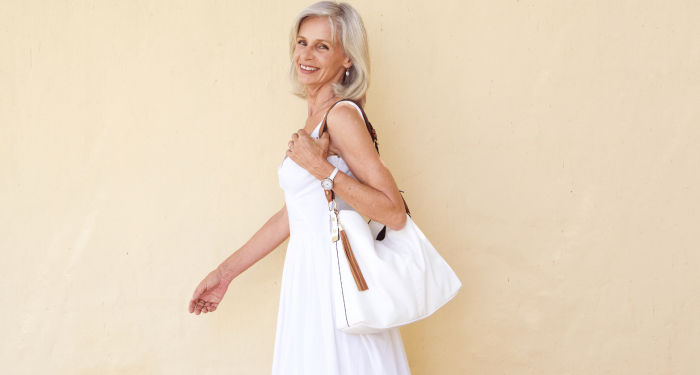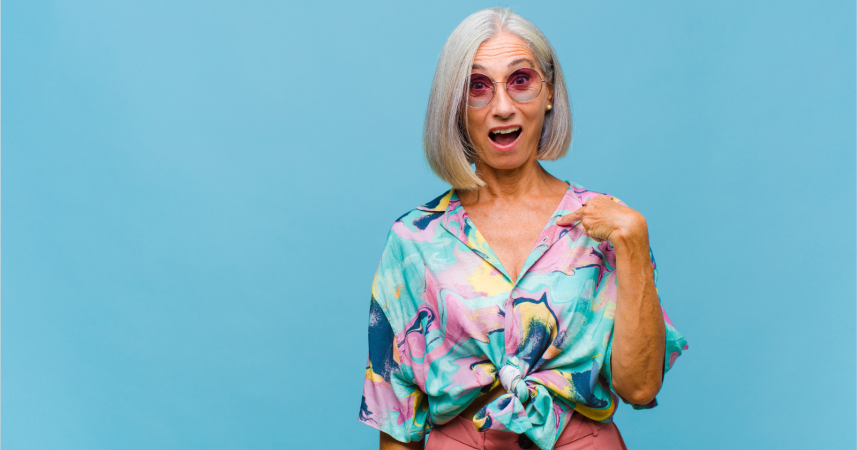
When did “age-appropriate” start meaning “invisible”?
Let’s be honest: the “no bold pieces after 50” rule isn’t really a style rule. It’s a story.
A story about what we’re allowed to enjoy.
A story about how visible we’re comfortable being.
And yes, a story about what we’d rather keep covered—physically and emotionally.
As someone who thinks a lot about the psychology behind everyday choices, I’ve noticed that the moment we start editing ourselves to fit someone else’s script, our closets start to look like filing cabinets: efficient, quiet, and a little lifeless.
If you’ve quietly benched bright colors, strong silhouettes, statement jewelry, or sleeveless tops “because of your arms,” this piece is for you.
Below are ten angles—part mindset, part practical—that have helped clients (and frankly, me) step out of the hiding habit and back into a wardrobe that feels alive.
1. It’s not really about your arms—it’s about being seen
Most of us don’t fear fabric; we fear visibility.
Bold pieces—color, print, a sharp shoulder—draw eyes. When we’ve internalized that aging women should take up less visual space, boldness feels like breaking a rule.
That’s why the “after 50” part matters. It’s a milestone our culture mislabels as the stage for shrinking.
Here’s a gentle reframe: visibility is not a performance; it’s presence. You’re not putting on a show when you wear citron or a sculptural cuff.
You’re simply allowing people to see you as you are—alive, changing, interesting.
2. Check the age myths you’ve accidentally signed
Some myths sneak in through compliments: “You look so age-appropriate!”
Others arrive through marketing that equates “timeless” with “invisible.” The problem isn’t classics; it’s compulsory classics.
Researcher Becca Levy’s work on age beliefs shows that positive views of aging shape health and behavior in powerful ways (and yes, they’re changeable).
As noted by her team at Yale, age beliefs aren’t fixed; they’re learned—and can be unlearned with intentional exposure to new narratives about later life. Yale Public Health summary.
So when you choose a bold dress because it delights you, you’re not breaking a rule. You’re rewriting one.
3. The “good girl” costume still fits—until it doesn’t
Many of us were praised for being pleasant, tidy, and low-maintenance.
The adult version of that praise can morph into “tasteful” and “subtle.” Nothing wrong with those words—unless they’ve become armor.
Ask yourself: who am I trying not to disturb? If the answer is “everyone,” it might be time to trade some politeness for presence.
“Vulnerability is not weakness; it’s our greatest measure of courage,” says researcher Brené Brown in her talk about showing up as our full selves. That line sits at the heart of style bravery, too.
4. Perfectionism loves beige
Perfectionism often masquerades as “good taste.” It whispers, If I keep everything neutral, no one can say I got it wrong.
But perfectionism is a narrowing strategy. It reduces risk—and the chance of joy.
If you notice yourself obsessing over whether a vivid jacket is “too much,” try flipping the question: What’s the small risk this outfit invites? A curious look? A conversation? A compliment you don’t know how to receive yet?
Those are growth edges, not errors.
5. Joy belongs in your closet (and it changes how you move)
I’ve watched women put on a fuchsia blouse and literally stand taller. Boldness shifts posture, gait, voice.
It’s not mystical—it’s feedback. When what you wear sparks joy, your body responds. Movement changes mood; mood changes meaning.
Suddenly the same Tuesday feels more like your Tuesday.
Fashion icon Iris Apfel put it bluntly: “More is more and less is a bore.” You don’t have to go maximalist, but you do deserve delight.
6. Confidence is a skill—dose it like a vitamin
If bold feels risky, don’t jump straight to neon head-to-toe. Micro-dose.
Start at the edges: a saturated scarf, a chunky ring, lipstick outside your usual family, a geometric frame, brighter trainers for errands. Wear the item for 90 minutes. Rate your comfort from 1–10. Repeat next week.
Confidence is not a switch; it’s a ladder.
Bonus: pair each micro-dose with something familiar (your favorite jeans, your best-fitting blazer). The brain tolerates novelty better when anchored to known comforts.
7. Bold doesn’t mean uncomfortable—fit is the real secret
Sometimes we avoid “bold” because we’ve only tried bold pieces that fit badly. A strong print on a too-tight sleeve will make anyone self-conscious. Solve fit first.
Three quick wins:
-
Tailoring is not a luxury; it’s a strategy. Shorten sleeves. Nip waists. Open seams for more drape.
-
Upgrade fabric. Fluid weaves and substantial knits read as intentional, not loud.
-
Build a base layer you love. A soft tank or breathable tee under a sleeveless dress changes everything.
When the fit supports you, the bold reads as ease.
8. Rewrite how you handle compliments
If one reason you avoid bold pieces is “I don’t know what to say when people notice,” script it now.
Instead of minimizing—“Oh, this old thing”—try:
-
“Thank you. It’s a fun change for me.”
-
“I appreciate that—I’m experimenting with color.”
-
“Thanks! I wanted something that feels like today.”
Practice once in the mirror. You’ll be ready when your barista or colleague beams at your chartreuse cardigan.
9. Use tiny experiments (yes, I bring my analyst brain to the closet)
Before I wrote about psychology and behavior, I spent years as a financial analyst. That part of my brain loves a simple test.
Try this: over the next month, run four “bold trials.” Each week, pick one variable—color, silhouette, print, statement accessory. Wear it to a low-stakes setting (coffee date, grocery run, volunteer shift).
Log three notes: how you felt before, during, after. Any feedback you received. What you’d tweak.
By the end, you’ll have your own data about what energizes vs. drains you. No influencer required.
10. Let your life stage lead your style
Our bodies and calendars shift after 50: hormones, careers, caregiving, grand-adventures, new hobbies. Style that refuses to evolve can feel like a mismatch—even when it still “fits.”
So ask: What wants more airtime in my life right now? Strength training? Painting? Travel? Community work? Choose one bold piece that amplifies that identity.
If you’re spending weekends in the garden, maybe it’s utility-chic in saturated olive with sturdy boots. If you’re launching a passion project, maybe it’s a cobalt blazer that meets your courage at the door. Form follows focus.
11. If you’re hiding, get curious—kindly
Sometimes we cover up because there’s pain: grief over a changing body, an injury, a comment that stung. Pushing yourself into boldness before you’ve processed that hurt can backfire.
This is where self-compassion matters. As psychologist Kristin Neff encourages, treat yourself the way you’d treat a dear friend learning something new: with warmth, patience, and practical support.
If you need help, talk to someone—therapist, support group, trusted friend. Style is allowed to be tender.
12. A practical starter kit for visible living
You don’t need a whole new wardrobe. You need a few allies. Here are mine:
-
One joyful color you can plug into jeans-and-a-tee: poppy, magenta, emerald, saffron—whatever makes you smile.
-
One unexpected silhouette that still feels like you: a boxy shirt, a wide-leg trouser, a sleeveless knit with strong shoulders.
-
One statement accessory that carries stories: a cuff from a local artisan, a scarf from a trip, a bold earring that frames your face.
-
One “yes” shoe that’s comfortable and confident: platform sandals, color-blocked sneakers, or a metallic flat.
-
Tailor on speed dial. The difference between “too much” and “just right” is often a half inch.
Wear any two together, then rotate.
Final thoughts
If you’ve been hiding behind “not for my age,” consider this permission to be seen again.
Not because bold makes you younger. Because bold helps you show up as the person you already are—curious, present, fully alive.
You don’t owe anyone a quieter version of yourself.
And you certainly don’t owe your arms a lifetime sentence.
Try one micro-dose this week. Let the world meet more of you.
If You Were a Healing Herb, Which Would You Be?
Each herb holds a unique kind of magic — soothing, awakening, grounding, or clarifying.
This 9-question quiz reveals the healing plant that mirrors your energy right now and what it says about your natural rhythm.
✨ Instant results. Deeply insightful.