
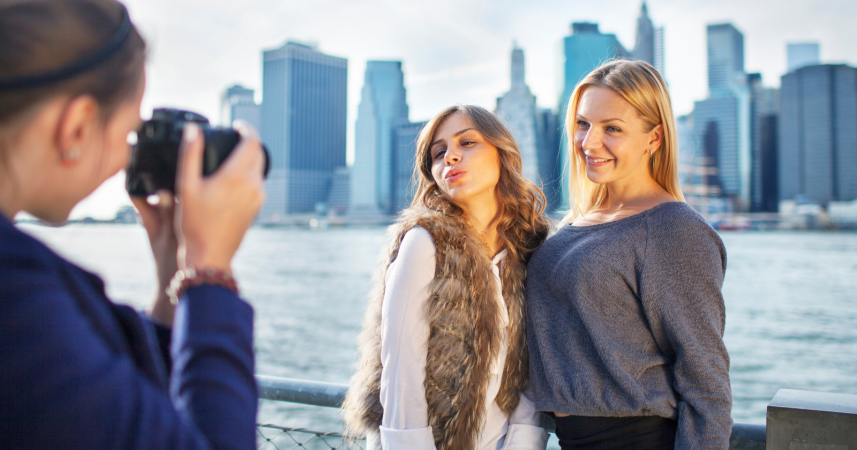
You don’t need to change your body to be photogenic—you just need to give it better instructions.

Add VegOut to your Google News feed. 
Let’s be honest—most of us don’t love how we look in photos taken on the fly.
A friend shouts “Smile!” and suddenly our shoulders tense, our jaw tightens, and the camera seems ten inches too close.
The good news? Looking great on camera isn’t about having “the perfect” face or figure. It’s about stacking small, learnable moves that flatter every body and every vibe.
Below are nine posing tricks I rely on—simple, repeatable, and wonderfully body-neutral.
Think of them like keyboard shortcuts for your next photo, whether it’s a travel snap, a LinkedIn headshot, or a big family moment you want to enjoy (not dread).
Let’s dive in.
1. Angle your body—not your values
Facing the camera straight on tends to flatten your shape and emphasize width.
Instead, rotate your body about 30–45 degrees away from the lens. Plant one foot slightly behind the other and let your hips follow the back foot.
From there, turn your chest back toward the camera just a touch.
Why this works: angles create dimension. They sketch natural lines from your shoulder to your waist to your hip, which looks dynamic on every body type.
Bonus: if you’re wearing a structured jacket or top, the angle helps the garment fall cleanly so seams don’t twist.
Try this in the mirror: stand square, then rotate. You’ll see how instantly your silhouette looks more intentional.
2. Lead with your forehead, lower your chin
Most of us instinctively pull our head back when a lens aims our way—hello, neck folds and sleepy eyes.
Instead, bring your forehead slightly toward the camera and lower your chin a tiny bit.
This elongates the neck and sharpens the jawline without strain.
As noted by portrait photographer Peter Hurley, the combination of a forward forehead and a subtle “chin down” changes the way light hits the face and brings the eyes to life.
He’s also famous for the “squinch”—a gentle lift of the lower lids that adds presence without a harsh squint.
Micro-tip: say a soft “mmm” right before the shutter. It relaxes the mouth and avoids the frozen “cheese” smile.
3. Shift your weight, then stack your posture
When we lock our weight evenly on both feet, everything looks rigid.
Instead, shift your weight to your back foot (the one farther from the camera). This frees your front knee to bend, which creates natural curves and a subtle S-shape through your frame.
From there, stack tall: think crown of the head up, shoulder blades softly hugging your spine. Then exhale.
Yes, exhale. That small breath out drops unnecessary tension in the belly and chest so your shape looks relaxed but supported.
I learned this trick while training for trail runs. On climbs, I stack through my ribs and breathe out to keep from cramping. Same body, same physics—just more fun shoes.
4. Soften the hands and make triangle space
Hands tell on us. Stiff, flat palms read as “awkward,” while soft, curved hands read as “easygoing.”
The simplest fix is to create gentle space around the body: float your fingers lightly at your waist or pockets, touch a necklace, or hold a prop (coffee cup, sunglasses, a book).
Look for triangles—between your arm and torso, elbow and hip, wrist and jacket hem.
Fashion photographer Lindsay Adler puts it bluntly: “If it bends, bend it.” A little bend in the wrist, elbow, or knee breaks up lines and communicates movement (she teaches this principle often).
Try relaxing the fingers like you’re holding a potato chip you don’t want to crush.
What to avoid: hands hiding completely behind the body or pressed tightly to your sides. Both erase shape and add tension.
5. Drop the nearer shoulder and lean a whisper
When your shoulder closest to the camera is lifted, it shortens your neck and can make your top half feel crowded.
Let that front shoulder drop a touch and lean your chest a whisper toward the lens—about an inch. This tiny lean does magic for the eyes and makes you look engaged with the viewer.
Seated? Slide to the front third of the chair, angle your knees off-center, and hinge slightly forward from the hips while keeping your spine long.
This avoids the “sinking into the couch” look and defines the waist without any sucking-in theatrics.
Every shape benefits from this: it’s not about shrinking anything, it’s about giving your features room to breathe.
6. Find your light (and make it work for you)
Light is the original retoucher. If there’s a window, turn your face slightly toward it so the light brushes across your features.
Outdoors, step just inside open shade (under an awning or tree) and face the brightest open sky—not the deep shade behind you.
This softens shadows and reduces squinting.
If the light is overhead (harsh noon sun), raise your camera slightly or tilt your forehead toward the light so shadows don’t carve deep lines under the eyes.
And if there’s backlight (sun behind you), ask the photographer to expose for your face or move a step so you’re not a silhouette.
Quick check I use: glance at your under-eyes. If they look raccoon-ish, shift until the shadows fill in.
The fix is usually a quarter-turn or one step sideways.
7. Give your expression something real to do
The camera catches micro-expressions—those tiny shifts that happen in a tenth of a second.
For a real smile, think of something specific: the text that made you snort-laugh, the smell of your favorite bread coming out of the oven, the moment your friend looked at you across a room and you instantly felt seen.
Let the thought hit and then smile with your eyes first; the mouth will follow.
“Fake it till you make it” gets a lot of airtime, but there’s a more grounded truth: motion and posture can change how we feel.
As social psychologist Amy Cuddy noted in her TED talk, “Our bodies change our minds, and our minds can change our behavior.”
Before a photo, take ten seconds to roll your shoulders, drop your jaw, and take a slow breath. You’ll look like you, just less guarded.
If you prefer a non-smile expression, try “pleasantly neutral”: lips together but soft, jaw relaxed, eyes warm.
It photographs elegantly and never reads as bored.
8. Frame yourself with edges, props, and movement
Photos love context. If you’re feeling awkward, use your environment as a co-star.
Lean a shoulder on a wall, sit on a stair with one foot a step lower, hook a thumb in a belt loop, or brush a coat lapel.
Gentle movement converts nerves into story: step into the frame, tuck hair behind one ear, flip a page of your book, swirl your coffee.
Two guidelines keep these actions flattering for every body:
-
Keep the biggest shapes (hips, shoulders) slightly angled as you move.
-
Let your movement finish in the same direction your eyes are looking. If your gaze and body disagree, it can look tense.
When in doubt, walk slowly toward the camera and glance just past it, then look back at the lens on the third step.
Moving loosens the face and adds that “caught in a moment” feel.
9. Edit your stance, not yourself
Here’s my simplest three-step checklist, especially for group shots or high-pressure moments:
-
Feet: back foot holds the weight; front knee soft.
-
Spine: tall and relaxed; ribs down, shoulders easy.
-
Face: forehead slightly forward, chin slightly down, eyes engaged.
Then—this matters—give yourself grace. You are not a statue; you are a person. A photo is a moment in a moving life.
If you don’t love the first frame, change one thing (angle, breath out, hand placement) and try again. Two tweaks usually do it.
I remember a board photo I dreaded when I worked as a financial analyst. We had two minutes between agenda items.
Instead of hiding in the back, I angled my body, stacked tall, and leaned a breath toward the lens. The result didn’t look “model-ish.” It looked like me—awake, grounded, present.
That’s what we’re after.
Quick combos you can memorize
-
Headshot: window light + forehead forward + lower lids engaged (“squinch”) + tiny lean.
-
Full-body: 45-degree angle + weight on back foot + soft hands creating triangle space.
-
Seated: front third of the chair + knees angled + hinge forward 5–10 degrees + chin slightly down.
-
Candid: slow walk + glance off-camera then back + exhale mid-step.
Use these like little recipes. Mix and match, trust how they feel, and tweak for your own style.
Final thoughts
Photos aren’t a test of worthiness. They’re a way to bookmark a life that’s busy, messy, and full of love.
When you know a few physical cues—and you practice them enough that they feel natural—you stop bracing against the camera and start collaborating with it.
You don’t need to change your body. You just need to give it helpful instructions.
Pick one trick from this list and try it today. Then add another next time. They stack quickly. Before long, you’ll notice you’re not dreading the lens—you’re directing it.
And that, no matter your body type, is the most photogenic thing of all.
What’s Your Plant-Powered Archetype?
Ever wonder what your everyday habits say about your deeper purpose—and how they ripple out to impact the planet?
This 90-second quiz reveals the plant-powered role you’re here to play, and the tiny shift that makes it even more powerful.
12 fun questions. Instant results. Surprisingly accurate.












