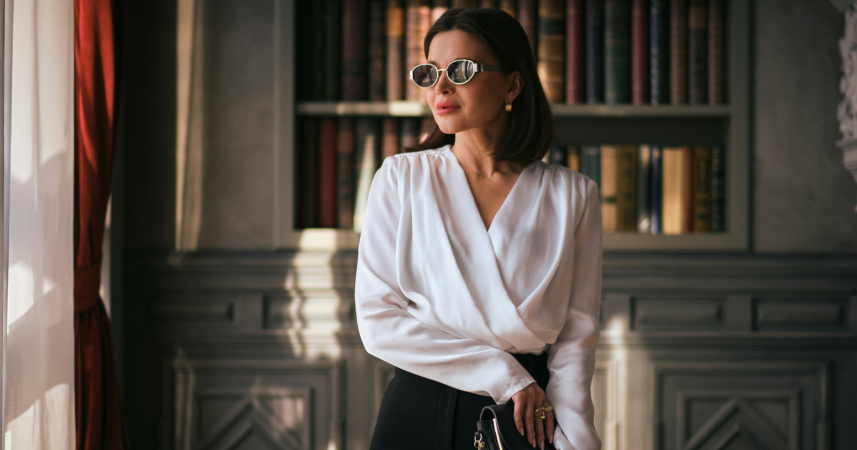
The more your clothes work quietly in the background, the more fully you can step forward.

Add VegOut to your Google News feed. 
We don’t all want the spotlight.
Some days, I just want to feel steady in my skin—competent, comfortable, and quietly put together—without turning heads.
If that’s you too, these ten tips will help you build an easy, low-drama personal style that supports your confidence rather than competing with it.
I’m speaking as someone who’s spent years analyzing numbers (hello, cost-per-wear) and just as many Saturdays volunteering at a farmers’ market in clothes that need to move, breathe, and still look intentional.
The common thread? When what I wear stops demanding attention, I have more attention to give—to my work, my people, and my day.
Let’s dive in.
1. Start with a calm color palette
Neutrals and soft, desaturated tones do a lot of heavy lifting when your goal is ease over attention.
Think oatmeal, navy, charcoal, olive, cream, and gentle blues.
You don’t need to banish color—just lower the contrast.
A muted blue shirt with slate trousers feels grounded; neon with black shouts.
A simple way to keep things cohesive is to pick three core colors (say, navy, grey, cream) and two accents (olive, dusty rose) and stay in that lane for a season.
Everything mixes, nothing clashes, and you won’t worry that your outfit is “too much.”
Ask yourself: What colors make me exhale? Wear more of those.
2. Prioritize fit over everything
Clothes that skim—rather than squeeze or swamp—create quiet confidence.
A $60 blazer that fits will look better than a $600 one that doesn’t.
Focus on shoulder seams that line up with your shoulder, hems that hit where you like, and waistlines that sit comfortably.
If tailoring feels fussy, start small: shorten sleeves, nip a waistband, or hem pants to a flattering length. When I moved from finance into writing, I kept one habit: calculating cost per wear.
A $20 alteration on trousers I wear twice a week melts to pennies, and the psychological payoff is huge—no tugging, no second-guessing.
3. Build around high-quality basics with texture
If you want to feel assured without broadcasting it, let texture do the talking.
A merino sweater, a crisp Oxford, a slub-cotton tee, a soft twill chino—these fabrics have interest up close but don’t read loud from across the room.
When I’m unsure, I ask: Would this look good in black-and-white?
If the answer is yes, the fabric probably has enough structure and texture to feel elevated without sparkle, logos, or shouting.
Pro tip: prioritize fabrics that hold their shape (merino, cotton poplin, Tencel blends).
You’ll look fresh longer, and that matters more to confidence than trend details ever will.
4. Keep silhouettes simple—and repeat what works
A few no-fail shapes remove decision fatigue: straight-leg trousers, an A-line or column skirt, a relaxed button-down, a crewneck sweater, a half-tucked tee with a third piece (more on that next).
When a silhouette consistently makes you stand taller, treat it like a uniform.
At the market, my go-to is a breathable tee, straight jeans, and a soft overshirt. No one’s clocking my outfit; I’m free to focus on the growers’ stories and the customers.
Ironically, repeating formulas can feel more like you because you’re not cosplaying a different person every morning.
5. Use the “third piece” for instant polish
Two pieces dress you; a third piece finishes you.
Add a cardigan, blazer, chore coat, scarf, or lightweight vest and watch your outfit look complete with zero extra volume.
The third piece is a quiet tool: it creates structure and intention without noise.
Choose softer construction—unlined blazers, knit jackets, sweater blazers—so you don’t feel armored.
In warm months, a linen overshirt or gauzy scarf does the same job. You’re signaling “I thought about this,” not “please notice me.”
6. Choose low-contrast footwear you can actually live in
If your shoes are comfortable, your posture changes. Confidence starts there.
Pick low-contrast shoes—cream, tan, taupe, navy, black—that blend with your pants or skin tone. They visually lengthen your line and won’t hijack the outfit.
For everyday: clean sneakers, loafers, simple ankle boots, or soft ballet flats.
Save metallics, platforms, or heavy hardware for when you want attention.
I trail run, so I’m picky: if new shoes don’t pass the “could I happily walk a mile?” test, they don’t stay. Quiet feet, quiet mind.
7. Let prints whisper, not shout
You can wear prints and still keep things understated.
The trick is scale and spacing. Small, tight patterns (micro-gingham, pinstripes, tiny florals) read as texture from a distance. Large, high-contrast patterns read as a billboard.
If you love pattern, anchor it with solids: a small-print blouse with solid trousers, or a striped tee under a plain blazer.
Another strategy is to keep prints away from the face if you feel they crowd you—printed skirts or scarves tied to a bag add interest without taking over your expression.
8. Accessorize like an editor
Think of accessories as punctuation. You don’t need exclamation marks to make a point.
One focal piece—matte hoop earrings, a slim leather belt, a quiet watch—often does more than a handful of competing details.
My simple rule: add, assess, remove one. It forces me to choose the strongest element and drop the rest.
Materials matter too: brushed metals, pebbled leather, and canvas come across softer than high-shine finishes or heavy logos.
9. Respect grooming and posture as part of your outfit
The most low-key outfit in the world loses power if you look like you wrestled with it.
None of this requires perfection; it’s about tidy edges that give you an “I’ve got this” feeling. Steam the shirt. Lint-roll the coat. Keep nails neat. Choose a hairstyle you can set once and forget.
Posture is style’s silent partner. Relax the shoulders, lengthen through the crown, soften the jaw.
There’s even research on “enclothed cognition”—how what we wear influences how we think and feel—which suggests that certain garments can prime a more focused, capable mindset (see Adam & Galinsky’s 2012 paper on the topic).
You don’t need a lab coat to benefit; a well-fitting blazer or crisp shirt can cue your brain for “on.”
10. Create a small, repeatable uniform
A uniform doesn’t kill creativity; it kills friction. Pick one or two formulas for your weekdays and another for weekends, then duplicate the pieces you reach for most. For example:
-
Weekday: straight trousers + knit tee + soft blazer + loafers
-
Weekend: relaxed jeans + breathable tee + overshirt + clean sneakers
When you know your defaults, you can invest in better versions and stop impulse-buying “fun” outliers that never feel like you. The confidence comes from recognition: oh right, this is me.
Putting it together (without making it a project)
If you’re tempted to overhaul everything, don’t. Try a two-week experiment:
-
Choose your five most calming colors.
-
Build two outfit formulas.
-
Edit accessories to a small tray of daily drivers.
-
Prep tomorrow’s outfit before bed (including shoes).
-
Keep notes: What felt easy? What needed fussing?
You’ll learn fast. Confidence isn’t a switch; it’s a chain of small, self-respecting choices.
A few lived-in examples
-
Presentation day: navy straight-leg trousers, cream knit tee, unstructured navy blazer, taupe loafers, simple hoops, tidy bun. I look like myself, but a little sharper.
-
Writing day in a café: soft black jeans, charcoal tee, olive chore coat, white sneakers, slim watch. Comfortable enough to sit for hours, polished enough to bump into anyone.
-
Farmers’ market volunteering: breathable tee, straight jeans, canvas overshirt, weather-proof sneakers, cap for sun. Everything in the same muted palette so dirt and dust don’t shout.
None of these outfits are remarkable—and that’s the point. They let you shine because they don’t demand center stage.
What to avoid (when you want calm over attention)
-
High contrast color blocking (black with white with red)
-
Loud logos or obvious “it” pieces (if they wear you, they cost you)
-
Overly tight or overly oversized fits
-
Shiny, clanky, or multiple competing accessories
-
Shoes that look great sitting down and terrible moving
Final thought
Confidence without spectacle is a craft—and a kind one. It asks you what makes your nervous system breathe easier, then builds a closet around those answers.
Start with calm colors, insist on fit, use the third piece, keep prints and accessories intentional, and treat grooming and posture as part of your outfit.
The more your clothes work quietly in the background, the more fully you can step forward.
And if you decide to keep a tiny signature—a certain ring, a stripe you love, a favorite shade of navy—that’s not standing out.
That’s just you, on purpose.