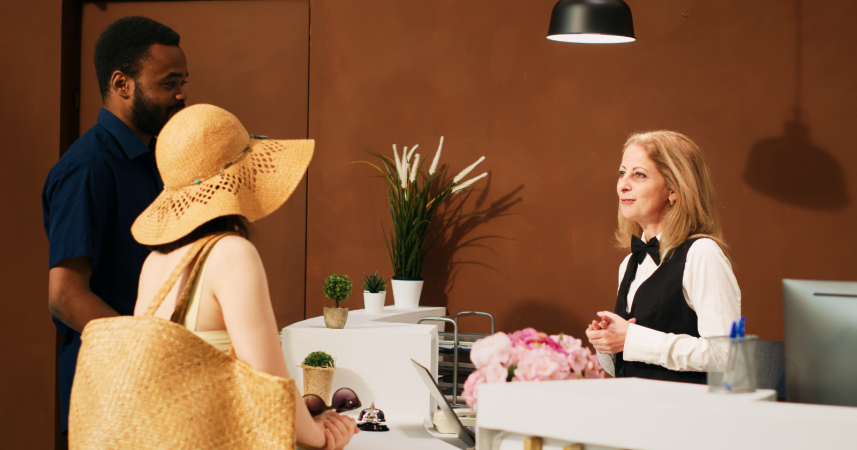
When a place gets the details right, everything else becomes easier.
If you want to know how someone moves through the world, watch how they walk into a hotel room.
Most people clock the obvious: Nice lobby, big bed, and cool pool.
I look for the small things—the tiny decisions that reveal whether a place respects your time, your body, and your brain.
That’s the luxury mindset I picked up working a decade in high-end food and beverage: standards aren’t about price tags, they’re about care.
You can taste it in a sauce that was reduced for six hours; you can feel it when a hotel gets the details right without making a big show of it.
Here’s the fun part: You don’t need to be fussy to notice these cues because you just need to be curious.
If these resonate, your standards probably already live a notch above the average traveler’s:
1) Arrival choreography
Ever notice how your shoulders rise or drop in the first ten minutes after you arrive? That’s the choreography at work.
What I’m scanning: signage that actually helps, a scent that isn’t smothering, and a welcome that’s paced like a good greeting at a restaurant—present, warm, not cloying.
If there’s a line, I’m watching how the team triages.
Do they break out tablets, offer water, and keep you informed, or do they vanish behind a monitor?
Digital keys matter too—I’m not anti-tech, but I am anti-friction.
A great property nails the basics—app works, elevator readers behave, and the Wi-Fi login doesn’t feel like filing your taxes.
If they hand me a drink, I take one sip and ask myself the same question I use to judge a bar program: Is this balanced?
A well-made nonalcoholic spritz with real citrus and a clean finish—huge green flag—or a warm, flat juice in a plastic cup—red flag and a flashback to a mall food court.
Little cues keep stacking: Luggage tags printed with my name (spelled correctly), a clear map or QR code that shows where the gym actually is, and a front desk that doesn’t make me recite my address while I’m holding two bags.
You can tell when leadership obsesses over the guest’s first ten minutes, because you feel like a person, not a reservation number.
2) Cleanliness that passes a chef’s white-glove test
Housekeeping is hospitality’s mise en place.
The more meticulous the prep, the smoother the service.
I check the spots hotels hope you won’t.
The underside of the remote, the tops of frames and vents, the seam where the carpet meets the wall, and the grout line behind the trash can.
It’s not about catching anyone out; it’s about consistency.
If they nail the invisible corners, they’ll nail the obvious ones.
The bed tells the truth: Are the linens crisp without a chemical perfume? I prefer a neutral, clean cotton smell—not “mountain breeze.”
Pillows should bounce back, not deflate into pancakes and I’m always checking for dust lines on the headboard.
If I swipe and pick up powder, the room got a speed clean, not a deep clean.
Bathrooms are where details win.
The mirror shouldn’t be freckled with yesterday’s toothpaste.
Glass should be truly clear, not pretending to be with a hard-water haze.
If the tissue box is half-empty and shoved behind the cups, that’s a mindset issue: Hide the problem instead of fix it.
In a great hotel, you see restraint—two great amenities, not nine mediocre ones—and you feel freshness without theatrics.
3) Water, coffee, and the mini-bar that respects your body
A chef once told me, “Everything begins with water.”
Hotels that care prove it: Do they provide filtered, refillable water in glass instead of burying $10 plastic bottles by the TV? Are there bottle-filling stations near the gym?
If the tap water is safe and tastes good, I appreciate a simple note that tells me so.
Coffee is a character test.
I don’t need a barista on the 12th floor, but I do need the setup to be intentional.
Fresh pods or ground coffee sealed properly, not a stale communal jar.
Real mugs, not paper cups that taste like cardboard.
A dairy alternative that isn’t sugary oat syrup, or a decent tea selection with water hot enough to do it justice.
If they give you a pour-over cone and a kettle? That’s love.
Then there’s the mini-bar.
Most of them read like a dare: Salt bombs, sugar bombs, and mystery liquor.
The thoughtful ones feel curated: A local kombucha, a couple of real-food snacks with ingredients you can pronounce, and maybe a small-batch chocolate bar.
Prices are clear (not “scan and pray”), and there’s at least one item that won’t leave you dehydrated and cranky at 2 a.m.
Eating well on the road is tough; the best hotels act like an ally instead of a pusher.
4) The sleep ecosystem, not just a bed

Sleep is the hotel’s main dish, while everything else is garnish.
I start with the blackout situation: Do the curtains overlap properly, or is there a beam of sunrise guaranteed to laser your eyelids at 5 a.m.?
If there’s a clip or a built-in magnet, that’s someone on the team who’s been woken up too many times on a red-eye turnaround and said, “Never again.”
Noise control matters as much as thread count: Are doors solid or hollow? Is the hallway a bowling alley after 10 p.m.? Can you hear the elevator ding like a microwave?
Great properties invest in sealing: Proper door sweeps, fitted windows, and HVAC units that don’t rattle like they’re about to taxi for takeoff.
I love when there’s a pillow menu, but even without one, the standard should be two densities in reach.
Sheets that breathe (hello, natural fibers), a mattress with support but not trampoline bounce, and—because I’m a nerd about light—I look for a bedside switch that actually kills everything—including that tiny LED on the thermostat.
If you have to crawl on the floor to unplug a blue laser from the router, that’s not luxury; that’s a hostage negotiation.
Bonus points for a wake-up call that rings when you asked for it.
Not “around” your request—on the dot.
Precision is a love language.
5) Bathroom engineering that was actually engineered
Good bathrooms are about design, but great bathrooms are about physics.
Water pressure should be generous without peeling your skin off.
Temperature should lock in and stay there while you’re rinsing shampoo, not play roulette when a neighbor flushes.
Drainage should keep the floor from becoming an ice rink.
You shouldn’t have to open the door mid-shower to grab the towel—there should be a hook within an easy reach.
Lighting is where many places whiff.
I want to see my face in natural, even light—no interrogation spotlight, no yellow cave.
A backlit mirror with a color rendering that doesn’t make produce look dull is ideal, especially if you’re staying mindful of your skin or shaving.
That’s not fussy; that’s practical.
Counter space beats clutter.
Two reusable pump dispensers of high-quality product beat six tiny bottles of “mystery gel” any day.
If they still use single-use plastic, I’m looking at whether the brand is worth it; if they’ve gone bulk, I’m checking cleanliness and scent—light, herbal, unobtrusive.
I like when hotels give you a place to put a dopp kit that isn’t the wet ledge of doom and I love when they include a little stool or a shelf in the shower so you aren’t doing calf raises while washing your feet.
Real hospitality solves real problems.
6) Breakfast and room service tell the truth
Finally, I judge a hotel by the way it handles the first meal and the late-night “I’m hungry but not for regret” situation.
At breakfast, labels should be clear and honest.
Not everyone eats the same way, but everyone deserves to know what they’re eating.
If you’re trying to fuel a workout or balance your day, you don’t want to play guess-the-oil.
I look for eggs cooked to order (and actually to order), fruit that tastes like fruit, and grains that aren’t an afterthought.
I’m not asking for a Michelin tasting menu; I’m asking for fresh, well-seasoned food served at the right temperature.
Buffets can be great, but most are a buffet of mediocrity—the good ones keep portions small and refresh often.
They don’t leave the tomatoes sweating under a heat lamp or hide the good yogurt behind a paywall; they’ll have something crisp and green, something protein-forward, and something indulgent that won’t derail you unless you want it to—like a pastry that crackles when you break it, not a sugar pillow from a truck.
Room service is the pressure test.
Read the menu: Is it tight and confident, or a chaotic list of 47 items? I’d rather see eight dishes they can execute well at 11:30 p.m. than a novel they can only perform at noon on Tuesdays.
When the tray arrives, I’m looking for the basics I learned in kitchens: hot food hot, cold food cold, clean edges, seasoning that doesn’t need an emergency salt packet.
A proper tea setup, real cutlery, and a napkin that isn’t the texture of a paper towel.
Service posture shows up here too: Can they handle a simple substitution without escalation? Do they offer suggestions based on what travels well rather than defaulting to the fried option?
When a place cares, you feel gently guided, not upsold.
The bottom line
If these details jump out at you, it’s not because you’re picky.
It’s because you respect your time, your body, and your standards.
When a place gets the details right, everything else becomes easier—your workout, your meetings, your downtime, your appetite.
You leave better than you arrived.
The next time you check in, run your own little tasting menu of cues.
Notice what your shoulders do, notice how you sleep, and notice whether breakfast makes you feel sharper or slower.
Your standards aren’t there to make life difficult; they’re there to make life better.
If a hotel clears this bar? Keep the name.
Tell a friend; reward the places that treat care like a craft—because that’s how we get more of them.
If You Were a Healing Herb, Which Would You Be?
Each herb holds a unique kind of magic — soothing, awakening, grounding, or clarifying.
This 9-question quiz reveals the healing plant that mirrors your energy right now and what it says about your natural rhythm.
✨ Instant results. Deeply insightful.