It’s not the big meltdowns—it’s the small stuff you probably do without thinking.
Flying has its magic moments—watching the sunrise above the clouds, stepping off the plane into a new city, feeling that little thrill of adventure. But let’s be real: there are also plenty of cringe-worthy moments that play out on airplanes every day.
And while flight attendants are trained to keep a professional smile, they’re also human. Certain passenger habits are almost guaranteed to trigger that inner eye-roll.
The tricky thing is that most of us don’t even realize we’re doing them. They’re just little behaviors, unconscious reflexes born out of impatience, nerves, or plain habit. But they add up.
Let’s break down the seven little things that make the cabin crew quietly sigh.
1. Standing up the second the plane lands
We all know that person. The wheels touch down and suddenly they’re up, yanking their bag from the overhead bin as if sprinting out will get them through customs any faster.
I get it. You want off the plane. You’ve been cramped in a seat for hours. Your legs ache, and you’re ready for fresh air. But here’s the truth—no one is going anywhere until the door opens.
Standing early just blocks the aisle, crowds the space, and makes the crew’s job harder when they still need to move around safely. There’s also the safety piece: sudden braking can still happen during taxiing. People have gotten hurt because they couldn’t wait three extra minutes.
One flight attendant I chatted with in LAX put it bluntly: “It doesn’t make the plane unload faster. It just makes everyone else’s blood pressure rise.”
So, if you’re tempted to jump up right away, remember: patience here actually saves everyone stress.
2. Ignoring the safety demo
Airlines have gotten creative—jokes, animations, even celebrities making cameos. Yet still, half the cabin zones out the second the safety instructions start. Earbuds go in, eyes go to the window, and phones get an extra scroll session.
You might think you’ve heard it a thousand times, but under stress the brain doesn’t always recall details. A study by the Federal Aviation Administration found that passengers who paid attention were significantly faster at finding and using exits during simulated emergencies.
And beyond safety, it’s a respect issue. Imagine giving a work presentation while a roomful of people rolled their eyes and ignored you. That’s how it feels for crew members who are literally teaching you how to save your own life.
It’s thirty seconds of focus. That’s all it takes.
3. Treating the call button like a room service bell
I’ll admit I once hit the call button just to ask for a second sparkling water. But I learned fast—it’s really meant for emergencies or urgent needs.
Constantly buzzing for snacks, blankets, or a “just wondering what time we land?” makes it harder for attendants to prioritize real issues. It’s like texting “u up?” every five minutes—technically fine, but annoying and unnecessary.
As etiquette expert Lizzie Post has said, “Courtesy is about recognizing that your needs exist within a larger system.” In other words, if you wouldn’t flag down a server at a restaurant every sixty seconds, don’t do it 30,000 feet up.
A better option? Wait until the cart comes by or politely catch an attendant’s eye when they’re nearby. It keeps the rhythm of service flowing—and spares you that invisible side-eye.
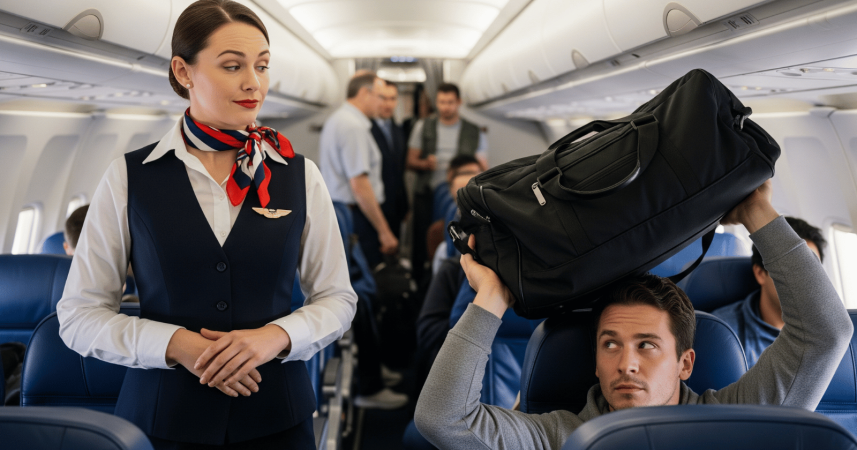
4. Hogging the overhead bins
Here’s a universal truth of modern air travel: overhead bin space is scarcer than patience during holiday season travel.
We’ve all seen the passenger who loads the overhead with three giant bags, a winter coat, and a duty-free haul. Then suddenly, there’s no space left for anyone else.
What happens next? A ripple effect. The flight attendants become baggage Tetris masters, fielding complaints, moving people’s belongings three rows back, and dealing with the domino frustration it creates.
The fix is simple. Put your smaller bag under the seat. Stow jackets later, after everyone’s settled. Don’t sprawl your stuff across multiple bins as if you booked the entire row.
Think of it this way: the bin is communal real estate. Use it fairly, and you save everyone—including the crew—a whole lot of hassle.
5. Going barefoot
I once sat next to a guy who slipped off his shoes, tucked his bare feet under him, and then propped one heel against the armrest in front. The look on the flight attendant’s face said it all.
Airplane floors are not yoga mats. They’re full of spills, germs, and who-knows-what else. Crew members will quietly tell you: those carpets rarely get deep-cleaned.
And beyond hygiene, it’s about boundaries. Nobody wants to brush against a stranger’s toes while waiting for the bathroom. It’s the quickest way to make an already cramped environment feel even less pleasant.
Socks or slippers—totally fine. Bare feet? Hard no. Save that for the beach.
6. Clapping when the plane lands
This one divides opinion. Some people argue it’s appreciation. Others—especially frequent flyers and crew—see it as awkward and unnecessary.
Think about it: do you clap when your Uber driver gets you home safely? Or when your barista spells your name right?
Pilots and attendants are professionals. Landing a plane is literally their job. While some passengers genuinely want to show gratitude, others clap more out of performative relief, like they weren’t sure the pilots could pull it off.
One flight attendant I overheard in an airport café said, “We’d prefer a simple thank you as you leave over clapping any day.” That kind of personal acknowledgment lands better than a half-hearted applause session.
7. Rushing the food and drink service
Every flight has at least one passenger who starts quizzing the attendants before the cart even makes it down the aisle: “Do you have Diet Coke? How about pretzels? Any chance of coffee now?”
The thing is, service follows a rhythm. Breaking it just slows everyone down. Attendants aren’t withholding snacks—they’re working methodically to get to you.
I’ve mentioned this before in another post, but impatience is one of the fastest ways to stress out the people serving you. The cart will reach your row eventually. Asking repeatedly doesn’t make it arrive sooner; it just disrupts the flow.
As psychologist Daniel Goleman noted in Emotional Intelligence, “Patience is a form of self-control that keeps social harmony.” On a plane, that harmony is fragile. Respecting the process helps everyone, including you.
Why these habits matter more than you think
On the surface, none of these things seem huge. Standing early, skipping the demo, going barefoot—so what? But here’s the thing: in an environment as controlled and stressful as an airplane, small actions ripple.
Crew members are juggling safety, service, and about a hundred unpredictable variables at once. When passengers add friction—through impatience, entitlement, or obliviousness—it compounds stress.
There’s also psychology at play. Social psychologist Robert Cialdini once noted that “small acts of cooperation create a culture of reciprocity.” On a flight, being considerate helps set a tone. Others mirror it. The whole cabin feels calmer.
Flip that around and you get the opposite: one person crowds the aisle, another cuts in, tensions rise, and suddenly it’s a less pleasant experience for everyone.
The bottom line
Most of these little habits aren’t malicious. They’re just blind spots we fall into when we travel—tiny decisions that feel harmless in the moment but grate on the people working around us.
Next time you’re on a flight, remember: flight attendants are balancing safety, service, and human psychology at 30,000 feet. Making their job a little easier isn’t just polite—it makes your journey smoother, too.
So keep your shoes on. Stay seated until it’s your row’s turn. And save the applause for concerts, not landings.
Air travel is stressful enough. Don’t be the reason the crew has to roll their eyes.
What’s Your Plant-Powered Archetype?
Ever wonder what your everyday habits say about your deeper purpose—and how they ripple out to impact the planet?
This 90-second quiz reveals the plant-powered role you’re here to play, and the tiny shift that makes it even more powerful.
12 fun questions. Instant results. Surprisingly accurate.