Three days surrounded by retirees taught me more about actually relaxing on vacation than a decade of optimized itineraries ever did.
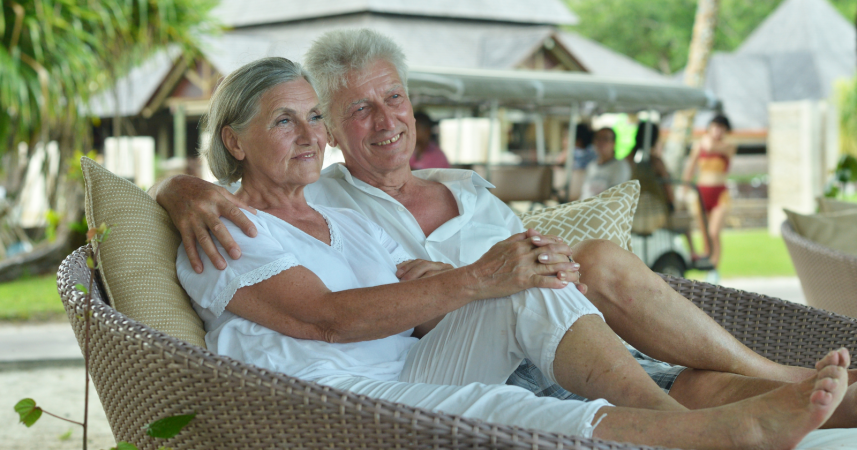
Last spring, I ended up at a resort in Palm Springs that turned out to be basically a retirement community with a pool.
I'd booked through one of those flash sale sites at 11 p.m. on a Tuesday, saw "all-inclusive" and "spa," and clicked buy before reading any reviews.
Big mistake.
The average age at this place had to be 68. Maybe 70. I spent three days surrounded by people who remembered where they were when Kennedy was shot.
But despite the generation disparity, it turned out to be one of the more eye-opening experiences I've had in a while. Here are the things I noticed about them.
1) They actually talk to strangers
I was sitting by the pool on day one, headphones in, scrolling through my phone, doing the universal "don't talk to me" pose that every millennial perfects by age 25.
This woman in her seventies sat down next to me and just started talking. Not "hey, nice weather" small talk. Real conversation. She asked where I was from, what I did for work, told me about her grandkids, asked if I was married. Within ten minutes, I knew her entire life story.
At first, I found it invasive. I'm used to the unspoken rule that strangers don't interrupt your bubble unless absolutely necessary. But after a couple of days, I realized how isolated that makes us. These people weren't being nosy. They were just being human.
By day three, I'd had more genuine conversations with strangers than I'd had in the previous six months combined. No networking angle, no transactional energy. Just people talking because that's what people used to do.
2) They don't document everything
I watched a couple in their seventies have breakfast on the terrace overlooking the mountains. Perfect golden hour lighting. Gorgeous view. They just sat there and ate.
They had none of the obsession with taking photos and checking angles that younger generations have. No "wait, let me get one more shot." They experienced the moment and moved on.
I'm saying this as someone who spent years as a music blogger and now makes a living partly through content creation. I know the value of documentation. My photography hobby means I'm constantly framing shots in my head. But watching these people just exist without performing their lives for an audience made me realize how exhausting our way of traveling has become.
The sunset on my last night there was incredible. I almost pulled out my phone. Then I didn't. I just watched it. And you know what? I still remember it. Maybe better than the hundred sunsets I've photographed and immediately forgotten.
3) They're not trying to optimize anything
Millennials approach vacation like it's a project that needs a Gantt chart. We research. We plan. We optimize. We create spreadsheets of restaurants ranked by Yelp score and cross-referenced with Instagram aesthetic potential.
The boomers at this resort just showed up and figured it out.
I overheard a conversation at dinner where this guy said he'd been coming to the same resort for 15 years and still hadn't been to half the restaurants. His wife laughed and said, "Why would we? We like the one we know."
That would drive me insane normally. The inefficiency of it. The missed opportunities. But watching them enjoy their predictable routine without any anxiety about whether they were "doing it right" made me realize how much energy I waste trying to maximize every experience.
Sometimes good enough is actually good enough. Sometimes the restaurant you already know you like beats the one that might be better but requires research and risk.
4) They take their time with everything
The pace at this place was glacial. Meals lasted two hours minimum. People sat in the hot tub for 45 minutes having conversations. The yoga class was so slow I kept waiting for it to actually start.
I'm used to cramming as much as possible into every day. My partner always jokes that I treat vacation days like they're going to expire if I don't use them hard enough. Five activities before lunch. Dinner reservations at the hot new place. Drinks somewhere Instagram-worthy. Maximize every moment.
These people did maybe two things a day. They'd have breakfast, sit by the pool, take a nap, have dinner, play cards. That was the whole day. And they seemed perfectly content.
The first day, I was climbing the walls. By the third day, I'd read half a book, had the best sleep I'd gotten in months, and actually felt relaxed instead of that wired, overstimulated feeling I usually bring home from trips.
Turns out you can't speedrun relaxation. Who knew?
5) They're genuinely disconnected
I saw maybe three people under 60 use their phones the entire time I was there. Most of the older guests didn't even bring them to meals.
They played actual card games. Physical newspapers appeared at breakfast. People brought books. Real, paper books that they read for hours without checking anything else.
I tried to explain to someone that I needed to check my email because I was waiting on an important response, and she looked at me like I'd said I needed to perform emergency surgery. "You're on vacation," she said, as if that settled it.
For them, vacation means actually vacating. Leaving work behind completely. Not checking Slack "just once." Not doing a quick inbox scan. Not staying "loosely available" in case something urgent comes up.
I realized I haven't taken a real vacation in probably five years. I've taken trips where I brought my laptop and checked email from beach chairs, but actual time off? No. And watching these people completely disconnect made me understand what I've been missing.
6) They value comfort over experience
Millennials are all about novelty and authenticity. We want the local hole-in-the-wall. We want to stay in neighborhoods, not tourist zones. We want experiences that feel real, even if they're uncomfortable.
The boomers at this resort wanted the exact opposite. They wanted familiar. Comfortable. Easy. The resort had the same menu every night with minor variations, and the activities were basic. But everyone seemed thrilled about it.
One woman told me she'd been to this same resort 22 times. Twenty-two times! I've been to Thailand once and I'm already planning where else I want to go in Southeast Asia because I've "done" Thailand.
She laughed when I said that. "Why would I go somewhere else when I know I love it here? Life's too short to gamble on vacations."
There's something almost radical about that level of contentment. About finding what works and not constantly chasing the next new thing. About valuing reliability over novelty.
I've been thinking about that a lot since I got back. The way my generation treats everything like it needs to be curated and shared and optimized and then immediately abandoned for the next experience. The way we're always chasing something just slightly out of reach instead of appreciating what's right in front of us.
I just read Rudá Iandê's book "Laughing in the Face of Chaos," and one line really stuck with me. "When we let go of the need to be perfect, we free ourselves to live fully, embracing the mess, complexity, and richness of a life that's delightfully real."
That's what I saw at this resort. People who'd stopped trying to have the perfect vacation and were just having their vacation.
The bottom line
Would I book that resort again? Probably not. I'm still a millennial at heart. I still want the new ramen spot and the undiscovered hiking trail and the local market that isn't on Google Maps yet.
But I learned something valuable from those three days surrounded by people who remember life before the internet. There's wisdom in slowing down. In talking to strangers without an agenda. In returning to what you know works instead of always chasing novelty.
The next time you're planning a trip and optimizing every detail, maybe ask yourself what you're actually optimizing for. Efficiency? Instagram? The feeling that you're making the most of your limited time off?
Or maybe, just maybe, the point is to stop optimizing altogether and just be wherever you are.
Either way, I promise to leave the spreadsheet at home. At least for one meal.