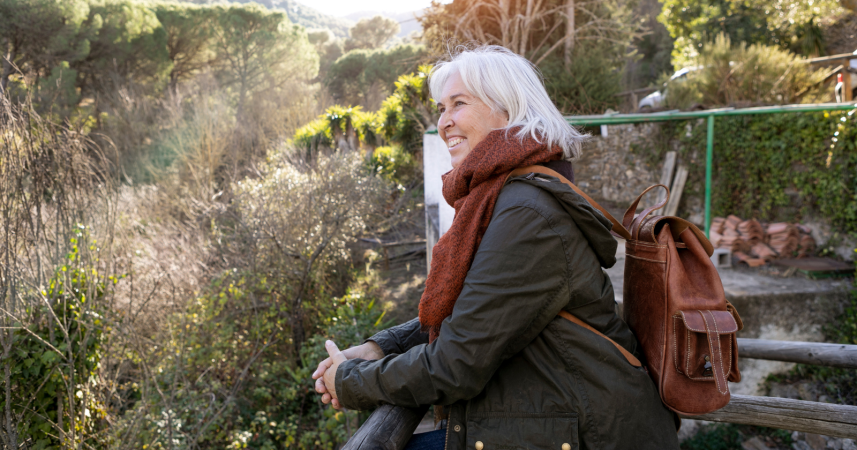
Some places don't reveal their full meaning until you've lived enough life to recognize what you're looking at.
My grandmother spent four decades teaching middle school in Sacramento, raising four kids on that salary, and volunteering at the food bank every Saturday.
When she finally retired at 65, she did something that surprised everyone: she booked a three-week trip to Japan by herself.
I remember thinking it was risky. What if something went wrong? What if she got lost?
She came back transformed. Not in some cliché eat-pray-love way, but genuinely different. She talked about the temples in Kyoto with a depth I'd never heard from her before. She understood something about impermanence that decades of Sunday school hadn't quite captured.
That trip taught me something important: some places don't reveal their full meaning until you've lived enough life to recognize what you're looking at.
Here are seven destinations that become more profound when you visit them with six decades of experience behind you.
1) Kyoto, Japan
There's a reason my grandmother chose Japan for her first big solo trip.
Kyoto isn't about rushing from temple to temple checking boxes. It's about sitting in a rock garden and actually feeling the silence. It's about watching a tea ceremony and recognizing the meditation in repetition.
When you're younger, you might appreciate the aesthetics. The perfectly raked gravel, the moss-covered stones, the precisely pruned trees. But in your 60s, you understand what these gardens are actually saying about acceptance and letting go.
The concept of wabi-sabi, finding beauty in imperfection and impermanence, hits different when you've watched your own body age. When you've lost people. When you know firsthand that nothing lasts forever.
The temples scattered throughout the city are active reminders that every moment is fleeting, which somehow makes each moment more precious.
2) Galápagos Islands, Ecuador
Evolution isn't just a theory when you're watching it happen in real time on these islands.
The Galápagos requires patience. You're not allowed to rush through. There are strict rules about where you can walk, how close you can get to the animals, how slowly you need to move.
This would have frustrated me in my twenties. Now, living in Venice Beach at 44, I'm starting to understand the value of slowing down. But I imagine in your 60s, you've fully made peace with the fact that the best experiences can't be rushed.
The giant tortoises that can live over 100 years become mirrors. The marine iguanas that have adapted to their environment over millennia remind you that change is constant but also gradual. You're watching natural selection, yes, but you're also watching resilience.
Darwin was 26 when he visited these islands. Imagine visiting them at 60, after you've done your own evolving.
3) Camino de Santiago, Spain
Walking 500 miles sounds ambitious at any age. But the Camino isn't really about physical achievement.
Sure, you need to be reasonably fit. But thousands of people in their 60s, 70s, and even 80s complete this pilgrimage every year. Because by that age, you understand that the point isn't arriving. The point is walking.
I learned during my evangelical vegan phase that pushing harder makes people resist more. The Camino teaches a similar lesson: the harder you fight against the difficulty, the harder it gets.
In your 60s, you've probably learned this lesson in other contexts. You know that some things just require putting one foot in front of the other, day after day. You know that transformation happens in repetition, not revelation.
The pilgrims you meet on the trail aren't there to prove anything. They're there to process something. Grief, transition, questions about meaning. The Camino gives you time and space to think while your body does something simple and ancient.
4) Petra, Jordan
Walking through the narrow canyon that leads to Petra's Treasury is like walking through a metaphor for life.
The path is longer than you expect. The walls close in around you. Then suddenly, impossibly, you're standing in front of a building carved directly into rose-red rock face over 2,000 years ago.
Petra is about civilizations that thrived and then vanished. About incredible human achievement that was eventually abandoned to the desert. About the fact that empires fall but beauty persists.
These aren't abstract concepts when you're in your 60s. You've watched industries transform. You've seen once-essential skills become obsolete. You've probably experienced your own version of building something significant and then watching it change or end.
But here's what Petra shows you: the Nabataeans who built this city are gone, but what they created still matters. Still moves people. Still means something.
That's a comfort you might not fully appreciate at 25.
5) New Zealand's South Island
The landscapes in New Zealand look prehistoric because, in many ways, they are.
The South Island has glaciers that have been carving valleys for millennia. Mountains that emerged from the sea millions of years ago. Forests that have evolved in isolation.
What makes this destination particularly meaningful in your 60s is the scale. When you're standing at the base of Aoraki Mount Cook, or hiking through Fiordland, your own timeline shrinks to its proper size.
Your problems, your achievements, your entire life is a brief moment in geological time. That sounds depressing, but it's actually freeing.
I think about this sometimes when I'm walking along Venice Beach, watching the Pacific that's been here long before humans and will be here long after. But New Zealand amplifies that feeling. The landscape makes you feel small in a way that's oddly reassuring.
By your 60s, you've probably made peace with your own mortality. New Zealand's ancient landscapes confirm what you already suspect: you're temporary, but you're part of something much larger and older.
6) Iceland
Iceland is all about transformation. Water becomes steam becomes ice becomes water again. Tectonic plates pull apart and create new land. Everything is in flux.
The whole island feels like it's still being born. You can visit geothermal areas where the earth is literally breathing. You can touch rocks that didn't exist a few decades ago. You can soak in hot springs while snow falls around you.
This constant state of becoming resonates differently depending on your age. In your 20s, transformation feels exciting. In your 60s, it feels familiar.
You've been through your own metamorphoses. Career changes, relationship evolutions, identity shifts. You know that change isn't something that happens and then stops. It's the permanent condition.
Iceland normalizes this. The landscape says: this is how it works. Nothing stays the same. New things emerge from what seemed like endings.
The midnight sun in summer or the northern lights in winter add to this sense of otherworldliness. Time operates differently here. Light behaves strangely. The usual rules don't apply.
7) Bhutan
Bhutan measures Gross National Happiness instead of Gross Domestic Product. That fact alone might sound like marketing when you're younger. But in your 60s, you've probably figured out that wealth and happiness aren't the same thing.
This tiny Himalayan kingdom has made deliberate choices about what matters. They've limited tourism to protect their culture. They've kept traditional architecture and dress alive. They've said no to certain kinds of development.
These aren't decisions made by people chasing growth. They're decisions made by people who understand what they want to preserve.
The monasteries perched on cliffsides, the prayer flags fluttering everywhere, the emphasis on Buddhism and community over individual achievement, all of this makes more sense when you've spent six decades in a culture that prioritizes different things.
Bhutan isn't perfect. No place is. But it offers an alternative model for what a society might value. When you're in your 60s, you've seen enough to know that the model you grew up with isn't the only option.
The country requires you to slow down. There's no rushing through Bhutan. And by your 60s, you've hopefully learned that rushing is overrated anyway.
Conclusion
These seven destinations don't become better in your 60s because you have more time or money, though those things help.
They become more meaningful because you've accumulated enough experience to recognize what you're looking at. You've made mistakes and recovered from them. You've built things and watched them change. You've loved people and lost people.
That context transforms how you see ancient cities, wild landscapes, and cultures different from your own.
My grandmother's trip to Japan didn't teach her anything new, exactly. It reflected back what she'd learned from four decades of teaching teenagers, raising kids, and showing up at the food bank every Saturday. The temples just gave her a framework to understand her own experience.
That's what travel does when you've lived enough life. It doesn't show you something entirely new. It shows you what you already know in a way you can finally see clearly.
If You Were a Healing Herb, Which Would You Be?
Each herb holds a unique kind of magic — soothing, awakening, grounding, or clarifying.
This 9-question quiz reveals the healing plant that mirrors your energy right now and what it says about your natural rhythm.
✨ Instant results. Deeply insightful.