The gap between miserable and comfortable at 35,000 feet comes down to what you packed in your carry-on.
I've done my share of long-haul flights over the years, and somewhere between that terrible red-eye to Tokyo and an endless stretch to Copenhagen, I figured out that comfort isn't something that just happens on airplanes.
You have to engineer it. The difference between arriving exhausted and miserable versus relatively human comes down to the small things you pack in your carry-on.
These aren't expensive splurges or fancy gadgets for the sake of it. They're strategic choices that experienced travelers swear by because they solve specific problems that happen when you're trapped in a metal tube at 35,000 feet for twelve hours.
Once you understand the psychology and physiology of what makes long flights so draining, you can counteract it with surprisingly simple solutions.
1. A quality eye mask
The cheap eye masks airlines hand out are basically decorative. They let in light from every angle, slide around your face, and somehow manage to press directly on your eyeballs.
A proper eye mask, the kind made from contoured memory foam or silk with a molded bridge, creates actual darkness.
Sleep researchers have found that even small amounts of light can disrupt your circadian rhythm and prevent deep sleep. Your brain interprets any light as a signal to stay alert, which is the opposite of what you need on a long flight.
When you're trying to sleep through someone watching a bright action movie two inches from your face, or the cabin lights come on at what feels like 3 a.m. for breakfast service, a quality eye mask becomes the difference between rest and exhaustion.
The investment is minimal compared to what it delivers. We're talking about maybe thirty dollars for something that'll last years and transform your ability to sleep in transit.
Experienced travelers know this and wouldn't dream of boarding a long-haul flight without one tucked in their bag.
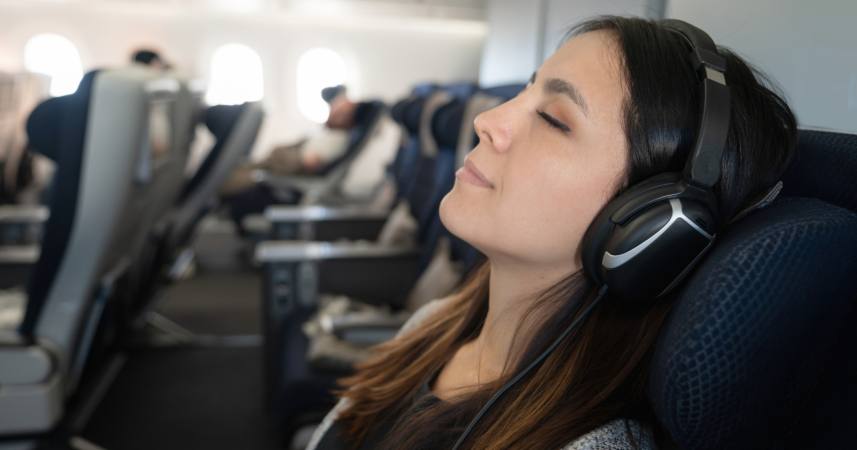
2. Noise-canceling headphones
Airplane cabins are incredibly loud. That constant engine drone sits at around 85 decibels, which is equivalent to standing next to a busy highway.
Your brain has to work overtime to process and filter that sound, which drains your energy even when you're sitting still doing nothing.
Quality noise-canceling headphones eliminate most of that background noise, and the psychological relief is immediate. Suddenly you can think clearly, focus on a movie, or actually relax.
The technology works by generating inverse sound waves that cancel out ambient noise, and the effect is almost magical when you first experience it.
Beyond just blocking engine noise, they create a bubble of personal space in a crowded cabin. You can ignore the people around you, the crying baby three rows back, and the guy having a loud phone conversation during boarding.
For anyone who values their sanity on long flights, these are non-negotiable. They're pricey upfront, but frequent travelers will tell you they're worth every penny.
3. A cashmere or merino wool scarf
This seems like an odd luxury until you've experienced how versatile a good scarf becomes at altitude.
Airplane cabins swing between arctic and tropical with no middle ground, and a large, high-quality scarf adapts to whatever situation you're facing.
Natural fibers like cashmere and merino wool regulate temperature brilliantly. They keep you warm when the air conditioning is blasting, but they breathe well enough that you won't overheat when the cabin gets stuffy.
I learned this on a flight to Europe years ago when I watched a woman across the aisle use her scarf as a blanket, then bunch it up as a pillow, then drape it over the seat as a barrier. It was like watching someone do magic with fabric.
The airline blankets are thin, scratchy, and often questionable in terms of cleanliness. Having your own soft layer means you can get comfortable without wondering when that blanket was last washed.
You can wrap it around your neck for warmth, cover your face for darkness, or ball it up for lumbar support. That versatility in one compact item is exactly the kind of smart packing experienced travelers live by.
4. Hydrating face mist
Cabin air has humidity levels around 10 to 20 percent, which, believe it or not, is drier than most deserts. Your skin loses moisture constantly during a long flight, leaving you feeling tight, itchy, and looking rough by the time you land.
A small bottle of facial mist gives you instant relief whenever your face starts feeling like dried leather. The cooling sensation is refreshing, and it helps your skin retain moisture throughout the flight.
Some travelers swear by rose water, others prefer mineral sprays, but the principle remains the same: regular hydration from the outside helps counteract what the cabin air is doing to you.
5. Lip balm and hand cream
The same dry air that destroys your face also wreaks havoc on your lips and hands. Chapped lips can go from annoying to painful surprisingly fast, and dry hands start cracking if you're on a particularly long route.
Having intensive moisturizers within easy reach means you can reapply whenever needed. Your lips and hands are constantly exposed, touching things, and getting washed, so they need more frequent attention than the rest of your skin.
Quality products with ingredients like shea butter, lanolin, or ceramides create a protective barrier that lasts.
This feels like a small thing until you forget to bring them and spend twelve hours with lips that hurt every time you open your mouth.
Experienced travelers keep these items in their carry-on pouch and reapply obsessively throughout the flight.
6. Your own tea bags or instant coffee
Airline coffee tastes like it was brewed sometime last week and then reheated using resentment. The tea selection usually consists of two options: generic black tea or chamomile that tastes like grass clippings.
If you're particular about your caffeine, and most of us are, bringing your own makes a huge difference.
A few bags of your favorite tea or some instant coffee packets take up almost no space but dramatically improve the in-flight beverage situation.
Flight attendants are almost always happy to give you hot water, and suddenly you're drinking something you actually enjoy rather than choking down whatever's on the cart.
Small comforts matter more when you're tired, uncomfortable, and far from home. This tiny luxury reminds you that you still have some control over your experience.
7. A refillable water bottle
Staying hydrated on long flights is crucial, but relying on the flight attendants to bring you water means you'll never drink enough.
The problem is, it feels awkward asking for refills over and over. The cups they give you hold about four sips, and the beverage service only comes around every few hours.
Bringing an empty bottle through security and filling it at a water fountain before boarding means you have water available whenever you want it. You can sip constantly without bothering anyone, which is exactly what you should be doing to counteract the dehydrating effects of cabin air.
8. A portable battery pack
How many times have you been on a flight where the power outlet at your seat was broken, or worse, nonexistent?
You watch your phone or tablet battery drain while you're using it for entertainment, and by hour six you're staring at the seat in front of you with nothing to do.
A high-capacity battery pack solves this completely. You can keep your devices charged through an entire long-haul flight, even if you're watching movies, listening to music, and scrolling intermittently. The peace of mind alone is worth carrying the extra weight in your bag.
During a particularly long flight to Asia last year, my seat power was dead and I was grateful I'd brought my battery pack. I watched three movies, listened to podcasts, and still landed with 40 percent battery on my phone.
The guy next to me spent the last four hours with nothing but the in-flight magazine and visible regret.
9. Compression socks
These look deeply unsexy, but experienced travelers don't care because they work. Sitting still for hours causes blood to pool in your legs, leading to swelling, discomfort, and in rare cases, dangerous blood clots.
Compression socks apply gentle pressure that keeps blood flowing properly back toward your heart.
The difference is noticeable the moment you stand up after a long flight. Without compression wear, your ankles might be puffy and your legs feel heavy and achy.
With compression socks, you walk off the plane feeling relatively normal. The medical evidence supporting their use is solid enough that doctors recommend them for anyone on flights longer than four hours.
Modern compression socks have come a long way from the beige medical stockings your grandmother wore. You can find them in normal colors and styles that look like regular socks.
Once you've experienced the difference they make, you'll never do a long-haul flight without them.
10. Comfortable slip-on shoes
Following on from our earlier point, your feet will swell during a long flight. This is just physics and biology working against you.
Wearing tight lace-up shoes for twelve hours turns into legitimate misery by hour six, when your feet have expanded half a size and you're trapped in leather prisons.
Slip-on shoes you can easily remove and put back on make all the difference. You can take them off once you're settled, let your feet breathe and expand naturally, and then slip them back on for bathroom trips without struggling with laces while blocking the aisle.
Look for options with arch support and breathable materials so your feet stay comfortable even when they're swollen.
Experienced travelers have learned that arriving with happy feet means you can actually start enjoying your destination immediately instead of hobbling around like you've been tortured.
The shoes don't have to be ugly or completely casual. Plenty of stylish options exist that prioritize comfort without looking like you're wearing bedroom slippers through the airport.
Conclusion
All these items give you agency over your comfort when almost everything else about flying is outside your control.
You can't make the flight shorter, the seats bigger, or the air less dry. But you can show up prepared with small luxuries that address each specific discomfort.
That preparation transforms the experience from something you endure into something you can actually handle with relative grace.
Just launched: Laughing in the Face of Chaos by Rudá Iandê
Exhausted from trying to hold it all together?
You show up. You smile. You say the right things. But under the surface, something’s tightening. Maybe you don’t want to “stay positive” anymore. Maybe you’re done pretending everything’s fine.
This book is your permission slip to stop performing. To understand chaos at its root and all of your emotional layers.
In Laughing in the Face of Chaos, Brazilian shaman Rudá Iandê brings over 30 years of deep, one-on-one work helping people untangle from the roles they’ve been stuck in—so they can return to something real. He exposes the quiet pressure to be good, be successful, be spiritual—and shows how freedom often lives on the other side of that pressure.
This isn’t a book about becoming your best self. It’s about becoming your real self.