Europeans build structures that make the good choice feel normal. and you can do the same—one small upgrade at a time.
I love the States, and I also love the way a lot of Europeans move through daily life.
After years in restaurants and plenty of trips with a fork in one hand and a notebook in the other, I started stealing a few of their habits.
None of these require a passport—no trendy overhaul, either—because it's just small shifts that make food taste better, days feel calmer, and health goals easier to hit.
Ready to borrow a few good ideas?
1) Lingering at the table
The first time I had lunch in Lisbon with a chef friend, I learned a lesson you will never get from a productivity podcast.
We sat, we ate grilled sardines, we talked, and we let silence do the seasoning.
Ninety minutes went by before anyone even looked for the check.
Europeans treat meals like a destination, not a drive-thru.
They slow down, they course things out, and they make room for conversation, which is the real main.
From a self-development standpoint, this is training in presence.
If you can learn to be fully there for a plate of tomatoes and olive oil, you can be fully there for a workout, a hard conversation, or a big idea.
Attention is a muscle, and the table is a great gym.
2) Walking as a default
When I lived near a market street in Paris for a month, my phone kept congratulating me for hitting 12,000 steps before lunch.
A lot of European cities are built for feet first.
Groceries are a few blocks away, coffee is on the corner, and transit fills the gaps.
The side effect is less friction around daily movement.
This matters because habits that require less willpower stick.
If you want more energy, clarity, and better sleep, engineer your environment for it.
Park further, keep a sturdy pair of shoes by the door, and make short walks your go-to between tasks.
Live your life by making the good thing easy.
3) Real vacations and real boundaries
A chef mentor once told me, “Rest is mise en place for your life.”
Many Europeans actually take their paid time off, then protect it like a prized recipe.
Emails can wait, and auto-replies are unapologetic; when they are off, they are truly off.
Athletes build muscle between sessions, not during them.
The same is true for creative thinking, leadership, and emotional patience.
Book time away and keep it sacred.
Start with a long weekend where your phone stays on airplane mode except for maps and photos.
Watch your baseline stress drop and your ideas improve.
4) Eating with the seasons
Walk through a Saturday market in Barcelona in May and you will see strawberries so fragrant they announce themselves.
In October you will find mushrooms and chestnuts everywhere.
Seasonality is a rhythm.
Cooking this way does two things:
- Your food tastes better with less effort because peak produce is doing the heavy lifting.
- You naturally diversify your diet across the year, which can support gut health and nutrient variety.
You do not need a perfect farm share to play along.
Start small, buy what looks great, and build your meal around it.
A ripe tomato on toasted bread with olive oil and sea salt is dinner.
I am not vegan, but I am very pro vegetable when they taste like themselves!
5) Moderation without the moral drama
In Rome, I watched a family share a carafe of wine at lunch like it was bread.
No big speech, no guilt, and no “cheat day,” just a simple pour and a slower pace.
Moderation is a skill.
Europeans often practice it by normalizing smaller servings and stretching them out across a meal.
There is less binge, more balance.
The lesson is about the wider idea of enough.
Apply this to desserts, screens, and even work.
A square of chocolate after dinner can be a ritual instead of a raid, while a 30 minute focused sprint can beat a jittery four hour tab-athon.
When you remove the moral charge, you can make clearer choices.
6) Repeating outfits like a uniform
I used to think style meant endless variety, then I spent time in Copenhagen and noticed how many people wore a simple rotation of well made basics.
Fewer pieces, higher quality, better fit, and repeat often.
There is power in this: Decision fatigue drops as your look becomes a signature and you spend less but buy smarter.
In kitchens, we call this standardization as it frees up creativity for where it counts, like plate design or the nightly special.
Try a personal uniform for weekdays: Two or three tops, two pairs of pants, one jacket, shoes that go with everything.
You will be surprised how much lighter your mornings feel.
Use the saved bandwidth for a proper breakfast or a quick journal entry.
7) Café culture without the laptop
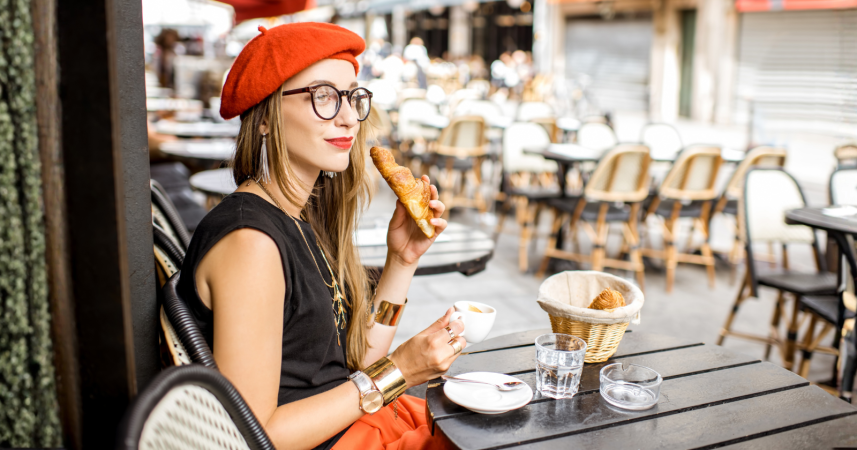
Finally, there is the way Europeans do cafés.
You sit, you sip, and you watch people or you read.
What you do not do is colonize the table with cords and a full workstation for three hours.
I am all for deep work, but not every public space needs to become an office.
The café can be a ritual for reflection; ten minutes with an espresso and a notebook can reset your whole afternoon.
You give your brain a quiet runway to land ideas.
If you are anxious about “wasting time,” here is a reframe.
Reflection is a performance enhancer.
Most of my best food ideas show up when my hands are idle and my senses are on.
Let the coffee be hot, the moment be slow, and the phone be face down.
The bottom line
You do not need to move to Madrid to borrow these habits because you can linger at your own table, make walking your default, guard your time off, shop what is in season, practice moderation, build a simple uniform, and treat the café like a sanctuary.
The throughline is intention.
Europeans build structures that make the good choice feel normal. and you can do the same—one small upgrade at a time.
What’s Your Plant-Powered Archetype?
Ever wonder what your everyday habits say about your deeper purpose—and how they ripple out to impact the planet?
This 90-second quiz reveals the plant-powered role you’re here to play, and the tiny shift that makes it even more powerful.
12 fun questions. Instant results. Surprisingly accurate.