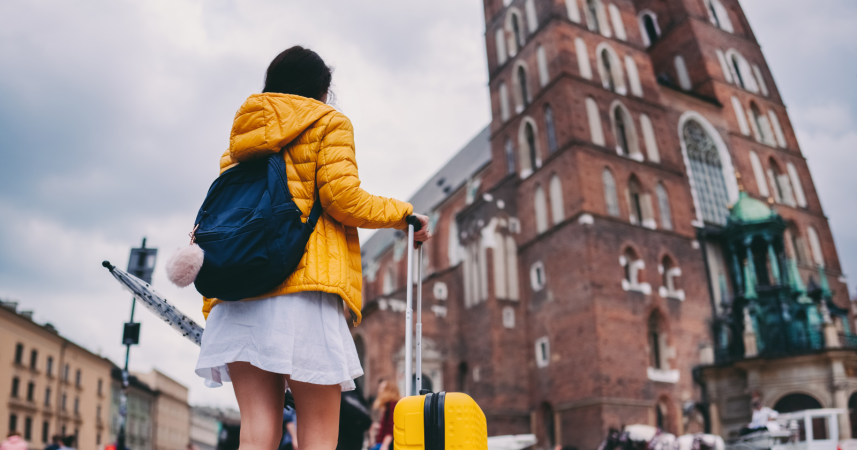
Five years solo taught me what first-timers miss—especially on night one.
I booked my first solo flight with the emotional range of a rom-com montage: exhilaration, nausea, suddenly ordering a neck pillow at 2 a.m.
Five years later, I’ve slept in rooms the size of espresso cups, navigated train strikes with a croissant in one hand and Google
Translate in the other, and learned the quiet science of moving through the world alone.
It’s not about fearlessness — it’s about building your own operating system—one that lets you feel safe, curious, and very much alive.
If I could time-travel a carry-on back to my younger self at Gate 32, this is what I’d pack inside.
Start with a “first 24 hours” script
Your first day sets the tone, and decision fatigue is the enemy.
Before you fly, pre-decide three things: how you’ll get to your accommodation, where you’ll eat within a 10-minute walk, and one low-stakes activity (a neighborhood stroll, a small museum, a market).
Screenshot the route from the airport, the name and address of your stay, and the door code.
Tell future-you exactly what to do: “Land → ATM → local SIM/eSIM → train/bus X → check-in → shower → snack → short walk before 8 p.m.”
When you know the first moves, the rest of the city opens its shoulders.
Pack for competence, not content
The outfits in your head will betray you. The shoes that respect sidewalks will not.
Pack a two-color backbone (navy + camel, black + ecru), one accent (rust, forest, cobalt), and silhouettes that swing sizes after salty dinners and long flights.
Bring a transformer layer (light blazer, overshirt, or scarf) that turns day clothes into dinner clothes.
Then add a micro-care kit: stain stick, mini steamer alternative (spritz bottle + a few drops of vodka), lint sheets, safety pins, fashion tape, de-piller, spare insoles.
Five minutes with that kit beats packing five more tops.
Safety is a system, not a mood
I’m not fearless; I’m methodical. I share my live location with one person, use a code word for “call me now,” and keep check-in texts simple: “Arrived, door locked, Wi-Fi works.”
I walk like I mean it (phone away, keys accessible), sit near the driver on buses at night, and choose bar seating or window two-tops where staff can see me.
I save the local emergency number and nearest 24-hour pharmacy in my notes, learn “help,” “doctor,” and “police” in the local language, and keep one credit card, a bit of cash, and a photocopy of my passport separate from the rest.
None of this is dramatic. It’s seatbelts.
Learn the three reads: neighborhood, menu, and body language
You don’t need to decode a whole culture on day one.
You do need to read a block.
Are shutters open? Are locals walking dogs after dark? Are cafés mixed-company or mostly tourists?
That’s data. Menus also tell the truth: if there’s a laminated photo novel in five languages, I save it for an “I need fries” moment; if it’s a small card with seasonal stuff, I settle in.
Body language is the third read: when in doubt, match the tempo you see—volume, eye contact, how people queue. Social ease follows faster than any phrasebook.
Make your phone boring and your bag interesting
Your phone should be a tool, not a tractor beam.
Turn off non-essential notifications, move social apps off your home screen, and keep your map, translator, and currency converter front and center. Download offline maps and a transit app before wheels up.
Meanwhile, make your day bag earn its ticket: cross-body with a zipper, inside pocket for passport, small pouch for cards and cash, and a micro umbrella because weather loves a plot twist.
I carry a cheap ring carabiner and clip my bag to my chair; petty theft hates mild inconvenience.
Choose lodging like a stage manager
Photos lie; reviews tell on them.
I filter for neighborhoods near transit but not on top of the loudest bar, search reviews for “quiet,” “safe,” and “solo,” and read the most recent comments first.
I message hosts/hotels with one clarifying question and judge by response time and tone.
My room must have: a deadbolt, a peephole, and a kettle or access to hot water (tea solves many moods). If it’s a shared space, I ask about gender mix and security.
I check in before dark when possible — if I can’t, I plan arrival like a military operation—screenshots, backup contact method, exact door instructions.
I’ve turned around twice in five years. My rule: if your gut says “no,” it’s “no.” Money returns; regret lingers.
Eat alone like it’s a hobby (because it is)
I learned the art of the solo dinner at bar seats. You’re part of the room, the menu arrives faster, and staff keep an eye out for you without hovering. I bring a tiny notebook; jotting sensations feels less lonely than scrolling.
If full dinner feels like a leap, start with breakfast or lunch.
Order one local thing and one comfort anchor: soup + salad, pasta + greens, small plate + bread. Learn to ask for a half-pour or carafe of water in the local language; it buys you time and signals you’re in the game.
If anyone questions why you’re alone, smile and say, “Best company in town.” Then return to your olives.
Build “anchor” habits that travel with you
Loneliness travels; so do rituals. I keep three anchors wherever I land: a morning loop (15–30 minutes, same streets, new details), a café I crown as “my spot,” and an evening stretch with a three-song playlist.
On travel days, I do a “reset trio”: shower, hot drink, light walk.
These habits shrink new cities to human size and restore you to yourself after a day of logistics gymnastics.
Budget like a person who wants to come back
I don’t chase every attraction; I chase days that make me want to return. I pick one splurge per city (tickets, tasting menu, day trip) and balance it with free joys: public parks, churches, markets, viewpoints, street music.
My food budget expands at lunch (same kitchen, lower prices) and relaxes at bakeries (carbs are heritage, and heritage is education).
I use cash for “fun money”—when the billfold sighs, I know I’ve reached “admire through glass” territory.
Being honest about money makes the day feel freer, not smaller.
Expect to be scammed once—and script your line
If you travel long enough, you’ll meet a “helpful” stranger with sticky pockets or a menu without prices.
My script is brisk and polite: “No, thank you,” “I don’t need help,” “I already have tickets,” “I can’t,” and, if necessary, silence paired with movement.
I buy metro tickets only from machines/official kiosks, keep my phone away near escalators and doors, and confirm taxi prices before I sit.
When a scam lands, I treat it like a weather event: I move on. The story is not “I was stupid.” The story is “I’m still here.”
Photos: capture the feeling, not just the skyline
I take my “proof” shot first, then I shoot how the city feels: the color of the fruit crates, the texture of stone steps, the way people park their bikes, the sign typography, the light at 4 p.m.
I put myself in the frame even when I don’t feel “photo-ready”; future-me wants evidence I was there. A mini tripod with a Bluetooth remote weighs nothing and ends the stranger-photo roulette.
I also take one video panning slowly, 10 seconds, to hear the soundscape.
Memory is a multi-sensory animal — feed it well.
Know when to leave a plan that isn’t working
The most relieving lesson: you’re allowed to bail. If the “must-see” is making you miserable, skip it.
If your day trip is three transfers and a prayer, pivot to a local picnic and a book. If a hostel vibe is frat-house at 1 a.m., check out early and sleep like a citizen elsewhere.
Flexibility isn’t failure — it’s mastery.
Some of my favorite travel days happened when I ditched a plan for what was actually possible with the body and brain I had at noon.
Learn polite phrases—and the local version of small talk
You don’t need fluency; you need hospitality. “Please,” “thank you,” “good morning,” “sorry,” and “delicious” get you 60% of the way.
Add two local small-talk tokens (weather, sports, something kind about the neighborhood) and watch faces soften.
I never lead with English — I start in the local language and switch if invited.
The point isn’t performance—it’s respect. People feel it.
Keep a “win file” for the wobbly days
Travel expands you; it also exposes your edges.
On days when everything is confusing and you’ve accidentally taken the wrong tram twice, open your win file (notes app, journal page) and read five moments you handled: found the platform, navigated the market, made a friend, fixed a booking, ordered dinner like a champ.
Confidence returns when you remember you’ve done hard things in the last 48 hours.
Leave every place a little better
I pick up two pieces of litter, learn one fact about the street I’m on, and tip like I worked service (I did).
I share a table when a café is slammed and wipe it down when I leave. I write one specific review per trip pointing out a staff member’s name.
Leaving a place better is the easiest way to feel like you belong on the planet—and belonging is the most underrated safety plan there is.
Five years in, solo travel feels less like bravery and more like literacy. You learn to read rooms, trains, weather, yourself.
You learn that joy often arrives after the second wrong turn, that the best meals are at 1 p.m., and that you can carry your life on your back without it being a metaphor for loneliness.
If you’re staring at a ticket you’re scared to buy, let me be the nudge: you don’t have to be ready. You have to be curious—and willing to back yourself with simple systems.
Book it. Pack the good shoes. Text someone your hotel address. And when you land, step out into the air that smells like someone else’s breakfast. It’s waiting for you.
What’s Your Plant-Powered Archetype?
Ever wonder what your everyday habits say about your deeper purpose—and how they ripple out to impact the planet?
This 90-second quiz reveals the plant-powered role you’re here to play, and the tiny shift that makes it even more powerful.
12 fun questions. Instant results. Surprisingly accurate.