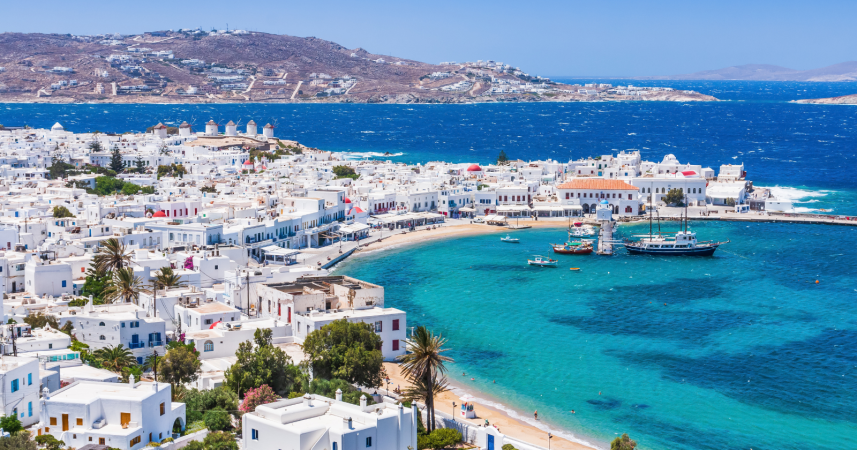
Six months on Greek islands rewired my idea of a “good life”—walkability, food, and community beat American hustle. I’m planning my retirement there.

Add VegOut to your Google News feed. 
The plan was to unplug for a couple of weeks.
It turned into six months, four ferry passes, a suspiciously deep tan, and a decision I didn’t expect: I’m not retiring in the U.S.
I bounced between islands—Naxos, Paros, Ikaria, Syros, Tinos, Crete, Milos—staying long enough to learn my baker’s schedule and my fishmonger’s jokes. I cooked, I wrote, I walked more than I drove, and I watched how people actually live when the coastline is your backyard and the calendar still respects seasons.
What changed me wasn’t postcard stuff. It was the tiny rituals and the way time moves when a place prioritizes people over speed. You feel it in your bones by week two. By month three, you can’t imagine going back to the way you used to measure a “good day.”
The pace resets your nervous system
Greek islands run on a gear American cities forgot existed.
Shops open late and close for the heat. Lunch is a real pause, not a protein bar over a keyboard. Dinner is a slow sunset with clinking glasses and kids orbiting around the table like satellites, not a last-minute scramble between obligations.
I kept waiting to be frustrated—where’s the rush, the optimization, the “go go go”? It never arrived. Instead, a chef in Chania looked at me like I was asking for a weather report when I apologized for lingering. “Of course you sit,” he said, waving at the harbor. “Where else would you be?”
After a month, my resting heart rate ticked down and my mornings stopped feeling like a test I could fail. I wasn’t lazy. I was paced. The day had room for a walk, work, groceries, a swim, and dinner with friends—without a calendar Tetris that made joy feel illicit.
Food culture makes health effortless
I love food. I also love feeling good in my body. On the islands, those aren’t opposing forces.
Markets make the default choice the better choice: tomatoes that taste like August, cucumbers with snap, beans that actually taste like something. Fish isn’t a “special night” item; it’s a Tuesday.
Olive oil is not a condiment; it’s infrastructure. Bread is a love letter from a person you know, and it goes stale in a day because no one is embalming it for shelf life.
I cooked root-to-stem without trying: zucchini blossoms stuffed and baked, eggplant grilled and smothered in garlicky tomato, greens wilted with lemon and oil, lentils with a crumble of feta and a fistful of dill. I ate lunch like a human—beans, salad, bread, a piece of fruit—and didn’t crash at 3 p.m.
What struck me is how little willpower it took to eat well. The food is built for lingering, not inhaling. You don’t “go on a diet” in the Cyclades.
You buy what’s good, you share it, and you take a slow walk after dinner. That’s the program.
Walkability beats square footage
There’s a particular kind of happiness that comes from solving your day on foot.
Need eggs?
Three minutes to the mini-market. Bread? Five minutes to the bakery with the sesame-crusted loaves.
Coffee? Two minutes to the café that remembers your order by day four.
Swim? Ten minutes to a cove with water so clear it looks edited.
Back home, errands require a car, parking, and a chunk of mental budget. On an island, your legs handle logistics and your mind gets to do literally anything else. I stopped doomscrolling without trying. I slept better.
My steps climbed without a wearable nagging me. And because I saw the same people daily, my life got populated with “good mornings” and small favors—the glue of community—without a standing calendar invite called “Community.”
Square footage matters less when your neighborhood is your living room. I’d trade a bigger house for a village I can cross end-to-end before my espresso cools.
Aging is visible and valued
In the U.S., we hide aging in gyms and gated communities. On the islands, elders are everywhere: at the morning kafenio, in the sea at 7 a.m., in black garb walking to liturgy, at family tables with the best seat and the first pour of wine.
I watched an octogenarian woman peel capers and tell three generations exactly how much lemon the salad needed. I saw a man in his seventies shuffle past my table each night with his worry beads, pausing to talk to the waiter’s mother, who simply arrived at 9 p.m. and started stacking plates because that’s what she’s always done.
It’s not sentimental. It’s practical.
Aging isn’t a stage you “manage” privately; it’s a role you inhabit publicly. You don’t have to fight to be seen, because you never disappeared in the first place.
And when your horizon is filled with people who are eighty and still walking to the market, retirement stops being a cliff and becomes a curve.
Healthcare won’t bankrupt your sunset years
I’m not getting into politics. I’m talking about stress.
In the U.S., a health scare is often a financial scare. You can do everything “right” and still worry about bills you can’t predict. On the islands, people talk about doctors, not deductibles. Pharmacies are first-responder hubs staffed by folks who actually know you. When something goes wrong, your neighborhood notices.
That alone changes how your shoulders sit near your ears.
I don’t need a concierge for everything. I need predictable, humane care that doesn’t hand me a second crisis because I needed stitches on a Sunday.
I watched that reality up close and realized how much invisible tension I carry at home just to live with the uncertainty.
Money stretches because “enough” is normal
Here’s a weird thing about places where people don’t introduce themselves by job title: the bar for a good day is lower and much easier to hit.
My best days were hilariously inexpensive. A ferry to a smaller island, a grilled sardine lunch, a late swim, espresso at golden hour, and a bottle of local white on a terrace with friends. I didn’t need “an experience.” I needed presence and places built for lingering.
I cooked more than I ate out and felt like I was living richly, not frugally. When you’re not constantly upsold on “the premium version” of basic life, your money starts working like a supportive friend instead of a treadmill operator.
It’s not that the islands are “cheap.”
They’re not. It’s that the social script doesn’t assume you should want constant newness. Repetition is allowed to be beautiful. Wednesday at the same taverna is a celebration, not a rut.
Island time isn’t inefficiency—it’s priorities
I came in hot with my American assumptions about slowness. By month two, I understood the difference between disorganization and a different order of operations.
Your electrician might not show at 9:00 sharp—but when your roof leaks, your neighbor is your first line of defense. Paperwork is an odyssey—but the grocer will float you a tab if you forget your wallet.
Timelines wobble—but funerals, name days, and baptisms stop the clock. Life’s important notes are played loud. Everything else can wait.
There’s a clarity to that hierarchy.
It doesn’t make bureaucracy fun, but it reframes inconvenience as the price of living in a place that treats people as the point, not a nuisance.
The trade-offs I can live with
This isn’t an Instagram fantasy. There are real trade-offs.
Island winters are quiet. Ferries get canceled. Bureaucracy is a contact sport. You might chase a package for a month. Work can feel remote if your network is stateside. And if you crave 24/7 everything, you’ll chafe.
But I looked at the ledger like a restaurateur: what’s the cost of goods for the life I want?
In the U.S., my “overhead” includes commutes, constant noise, healthcare roulette, and a culture that treats rest like a moral failure. On the islands, my overhead is patience. I can budget for patience.
The moment I knew
It wasn’t a sunset. It was lunch.
I was alone at a seaside taverna in Syros with a plate of fava, a pile of horta with lemon, grilled octopus, and bread with obscene olive oil. An older couple arrived, nodded, and sat near me. We didn’t speak. We just ate. At some point, the man raised his glass slightly, and I did the same.
Nothing happened. Which is to say, everything did. I felt part of the room—no performance, no noise, no need to prove I was “making the most of it.” I was. By doing less and tasting more.
That’s when I realized retirement isn’t a place on a map. It’s a rhythm in your day. The islands taught me mine.
The plan I’m sketching
I’m not selling everything and moving tomorrow. I’m building a bridge.
A year or two before I “retire,” I’ll start with longer stays in shoulder seasons—April/May and late September/October—to test routines when the islands aren’t dressed for company. I’ll pick a base with walkability, year-round community, and a ferry that doesn’t get temperamental at the first gust—Syros or Naxos are front-runners. I’ll rent before I buy, make friends at the market, and learn the office hours of whoever stamps the important paper.
I’ll still travel. I’ll still eat fancy tasting menus sometimes. But the spine of life will be simpler: cook, swim, walk, write, host. I’ll measure success by how many names I know at the bakery and how often dinner runs long for the right reasons.
Why I’m not retiring in the U.S.
Because I don’t want my older years to be a project I manage. I want them to be a life I inhabit.
I want quiet mornings, edible tomatoes, neighbors who wave, healthcare that doesn’t keep me up at night, and a culture where rest isn’t suspicious. I want to walk to the sea. I want to become one of those people in black who still tells everyone exactly how much lemon the salad needs.
Six months on the islands didn’t change who I am. It reminded me who I want to be when I stop pretending that productivity is the same thing as a life.
I can’t promise I’ll never drift back. But I can tell you this: the Greek islands handed me a blueprint for dignity, pleasure, and community that I never found at home. That’s not something I’m willing to retire from.
What’s Your Plant-Powered Archetype?
Ever wonder what your everyday habits say about your deeper purpose—and how they ripple out to impact the planet?
This 90-second quiz reveals the plant-powered role you’re here to play, and the tiny shift that makes it even more powerful.
12 fun questions. Instant results. Surprisingly accurate.