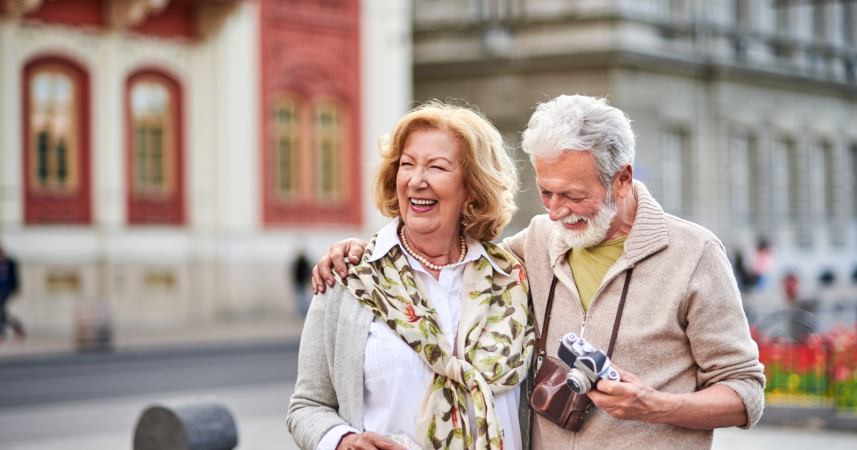
Good news—they wake up fast. Book the thing, pack the small bag, leave room for wonder, and let the road remind you who you still are.
Age isn’t just a number. It’s a posture.
I’ve met travelers in their 20s who move like they’re already tired of the world, and people in their 70s who treat every day like a backstage pass. The difference isn’t knees or miles—it’s mindset. If you still travel in the following ways after 70, your spirit is doing push-ups most people your age gave up on years ago.
Let’s get into it.
1) Build your own itinerary
Packages are fine. But when you’re still sketching your own route on the back of a café receipt, that’s youthful energy.
You pick a city because a photo essay grabbed you. You anchor on two or three musts, then leave white space for surprises. That white space is where aliveness lives.
I like a simple rule: one planned thing, one spontaneous thing, one quiet thing each day. A gallery before lunch. A detour down a street market that smells like cumin and cardamom. An hour with a book on a bench, just watching life. If you’re still comfortable with that mix—structure plus improvisation—you haven’t calcified. You’re practicing creative constraint.
And when something slips—train delays, closed museums—you don’t melt. You pivot. A younger spirit isn’t the one that never stumbles; it’s the one that recovers quickly and keeps moving toward something interesting.
2) Pack light and move often
A carry-on is a philosophy. It says, “I’m here to move.”
If your bag still slides into the overhead without drama, you’ve kept the travel muscle flexible. Light packing means you can switch neighborhoods, catch an earlier train, or follow a local tip without paying a baggage tax in energy.
It’s not about deprivation. It’s about clarity. Two pairs of shoes you can walk all day in. Layers that work from foggy mornings to glowing sunsets. A compact camera or phone you actually use because it’s not buried.
Quick personal note: I learned this the hard way on a long trip through Spain. I started with too much. By Lisbon, I’d mailed home a third of my stuff and felt ten years younger. When your kit is dialed, your curiosity is lighter too. You stop guarding objects and start gathering moments.
3) Ride public transit
Cabs are easy, but subways, trams, and buses are where a city hums at street volume. If you’re still tapping transit passes and reading line maps, you’re telling your brain, “I can learn new systems.”
There’s a subtle courage in this. You ask a stranger which platform goes to Trastevere. You decipher the difference between the green line and the light-green line in Tokyo. You miss a stop, laugh, and get off at the next one. That’s cognitive agility, not just frugality.
Public transit also gives you incidental exercise and incidental encounters. You’ll overhear the argument, the lullaby, the soccer score analysis. You’ll see morning faces, end-of-shift shoulders, teenagers practicing independence. These details are free anthropology.
And when you do spring for a rideshare, you treat it like a conversation, not a bubble. “What’s one place locals love that visitors miss?” If you’re still asking that question, you’re younger than your passport says.
4) Learn the small words
You don’t need fluency to connect. You need humility enough to try.
Hello. Please. Thank you. Delicious. Where? How much? Beautiful. These words are small, but they’re bridges. Use them badly and you’ll still watch faces soften. Add a smile and a gesture, and you’re communicating what matters: respect.
I’ve mentioned this before but the fastest empathy hack I’ve found is learning how to compliment something specific in the local language—someone’s craft, their city’s morning light, the bread they baked. It’s not flattery. It’s attention.
Bring a notebook. Write down new phrases you hear. Practice them to the barista who already knows you’re not from here and is still cheering for you. If you’re still willing to sound silly in service of connection, your spirit hasn’t aged out of play.
5) Eat with curiosity (and intention)
Food is a map. If you’re still reading it, you’re still exploring.
As a vegan, I travel with two priorities that live happily together: curiosity and care. Curiosity sends me to farmers’ markets at 8 a.m. to see what’s in season, or into small vegan cafés tucked behind bookstores. Care keeps me aligned with my values and the planet while I eat. The combo doesn’t shrink my experience—it sharpens it.
Try this: wherever you land, make your first stop a produce market. Notice the citrus varieties, the herbs piled like green clouds, the grandmothers negotiating like pros. Ask for one thing you can eat now and one thing that needs a day to ripen. That little ritual turns any city into a kitchen you’re learning.
Cooking classes, plant-forward tasting menus, street food that happens to be vegan (hello, falafel in Amman, socca in Nice, masala dosa in Bengaluru)—these are invitations to understand a place from the inside out. If you’re still saying yes to them, you’re not stuck in “what I know,” you’re alive to “what’s next.”
6) Choose human-scale adventure
“Adventure” doesn’t have to mean cliff edges. It can be the walking architecture tour that covers five miles of stories. The sunrise ferry no one takes because it’s too early. The e-bike ride to a hilltop café you can’t get to any other way.
Younger spirits keep a micro-adventure in their pocket. Pick one that makes your heart lift a little and your knees still happy. Kayak the calm harbor. Book the city night run with a local club. Join the group hike with a gentle incline and a grand payoff.
A small challenge resets your senses. You come back to your hotel with cheeks warmed by wind and a new memory stamped in. The people you meet on those trails and tours tend to be curious, too. Momentum loves company.
7) Talk to strangers like it’s a skill (because it is)
Conversation ages when it becomes transactional. It stays young when it’s curious, low-stakes, and specific.
Ask the barista how they make that layered drink you’ve never seen. Ask the museum guard which gallery they wish more people visited. Ask the market vendor what they cook when they go home tired. These questions open worlds.
I carry a tiny pocket list of prompts for myself: “What’s your favorite quiet street here?” “If I only have one sunrise, where should I watch it?” “What local habit would surprise visitors?” If you’re still collecting and using questions like this, you haven’t retired your social muscles. You’re giving serendipity a job.
Quick anecdote: in Berlin, a simple “What song should I listen to on the U-Bahn?” turned into a thirty-minute playlist exchange with a stranger who introduced me to an indie band I’d never heard. Music, travel, connection—three for one.
8) Keep your plan playful
A rigid plan gets fragile. A playful plan flexes and often gets better.
Build in “curiosity windows.” That might be 4–6 p.m. with no reservations and no agenda except to follow what looks alive when you’re there. It might be a whole day where the only rule is “no taxis,” to force yourself into the city’s true rhythm.
Travelers who age well keep experimenting with formats: a week in one neighborhood instead of three cities; a sleeper train instead of a flight; a house-sit where the deal is you water the plants and a neighbor tells you their favorite bakery. You try new ways not to prove a point, but to keep discovery oxygenated.
If you’re still letting a street musician hold you for an extra twenty minutes or following a scent down an alley to a tiny restaurant, you’re doing travel like jazz. Not sloppy—skilled improvisation.
The bottom line
If you still build your own days, carry less, ride the tram, learn small words, eat with curiosity, choose human-scale challenge, talk to strangers, play with your plan, use tech wisely, learn on purpose, listen to your body, travel with values, and let others shine—you’re not just “doing well for your age.” You’re modeling a way to stay alive to the world.
Travel doesn’t have to get narrower as we get older. It can get sharper, kinder, and more you.
And if you’ve let some of these muscles go quiet? Good news—they wake up fast. Book the thing, pack the small bag, leave room for wonder, and let the road remind you who you still are.