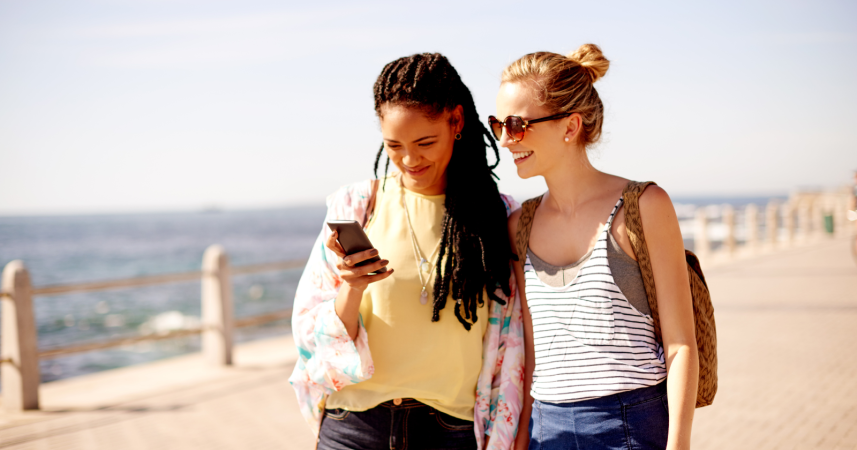
Vacations are supposed to be an escape from daily life. But for some, the real trip isn’t to the beach or the mountains—it’s straight onto Instagram.

Add VegOut to your Google News feed. 
Travel has always been about storytelling.
We bring back souvenirs. We share photos. We tell friends about the sunsets and the food.
But with social media, travel stories aren’t told after the fact—they’re broadcast live, minute by minute.
For some, it’s harmless sharing. For others, it turns into a 24/7 highlight reel where every cocktail, every pool float, and every “candid” laugh is carefully documented.
And while it looks like fun from the outside, psychology suggests it’s also revealing.
The people who post their entire holiday online are broadcasting more than beaches and buffets. They’re broadcasting traits they may not even know they have.
Here are seven of the most common.
1. A craving for validation
Every like is a tiny dopamine hit. And when you post your entire holiday, you’re not just sharing memories—you’re seeking affirmation.
It’s the psychology of social proof: If people see I’m having a good time, then it must be a good time.
The problem?
The more you post, the more obvious the craving becomes. Vacations that should feel immersive instead start to feel like performances.
Friends might smile at the photos, but deep down they’re clocking the neediness. It reads less like “I’m enjoying myself” and more like “Please clap.”
Ironically, the people who radiate real confidence often post less. They’re too busy living it.
2. Difficulty being present
When your first instinct is to reach for your phone every time a sunset appears, you’re not soaking it in—you’re framing it.
Posting everything reveals a subtle discomfort with presence. Instead of letting the moment be enough, it has to be captured, filtered, and uploaded for it to “count.”
Psychologists call this self-objectification: experiencing your life as if you’re watching yourself live it.
The tragedy?
The more you document, the less you actually remember. Studies show constant photographing dulls memory because the brain outsources the experience to the device.
The cringe is when everyone else is sighing at the view, and you’re sighing at your Wi-Fi signal.
3. A tendency toward insecurity
Oversharing isn’t always about showing off—it’s often about covering up.
When people flood feeds with every poolside cocktail and every resort angle, it’s sometimes less about joy and more about reassurance: See, I am living well. I am successful. I am enough.
Psychology suggests that insecure individuals often overcompensate with curated images.
They’re not posting for strangers—they’re posting for their inner critic.
The irony?
The more perfectly staged the holiday looks, the less convincing it often is. Viewers sense the performance, even if they can’t articulate it.
It’s not that posting equals insecurity. But when posting is compulsive, it usually tells on you.
4. A performative relationship with luxury
Vacations used to be private indulgences. Now, they’re often treated as status updates.
When someone posts every pool float, every champagne flute, every “casual” balcony view, what they’re really broadcasting is a relationship with luxury that’s more about performance than pleasure.
It’s less “I’m enjoying this” and more “I need you to know I can afford this.”
True wealth tends to be quieter. The loudest luxury posts often reveal new money energy—or at least the desire to signal it.
People watching may smile at the infinity pool shots, but inside, they’re thinking: If you’re really relaxed, why are you working this hard to prove it?
5. A fear of missing out (even on their own trip)
Ironically, people who post their entire holiday often seem afraid of missing the holiday itself.
There’s a constant compulsion: If I don’t document it, was it worth it? If no one sees it, did it happen?
Psychologists link this to FOMO turned inward—the fear of missing out not on others’ lives, but on your own memories.
The photo becomes the proof of existence.
But here’s the catch: while trying not to miss out, they actually miss the thing itself. The laughter, the smells, the quiet details slip away while the perfect caption is typed out.
Later, scrolling their own feed, they’ll remember the posts more vividly than the actual sunsets.
6. Competitive social positioning
Let’s be honest: travel posting is often less about “sharing joy” and more about “flexing rank.”
Posting every meal, every excursion, every luxury detail is a subtle way of saying, Look at my life compared to yours.
It’s competitive display dressed up as casual sharing. And it’s not new—humans have always used status symbols. Social media just turbocharges the ability to flaunt.
The awkward part?
Overposting often backfires. Instead of envy, it generates quiet eye-rolls. Friends don’t always think, Wow, I wish I were there. More often, they think, Wow, you need us to know you’re there.
What feels like winning can actually come across as insecurity disguised as superiority.
7. An addiction to external narrative
At its core, posting everything reveals one big truth: the holiday isn’t complete until it’s packaged into a story for others.
This is the psychology of narrative identity—the way we construct our lives as stories to make sense of them.
For chronic posters, the story isn’t just for themselves. It’s curated for the audience.
It’s not “I had fun on vacation.” It’s “I am the kind of person who has fun, stylish vacations—and you’re all here to witness it.”
Living for the narrative often overshadows living for the experience.
When your holiday exists more vividly online than it did in your own memory, you haven’t taken a trip. You’ve produced content.
The bigger picture
None of this is to say posting your holiday makes you a bad person. Sharing is human. We all want to be seen.
But there’s a line between documenting memories and outsourcing your sense of joy to the feed.
The constant posting tells on you.
It reveals needs—for validation, for status, for reassurance—that you may not even realize you’re broadcasting.
Meanwhile, the people quietly living their holidays often come back glowing, refreshed, and present. Not because they didn’t take photos, but because they weren’t performing the whole time.
Closing thoughts
Vacations are supposed to be escapes.
When they become productions, the rest of us see the cracks.
So next time you feel the urge to upload your entire trip, pause. Ask yourself: Am I sharing this to connect, or am I sharing this to prove?
Because the difference is everything.
And sometimes, the most enviable holiday flex is the one no one else sees.