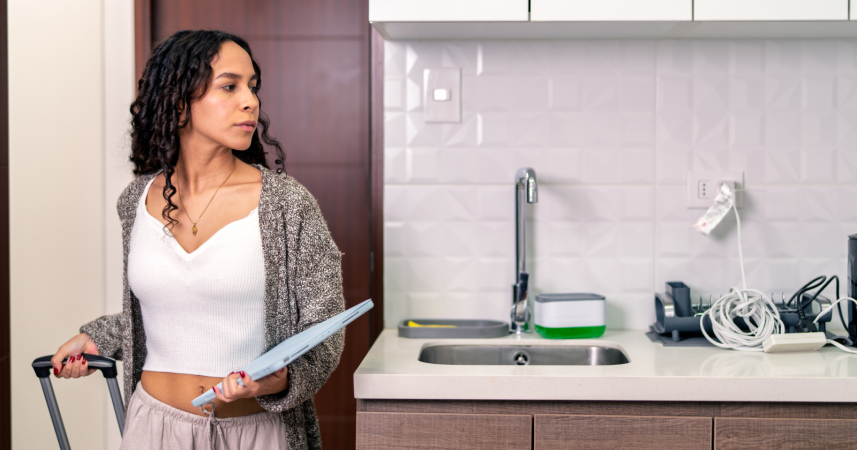
What was supposed to be a dream stay on the Amalfi Coast turned into a chaotic lesson in patience, perspective, and letting go of control. From broken plumbing to missing keys, this trip reminded me that the best personal growth doesn’t always happen in perfect places—it happens in real ones.
Something is intoxicating about planning a trip to Italy.
The promise of cobblestone streets, lazy afternoons with an Aperol Spritz, and waking up to the sound of church bells echoing across a sun-drenched piazza.
So when I finally decided to take a solo trip to the Amalfi Coast after years of work and too little rest, I wanted everything to be perfect.
I spent hours scrolling through listings, zooming in on photos of terracotta balconies draped with vines, and reading every review twice.
Eventually, I found it, the one.
The listing had five stars, a host described as “attentive but never intrusive,” and photos that looked like they’d been shot for Architectural Digest.
It was perched on a cliff, with an infinity view of the Tyrrhenian Sea and what looked like a lemon grove just below the terrace.
I could already picture my mornings there: espresso in hand, writing as the sun painted the sky pink.
Reality, as it turned out, had other plans.
When “rustic charm” means broken plumbing
It started the moment I arrived.
The host, let’s call him Marco, wasn’t there to greet me, despite assuring me he would be.
Instead, he sent a string of messages with vague instructions like “go past the restaurant and up the small path.”
The “small path” turned out to be a steep, rocky incline with no signage, no lighting, and way too many curious stray cats.
When I finally made it to the top, drenched in sweat and dragging my suitcase like a stubborn mule, the key was missing from the lockbox.
I messaged Marco again. His reply: “Ah, maybe cleaner forgot. Try again later.”
Not exactly the warm Italian welcome I had imagined.
Eventually, I got in after waiting an hour while a neighbor lent me an old key that somehow worked. The interior was different.
The walls were damp, the air smelled faintly of mildew, and the “luxury rain shower” dripped like a leaky faucet.
When I turned on the kitchen light, a family of ants scurried across the countertop like they were late for dinner.
The place had “character,” sure, but it wasn’t the kind you brag about.
The Wi-Fi password was optimism
As a writer, I can deal with a lot of things. No air conditioning? Fine. A temperamental espresso machine? Manageable. But no Wi-Fi? That’s a deal breaker.
The listing had promised “high-speed internet, perfect for remote workers.” What it actually had was a router that blinked like it was trying to send an SOS.
When I asked Marco, he told me, “It works best at night.”
That line still makes me laugh. As if the Wi-Fi was solar-powered in reverse.
I ended up tethering my phone just to check emails and send drafts. Every photo I uploaded took minutes. Every page loaded like it was 2003, and I was on dial-up again.
It made me realize how dependent I’d become on being constantly connected. There was a strange kind of withdrawal at first, like losing a limb you didn’t know you used so much.
But something unexpected happened after a few days. Without reliable internet, I started spending more time offline, reading, journaling, wandering through town.
It wasn’t convenient, but it was clarifying.
When discomfort teaches you who you are

I’ve always believed that travel is one of the best forms of self-development. Not because it’s glamorous, but because it exposes the cracks in your comfort zone.
This trip tested me in ways I didn’t expect.
I had to problem-solve constantly, how to fix a tripped breaker, how to ask for help in halting Italian, how to find the one café with decent Wi-Fi and working outlets.
It reminded me of something Ryan Holiday wrote in The Obstacle Is the Way: “The impediment to action advances action. What stands in the way becomes the way.”
That line came back to me every time something went wrong, which was often.
When the shower stopped working entirely, I filled a pot with boiled water and bathed like I was camping.
When the bed frame cracked on night three, I dragged the mattress to the floor and made it work.
It wasn’t pretty, but it taught me remarkable flexibility, the kind that doesn’t come from comfort, but from resilience.
The seductive illusion of perfection
I’ll admit it, part of what drew me to that Airbnb was the fantasy.
We live in an era of curated perfection, filtered sunsets, immaculate kitchens, and every “authentic” travel moment edited within an inch of its life.
I fell for it, hard.
Those photos had been taken from the right angles, at the right hour, with just enough saturation to make everything glow.
The truth was still there, buried between the lines of the reviews, words like “rustic,” “quaint,” and “authentic,” which, in hindsight, were polite synonyms for “rough around the edges.”
We do this not just with travel, but with life. We scroll through social media, compare our messy realities to someone else’s highlight reel, and wonder why our own experiences fall short.
That Airbnb was a literal manifestation of that illusion, a reminder that beauty online doesn’t always translate offline.
And maybe that’s the deeper lesson.
Expectations are premeditated disappointments
There’s a saying I once heard from a chef I worked with: “The more you expect, the less you taste.”
He meant it about food, but it applies to everything.
When you sit down at a meal expecting it to change your life, you miss the simple pleasure of what’s in front of you.
When you travel expecting magic, you miss the quiet lessons hidden in the mess.
My Airbnb nightmare taught me to lower my expectations, not in a cynical way, but in a freeing one.
Without the fantasy of “perfect,” there’s room for what is. For the imperfect, the unexpected, the absurd.
Like the moment I finally gave up trying to “fix” the place and instead went to the local market.
I bought fresh tomatoes, buffalo mozzarella, basil, and a bottle of cheap wine. I made a caprese salad and ate it on the terrace as the sun dipped below the sea.
The ants were still there, the Wi-Fi was still useless, but for the first time, I didn’t care.
Travel as a mirror for the mind
Here’s the thing: when you’re out of your element, everything reflects back at you.
Your habits, your control issues, your impatience, all of it surfaces.
The Airbnb wasn’t just a bad booking; it was a mirror.
It showed me how attached I was to convenience and how quickly frustration can replace gratitude when things don’t go to plan.
I started journaling about it each morning, and a pattern emerged. The more I focused on what was wrong, the more miserable I felt.
The more I let go, the more peaceful I became.
It’s cliché, but perspective really does shape experience.
By the end of that week, I’d stopped thinking of the place as a mistake. It became a kind of boot camp for patience, a crash course in finding calm within chaos.
And weirdly, I left feeling stronger for it.
But here’s the thing that surprised me most
Even after all the frustration, the broken plumbing, the missing key, the nonexistent Wi-Fi, I’d still go back to Italy in a heartbeat.
Not to that Airbnb, obviously. But to the experience itself.
Because growth rarely happens in perfect settings. It happens when things fall apart and you’re forced to adapt.
It happens when the story you planned crumbles, and a better, truer one takes its place.
I think about that trip now whenever life doesn’t go as planned.
When work gets chaotic, when relationships feel off, when the path ahead looks nothing like what I envisioned.
I remind myself, maybe this is the point. Maybe the cracks are where the light gets in.
What I learned from my Italian Airbnb disaster
Looking back, here’s what that “nightmare” really taught me.
First, control is an illusion. You can do all the research, read all the reviews, double-check every detail, and still, life will surprise you.
Second, discomfort is data. Every annoyance, every setback, every challenge teaches you something about how you operate under pressure.
And finally, gratitude isn’t about circumstances; it’s about attention. There’s beauty even in the broken, if you’re willing to look for it.
I came home sunburned, slightly traumatized, and a little wiser. But I also came back with stories worth telling, and lessons that stuck far longer than the tan.
And maybe that’s what travel, and life, is really about.
What’s Your Plant-Powered Archetype?
Ever wonder what your everyday habits say about your deeper purpose—and how they ripple out to impact the planet?
This 90-second quiz reveals the plant-powered role you’re here to play, and the tiny shift that makes it even more powerful.
12 fun questions. Instant results. Surprisingly accurate.