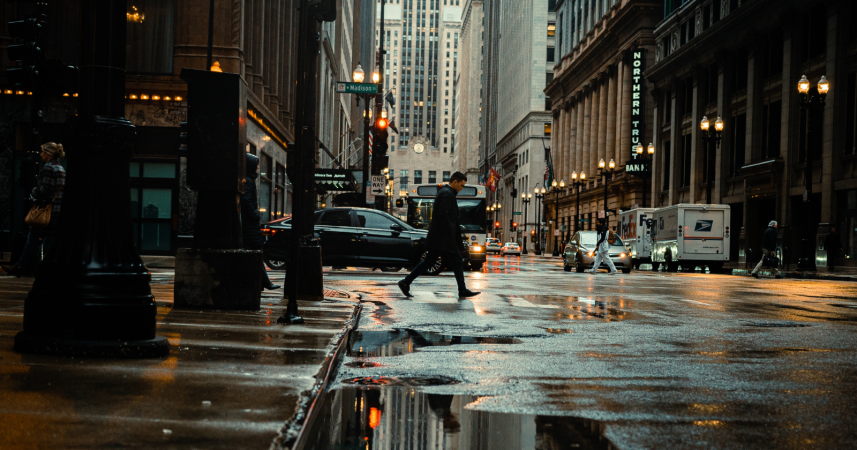
The city taught me that growth often hides inside chaos — and that sometimes the only plan you need is the willingness to see what’s possible.
I wish I could tell you I had some grand vision when I landed at JFK.
I didn’t.
I had two suitcases, a short-term sublet in a building with questionable elevators, and a vague sense that life was supposed to feel bigger than it currently did.
There’s a moment in every major move where the romanticism burns off and all you’re left with is the reality of your choices.
You hear the sirens at 3 a.m., you look at your bank account, and you ask yourself, “What exactly is the plan here?”
New York doesn’t care whether you have one.
That’s the beauty and the terror of it.
The city forced me to get honest with myself
It’s funny how you can leave an entire version of yourself behind just by getting on a plane.
I had spent years in luxury F&B, learning the rhythm of restaurant life and hiding behind the constant adrenaline of service.
You’re always moving, always responding, always needed.
It’s easy to mistake activity for direction.
New York doesn’t let you hide like that.
The city is a mirror.
A loud, chaotic, unfiltered mirror.
When you walk everywhere, when you overhear strangers’ lives on the subway, when you spend half your time waiting in line for something, you inevitably start examining your own decisions more closely.
Was I running toward something?
Or away from something?
I didn’t know yet. But the city made sure I started asking the right questions.
I learned that curiosity gets you further than confidence
Confidence gets talked about like it’s the key to everything.
But New York taught me that curiosity is what actually keeps you moving.
Every time I felt overwhelmed, I treated the city like a massive tasting menu.
Try a little here, experiment a little there, say yes before you’re ready.
That mindset came straight from my restaurant background.
Chefs don’t “know” how a dish will turn out before they test it.
They just try something, adjust, try again.
I went to networking events where I knew absolutely no one.
I wandered into restaurants alone and ate at the bar because I wanted to know how certain dishes were built.
I tried workout classes where I was clearly the least coordinated person in the room.
Curiosity kept me from shrinking.
It turned the whole city into an experiment instead of a threat.
I realized you can reinvent yourself faster than you think
There’s a strange freedom that comes with being new somewhere.
No one knows your history.
No one has expectations for who you’re supposed to be.
No one is cross-checking your current decisions against your past behavior.
For the first time in years, I asked myself what I actually wanted.
Not what made sense. Not what I thought I “should” want by a certain age. Not what my industry peers were doing.
This is one of the reasons I love reading nonfiction.
So many authors talk about self-renewal like it’s this dramatic, once-in-a-decade moment.
But when you’re living in a place like New York, reinvention is built into the culture.
Your job changes, your neighborhood changes, your circle changes.
You either evolve or you get stuck.
The city doesn’t wait for you.
And oddly enough, that’s liberating.
I stopped chasing perfection and started chasing momentum
One of the most humbling lessons New York gives you is that someone is always better, faster, smarter, fitter, or wealthier than you.
In most places, that might feel discouraging.
Here, it’s motivating.
The city has this kinetic energy that pushes you to simply start.
You quickly realize it’s pointless to wait for the “perfect” moment because someone else is already doing the thing you’re hesitating over.
When I first started writing more seriously, I would obsess over every sentence.
I would rewrite paragraphs ten times.
I thought every piece needed to sound polished and impressive.
New York cured me of that.
The city rewards momentum, not meticulousness.
You learn to put your work out there, get feedback, adjust, and keep going.
Perfection is a trap.
Momentum is oxygen.
I discovered that solitude is a skill, not a punishment
 This surprised me the most.
You would think a city with eight million people would eliminate loneliness.
Somehow, the opposite is true.
There’s a unique type of solitude that hits when you’re surrounded by constant motion that has nothing to do with you.
But learning to be alone without feeling lonely changed everything.
I explored neighborhoods solo. I tried restaurants solo.
I walked for hours with podcasts or audiobooks as my only company.
I people-watched.
I sat by the water in Brooklyn Bridge Park and let my thoughts catch up to me.
Solitude became a place to think, not a void to fill.
And once you learn that skill, you make decisions from clarity rather than insecurity.
You stop needing constant validation.
You get comfortable with your own company, which strangely makes you better at choosing who you let into your life.
I learned that your network grows when you stop trying to “network”
Here’s a paradox the city taught me: the harder you try to network, the worse you get at it.
Real connections in New York came from the most unexpected moments.
A conversation at a coffee shop while waiting for my pour-over.
A chat with a trainer at the gym who happened to know someone in publishing.
A bartender who recommended a book that later shaped a major idea I wrote about.
When you show up as a human instead of a résumé, people respond.
When you ask questions instead of trying to impress, people open up.
It’s the same principle you learn in hospitality.
You don’t win people over by forcing a performance.
You do it by being genuinely present.
I found out that resilience is built in the little choices, not the big moments
Everyone loves the dramatic stories about surviving New York.
The career pivot, the apartment disaster, the heartbreak, the big break.
But the true resilience comes from smaller, quieter choices.
Getting on the train when it’s raining and you’d rather cancel your plans.
Showing up for the freelance gig even when your savings look ugly.
Cooking a decent meal at home instead of ordering takeout because discipline matters.
Taking care of your body because you can’t chase big dreams with no energy.
These tiny decisions stack up.
They become evidence for who you’re becoming.
One of the best books I read during my first year in the city talked about identity being shaped by repeated actions.
Every small choice is a vote for the type of person you want to be.
New York taught me to cast those votes intentionally.
And finally, the city showed me that uncertainty isn’t something to fear
Uncertainty is the whole point.
Moving to New York with no plan should have been the biggest mistake of my twenties or early thirties.
On paper, it was reckless.
But in practice, it stripped away the illusion that any of us ever truly have everything figured out.
Uncertainty forces you to pay attention.
It sharpens your instincts.
It pushes you to build a life through trial and error instead of waiting for perfect clarity.
New York taught me that not knowing what comes next doesn’t mean failure.
It means possibility.
It means you’re still in motion.
It means there are chapters forming that you can’t see yet.
Conclusion
If I had waited until I had a neatly defined plan, I never would have moved here.
I never would have learned how resourceful I could be.
I never would have discovered how much I love writing about food, personal growth, and the messy process of figuring life out.
The city taught me that growth often comes disguised as chaos.
That curiosity can carry you further than confidence.
That reinvention is always available.
That solitude is strength.
That momentum beats perfection.
And that uncertainty is not the enemy.
I didn’t move to New York with a plan.
I moved here with a willingness to find out what was possible.
Turns out, that was enough.
Just launched: Laughing in the Face of Chaos by Rudá Iandê
Exhausted from trying to hold it all together?
You show up. You smile. You say the right things. But under the surface, something’s tightening. Maybe you don’t want to “stay positive” anymore. Maybe you’re done pretending everything’s fine.
This book is your permission slip to stop performing. To understand chaos at its root and all of your emotional layers.
In Laughing in the Face of Chaos, Brazilian shaman Rudá Iandê brings over 30 years of deep, one-on-one work helping people untangle from the roles they’ve been stuck in—so they can return to something real. He exposes the quiet pressure to be good, be successful, be spiritual—and shows how freedom often lives on the other side of that pressure.
This isn’t a book about becoming your best self. It’s about becoming your real self.