ChatGPT said:
Airports are strange places.
They’re designed for efficiency, but to the anxious mind, they feel like a maze of hidden triggers.
The ticking clock, the crowd’s hum, the security line that never moves—it’s a perfect storm for overthinking.
And even though most people experience some pre-flight jitters, anxious travelers operate on a different wavelength entirely.
Their thoughts spin faster. Their behaviors become rituals. Every small delay feels personal.
If you’ve ever found yourself power-walking to your gate two hours early or triple-checking your passport, you’ll probably see yourself in a few of these.
Here are ten things only anxious travelers tend to do at the airport—and what psychology says about why.
1) They arrive way too early
Let’s start with the obvious one.
For anxious travelers, getting to the airport early isn’t just about being prepared—it’s about control.
Psychologists call this anticipatory anxiety: the stress that builds in expectation of a future event.
Arriving early provides a false sense of safety. You’ve beaten the unknowns—traffic, long security lines, slow coffee baristas.
But in reality, what you’ve done is buy yourself more time to… worry.
I used to be that person sitting at the gate three hours before boarding, pretending to read but actually calculating backup plans in my head.
Eventually, I realized that no amount of buffer time could quiet an anxious mind that doesn’t trust the process.
2) They check their passport or ticket every five minutes
You know that moment when your brain convinces you your passport has vanished from your bag, even though you just looked at it thirty seconds ago?
That’s classic compulsive reassurance-seeking, a behavior linked to anxiety. Your brain doesn’t trust memory alone—it needs physical proof, over and over again.
According to the Anxiety and Depression Association of America, people with high anxiety often perform repetitive behaviors to temporarily relieve tension.
Unfortunately, the relief doesn’t last long.
So the cycle repeats: unzip bag, check passport, exhale, rezip, doubt self, repeat.
3) They overanalyze the security process
To the average traveler, airport security is an inconvenience.
To the anxious traveler, it’s a psychological obstacle course.
They rehearse what to take off, when to grab bins, how to arrange electronics, and silently hope the TSA agent doesn’t ask a trick question.
This tendency stems from hypervigilance, the heightened state of scanning for potential threats or mistakes. It’s a common symptom of anxiety, rooted in the brain’s survival wiring.
You’re not being dramatic when you feel your pulse race in the security line—you’re reacting to what your mind perceives as possible danger.
4) They avoid eating before the flight
Many anxious travelers skip food altogether. They tell themselves, “I’ll eat on the plane,” but deep down, it’s about control again.
The gut and brain are tightly linked, and when you’re anxious, your body shifts blood flow away from digestion and toward muscles and alertness.
That’s why your stomach feels tight or unsettled in stressful situations.
Some people fear nausea. Others worry that eating will make them sluggish or “off.”
But here’s the irony—skipping food often makes anxiety worse because it lowers blood sugar and intensifies jitteriness.
The fix? Eat light but don’t starve yourself. A banana and water will serve you far better than an empty stomach full of nerves.
5) They keep rehearsing what could go wrong
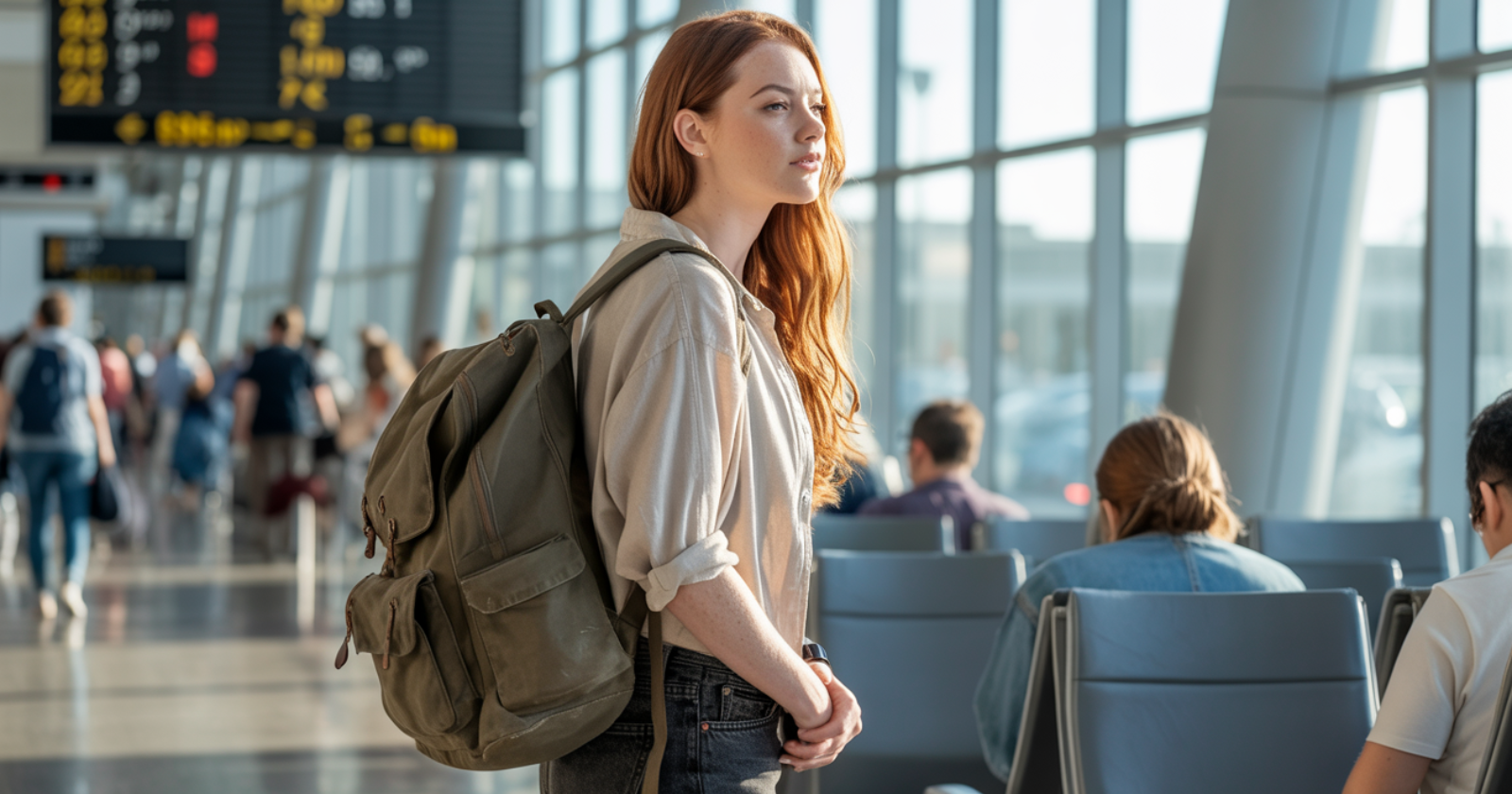
The anxious traveler is a professional catastrophizer.
They’ve already imagined every worst-case scenario: missing the flight, sitting next to a screaming toddler, turbulence so bad it feels cinematic.
This comes from cognitive distortion, specifically “fortune-telling”—the tendency to predict negative outcomes without evidence.
Our brains evolved to anticipate danger as a survival mechanism. The modern problem? Airports aren’t tigers.
But your amygdala doesn’t know that. It’s frightening as if your life depends on whether your carry-on fits in the overhead bin.
6) They can’t relax at the gate
Here’s the paradox.
Even when everything goes right—security was smooth, the boarding pass scanned fine, the flight’s on time—the anxious traveler still can’t relax.
They’ll sit rigidly, eyes darting between the boarding monitor and their phone every sixty seconds.
Maybe they’ll get up to “stretch” but really just recheck the gate number.
Psychologists refer to this as intolerance of uncertainty. It’s the discomfort that comes from not being in control of what happens next.
An anxious mind craves predictability. But airports are the opposite—full of unknowns, delays, and last-minute changes.
So you stay on high alert, mistaking vigilance for preparation.
7) They constantly compare themselves to calm travelers
This one’s sneaky.
You see that person casually sipping coffee, scrolling their phone, totally unfazed—and your inner critic flares up.
“Why can’t I be like that?” you think. “What’s wrong with me?”
According to psychologist Kristin Neff, this self-judgment loop only amplifies anxiety. Her research on self-compassion shows that people who treat themselves with kindness in moments of stress actually calm their nervous systems faster.
So the next time you find yourself envying that relaxed traveler, remember: calm isn’t a competition. You’re allowed to feel uneasy.
It doesn’t make you weak—it makes you human.
8) They pack “just in case” items they’ll never use
If your bag is half first-aid supplies and backup chargers, you’re not alone.
Anxious travelers often overpack because uncertainty triggers a need for control.
It’s why you bring four chargers, two neck pillows, and snacks for a seven-hour flight.
It’s not just about practicality—it’s about soothing an internal fear that something might go wrong and you won’t be ready.
Here’s the catch: the more you rely on safety behaviors, the more your brain believes danger is real.
True peace comes not from over-preparing, but from trusting you can handle whatever happens.
9) They rehearse their responses to tiny interactions
Ever practiced what to say at the check-in counter or worried about sounding “weird” when ordering coffee at the gate?
That’s social anxiety sneaking in. It’s not always about the flight—it’s about being perceived as awkward or incompetent in public settings.
Airports heighten this because everything feels like a performance. You’re being watched, scanned, and assessed at every step.
But here’s what helps: remembering that everyone else is too absorbed in their own world to notice yours.
The person behind you in line isn’t judging your tone—they’re wondering if their bag is overweight.
10) They need post-boarding reassurance
And finally, even after sitting down on the plane, anxious travelers aren’t fully at peace.
They check the overhead bin to make sure their bag is still there. They glance at the flight attendants’ faces, scanning for signs of calm or concern.
This behavior ties back to emotional contagion, a term in psychology describing how we subconsciously mirror others’ emotions.
When the crew seems composed, you feel grounded. When turbulence hits and they stay calm, you breathe again.
It’s a subtle reminder that anxiety thrives on uncertainty—but it also responds to steady energy.
The bigger picture
Here’s the thing: anxiety at the airport isn’t really about airports.
It’s about control, uncertainty, and the brain’s attempt to protect you from perceived chaos.
Psychologists often say anxiety is the price we pay for imagination. The same mind that dreams big also catastrophizes.
It visualizes problems before they happen, thinking it’s keeping us safe.
The goal isn’t to eliminate anxiety—it’s to recognize it. To notice when your rituals cross the line from helpful to obsessive.
To remind yourself that control is comforting, but not necessary.
Airports, in many ways, are life condensed. You plan, you prepare, you get thrown curveballs—and you adapt.
So maybe that’s the real lesson for anxious travelers: it’s not about never worrying again. It’s about learning that you can handle the worry when it comes.
And sometimes, that realization alone is enough to make the journey a little lighter.