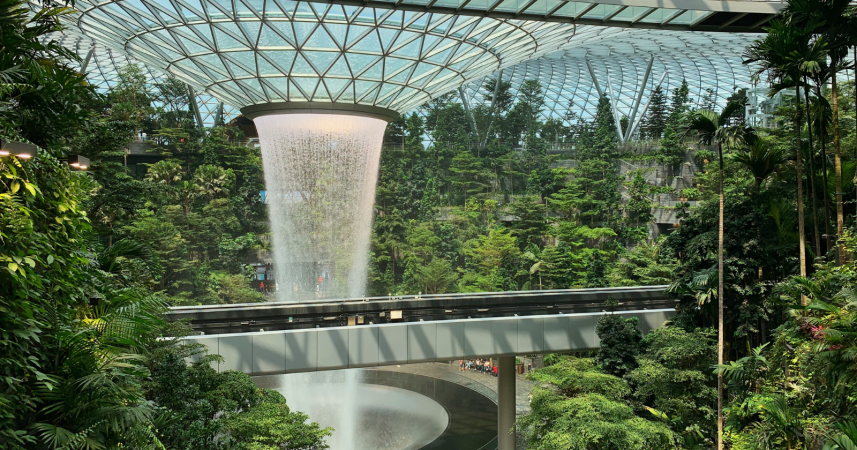
Six months in Singapore showed me that behind the spotless skyline lies a sweaty, rule-bound maze of malls, migrant stories, and silent social fines.

Add VegOut to your Google News feed. 
I arrived at Changi with every influencer cliché rattling in my carry-on: spotless streets, hawker-stall heaven, a skyline so glossy it could double as a phone commercial.
And to be fair, all of that is real.
But spend half a year here—sweating through MRT commutes, making friends outside the expat bubble, paying rent that costs more than some U.S. mortgages—and you start to see seams in the immaculate fabric.
This isn’t a hit piece. I still love Singapore in the way you love a puzzle that never fully solves. But beneath the headlines—“Cleanest city-state in the world,” “Asia’s financial powerhouse,” “Fine city (pun intended)”—lies a more complicated, often un-Instagram-able reality. Here’s the version I discovered between my first kaya toast and my last feverishly spicy bowl of laksa.
The heat isn’t just hot—it’s psychological
Travel blogs warn you about the humidity. They don’t tell you your entire wardrobe philosophy will collapse in week two.
I tried the standard hacks: linen shirts, midday showers, power banks for pocket fans. Nothing prepared me for the moment my laptop literally shut down on a café patio because the aluminum chassis reached “I-could-fry-an-egg” temperatures.
Locals cope by darting from mall to mall—air-conditioned tunnels connect half the downtown. But if you’re determined to “see the real Singapore,” you’re going to sweat. And with each damp shirt you’ll realize why indoor culture here is so strong: the climate herds you into polished, fluorescent comfort. It’s less an invitation and more an ultimatum—embrace the malls or melt.
Hawker centres are cheap—until they aren’t
Hawker food gets billed as budget heaven, and if you stick to kopi O and chicken rice, it is. But six months in, monotony sets in, and you start scanning menus for vegetables that aren’t boiled cabbage or token cucumber slices. Suddenly you’re paying café prices for quinoa bowls in Tiong Bahru or craft coffee in Robertson Quay.
My grocery bill also shocked me. Most produce is imported, so blueberries can run eight U.S. dollars a punnet. I once paid the equivalent of $14 for three bell peppers because I’d promised to make fajitas for friends. Lesson learned: cook local or be prepared for sticker shock that rivals Manhattan.
Those spotless streets come with unwritten rules
Yes, Singapore fines you for littering, jaywalking, chewing gum. That part’s old news. What caught me off guard were the social fines—the nod-nod, wink-wink taboos no brochure spells out.
Talking politics in a group setting? You’ll notice people lower their voices and glance around.
Public displays of frustration—yelling at a taxi driver, for instance—earn you instant side-eye.
Even standing on the wrong side of an escalator (left if you’re not walking) sparks a chorus of passive-aggressive throat clears.
It’s social engineering at scale. The payoff is a city that runs smoother than any I’ve seen. The trade-off is you carry an invisible rule book in your head, always wary of flipping to the wrong page.
Diversity is real—and complicated
On paper, Singapore is a multicultural success story. You’ll see Hindu temples next to mosques next to Buddhist shrines. You’ll eat prata for breakfast, nasi lemak for lunch, and dim sum for dinner.
But scratch the surface and the caste lines appear. Migrant workers from Bangladesh and India live in dormitories far from the glass towers they build. Domestic helpers, mostly Filipino and Indonesian women, get their own seating sections on Sunday ferry rides to Batam—an unspoken reminder of class hierarchy.
I volunteered with a group that ran English classes for construction workers. Hearing their stories—ten-hour shifts, six-day weeks, passports held by employers—reshaped my definition of the “Singapore dream.” The city glitters, but some people polish that shine from the shadows.
Public housing isn’t the backup plan—it’s the plan
Eighty-plus percent of citizens live in HDB flats. From afar, they look utilitarian—pastel Lego bricks stacked to the sky. Up close, they contain multitudes.
My local friend Alex invited me to his family’s four-room in Ang Mo Kio. The elevator opened on a long corridor dotted with offering altars, shoe racks, and the occasional stray cat napping on a welcome mat. Inside, it felt like any middle-class home: Netflix on a wall-mounted TV, IKEA furniture, the smell of garlic and soy sauce lingering from dinner.
HDBs taught me community can be engineered. Each block has void decks—open ground-floor areas for weddings, funerals, chess tables. Laundry poles stretch out like urban flags, mapping each family’s color palette. It’s public housing, yes, but also a lived mosaic you won’t glimpse from a rooftop bar.
Nature hides in elevator-length distances
Google “Singapore attractions” and you’ll get Gardens by the Bay and the cloud forest dome. They’re spectacular—and air-conditioned. But the soul of Singapore’s green life is sweaty, muddy, and buzzing at 6 a.m.
MacRitchie Reservoir’s treetop walk gave me my first wild monkey encounter (tip: secure your snacks). Cycling the park connectors after a tropical downpour smelled like someone unfurled a giant lime leaf over the island. Even tiny neighbourhood parks host monitor lizards the size of toddlers.
The city’s branding as a “garden metropolis” isn’t marketing spin; it’s strategy. Urban planners weave green corridors between HDB clusters, so a three-minute stroll can shift you from concrete to canopies. You rarely see that on tourist reels because, well, it’s hard to glamorize mosquitoes on Instagram.
Loneliness travels light—even here
Singapore ranks high on global livability indexes, but nobody tells you how transient the social scene feels. Expats cycle in and out with two-year contracts, students fly home after semesters, locals juggle national service, family obligations, and tireless career climbs.
Making friends felt like speed-dating. You swap WhatsApp handles at a networking night, grab laksa once, then realize they’re relocating to Hong Kong next quarter.
Around month four, I found community in a mixed martial arts gym above a hardware store. Shared sweat forged bonds tourist bars didn’t. If you’re planning a stay, anchor yourself in an interest group fast or risk floating through surface-level hellos.
Speaking English doesn’t mean speaking the same language
Officially everyone speaks English. Unofficially you’ll hear Singlish—a rapid-fire blend of English, Malay, Hokkien, and a sprinkle of onomatopoeia (lah, sia, lor).
First week, a kopi stall uncle asked, “You makan already or not?” I smiled blankly until he switched to textbook English: “Have you eaten yet?” Another time someone responded “can” to my long explanatory text, leaving me unsure if that meant yes, maybe, or why are you still talking.
Learning to love Singlish became a milestone. It’s musical, efficient, and signals you’ve stepped off the tourist path. When I finally used “lah” unironically and nobody laughed, I knew I’d leveled up.
The future is here—and it’s a little eerie
Cashless everything. Delivery robots in Punggol. Facial recognition immigration lanes. Efficiency is intoxicating until you realize you haven’t handled physical money in weeks and the government can tell which hawker stall you frequent most.
Privacy debates feel muted here—people trade data for convenience without much fuss. But as someone who still carries a notebook to brainstorm offline, the city’s seamless tech sometimes felt like velvet handcuffs.
A local friend summed it up: “In Singapore, the state is the parent. We’re well taken care of, but we all share the same living room.” That comfort comes with CCTV eyes on every block.
Leaving taught me what stayed
When my six months ended, I packed more than souvenirs. I left with stricter recycling habits (bin systems here leave no excuse), a newfound respect for order (you arrive on time or don’t bother), and a deeper skepticism of shiny narratives.
Because the truth is, every city sells a brand. Singapore’s brand—clean, safe, futuristic—isn’t fake. It’s just incomplete. And maybe that’s the point. Perfection invites scrutiny; nuance invites belonging.
If you visit, marvel at Marina Bay Sands at sunset. But also wander a wet market at dawn, where fish guts hit concrete and grannies haggle over choy sum. That’s the Singapore no one prints on postcards—but it’s the one that changed me the most.