Some places don’t just take you off the map—they strip away the noise and remind you what solitude really feels like.
Some people crave city lights, the constant hum of traffic, and an endless list of social events.
And then there are the rest of us—the ones who sometimes want nothing more than to disappear for a while.
If you’ve ever fantasized about booking a one-way ticket just to escape the noise, you’ll know what I mean.
Solitude isn’t loneliness. It’s a form of nourishment. It’s the mental equivalent of letting a good wine breathe before pouring a glass.
I’ve found that certain destinations practically demand you slow down and embrace being alone. They aren’t just remote; they’re soul-restoring.
Here are ten places that always seem to call to people who crave real solitude.
1. Svalbard, Norway
Ever thought about what silence actually sounds like? On the Arctic archipelago of Svalbard, you’ll find out.
There are more polar bears than people here, and the raw beauty of glaciers, icy fjords, and midnight sun or polar night makes it feel otherworldly.
It’s not just the isolation—it’s the humility it teaches. Standing under the northern lights in negative 20-degree weather, you realize how small you are.
And weirdly, that’s comforting.
2. The Faroe Islands
Wedged between Iceland and Norway, the Faroe Islands feel like a real-life desktop wallpaper—green cliffs dropping into crashing seas, sheep outnumbering humans.
Tourism is growing here, but wander off the main village roads and you’ll have trails and vistas to yourself.
I remember sharing a single cup of coffee with a local fisherman who told me, “The land shapes us more than we shape it.”
That’s the kind of perspective you don’t get at a Starbucks.
3. Patagonia, Chile and Argentina
Patagonia is vast, rugged, and wild in a way that strips you down to essentials. Think windswept plains, jagged peaks, and lakes the color of turquoise glass.
This is where solitude becomes an endurance test. Hiking Torres del Paine for days with only the sound of your boots crunching ice? It forces you inward.
Psychology Today talks about “awe therapy”—the way exposure to massive natural beauty can lower stress and foster humility. Patagonia is the poster child for that.
4. Bhutan
Bhutan isn’t just remote geographically—it’s spiritually removed from the chaos most of us live in. The country measures progress in Gross National Happiness instead of GDP.
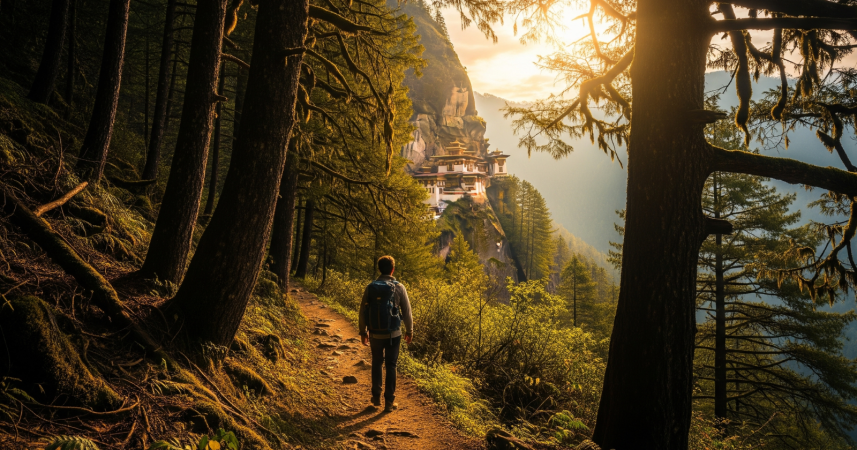
Hiking up to the Tiger’s Nest Monastery, you pass through forests where the silence feels almost curated.
It reminded me of something I read in Rudá Iandê’s book Laughing in the Face of Chaos:
“You have both the right and responsibility to explore and try until you know yourself deeply.”
Bhutan makes that exploration feel not just possible, but essential.
5. The Scottish Highlands
There’s something raw and poetic about the Highlands. Mist clings to rolling hills, ruins dot the landscape, and lochs stretch into the horizon like mirrors.
Writers have always flocked here for inspiration. I get why. The Highlands remind you that solitude doesn’t have to be lonely—it can be a collaboration with history, myth, and nature.
Sitting in a stone cottage with rain pelting the windows, you start to hear your own thoughts more clearly.
6. Mongolia’s Gobi Desert
The Gobi isn’t the postcard desert of endless dunes. It’s rocky, harsh, and alive with subtle details—a wild horse on the horizon, the taste of salty air at night.
Mongolian nomads still live as they have for centuries, and sharing a simple meal inside a ger (a traditional yurt) with a family who speaks no English was one of the most grounding experiences I’ve ever had.
Their happiness didn’t come from distractions or possessions. It was presence, plain and simple.
7. The Azores, Portugal
For a taste of solitude without going full survivalist, the Azores strike a balance. These volcanic islands in the Atlantic are lush, full of crater lakes, hot springs, and waterfalls—but still off the radar compared to mainland Europe.
Rent a small car, roll down the windows, and drive winding coastal roads with no destination in mind.
Sometimes solitude isn’t about disappearing into the wilderness—it’s about giving yourself permission to be aimless.
8. Alaska’s Denali National Park
Alaska has a way of making you feel like you’ve stepped back a few centuries. Denali’s six million acres of wilderness are home to moose, wolves, and grizzlies, with just one road cutting through.
When I was there, I went nearly two days without seeing another person. At first, it was unsettling. Then it became liberating.
Research shows that intentional solitude can significantly boost creativity and self-awareness, offering mental clarity most environments simply don’t.
9. The Lofoten Islands, Norway
These islands are rugged fishing villages surrounded by steep mountains and Arctic waters. The combination of red cottages, sharp peaks, and icy blue seas is like a living painting.
I kayaked here in almost total silence except for the dip of paddles. The rhythm was hypnotic.
Sometimes that’s what solitude is—a cadence that pulls you back to yourself, away from the chaos of buzzing phones and endless notifications.
10. Easter Island, Chile
Finally, Easter Island—a speck of land in the middle of the Pacific, known for its massive moai statues.
Standing face-to-face with one, I felt both connected and detached.
It’s a reminder that humans leave marks, but time swallows everything eventually. Solitude here isn’t just about space; it’s about perspective.
We’re all just passing through, and that’s strangely reassuring.
The bottom line
The common thread in all these places isn’t just their remoteness.
It’s what they give you: a chance to reset, to question, to listen to your own thoughts without interruption.
Solitude isn’t something to fear—it’s a tool. It’s the pause button modern life rarely gives us.
And while you don’t have to trek across Patagonia or freeze in Svalbard to find it, these places remind us what’s possible when we step away.
Maybe that’s the true gift of remote destinations: they don’t just give us space from others—they give us permission to be fully ourselves.