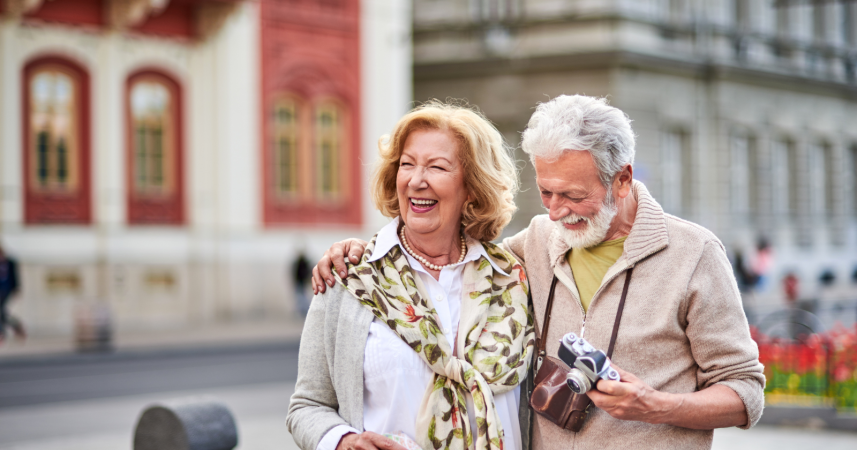
Travel isn’t just about where you go—it’s about finding places that help you feel more like yourself.
When my dad finally retired, he didn’t celebrate with a gold watch or a backyard barbecue. He booked a flight to Lisbon.
At first, I thought he was chasing weather—the kind of sunshine that nudges you into a nap whether you like it or not. But after a few weeks, he called me and said something that’s stuck: “I’m not just walking more, I feel like I belong to something again.”
This piece isn’t about listing postcard-perfect cities. It’s about unpacking what travel gives us—especially in the second act of life. And why more boomers are choosing places that give them a sense of movement, connection, and wholeness—not just scenic backdrops.
As Rudá Iandê writes in Laughing in the Face of Chaos,
“Peace comes from belonging—from allowing every part of ourselves to take its rightful place in the whole.”
Let’s talk about cities that do just that.
1. Lisbon, Portugal
For: Scenic walking, slow mornings, and sunny soul expansion
Lisbon is what happens when a city learns to exhale. Cobblestone streets wind like curious thoughts, and trams click by like time unbothered.
For boomers, it’s the walkability that wins—but more than that, it’s the rhythm. You get to move with the day instead of racing it.
Healthline notes that people who walk more could gain up to 11 years of life. And when your daily walk includes a stop for fresh pastries and the Atlantic breeze? That’s medicine without the bitter pill.
2. Kyoto, Japan
For: Reverence, reflection, and timeless routine
There’s something about Kyoto’s stillness that invites your own thoughts to stretch out and sit beside you. Gardens aren’t just pretty—they’re meditative paths disguised as scenery.
In a world that rewards noise, Kyoto gives silence the upper hand. A morning stroll here is like a daily tea ceremony for your nervous system.
3. Medellín, Colombia
For: Connection, community, and the art of surprise
Medellín has reinvented itself more times than a midlife career-changer. It’s bright, buzzy, and booming with optimism. The outdoor escalators aren’t just cool infrastructure—they’re symbols of accessibility and inclusion.
Seniors here don’t just stay active, they stay involved. And as the Stanford Post points out, older adults who volunteer regularly experience lower depression and enhanced cognition.
4. Ljubljana, Slovenia
For: Clean air, green spaces, and easy elegance
This might be Europe’s most lovable capital. No cars in the city center. A river that seems to know it’s photogenic. Cafés where you can sit for hours without being nudged by a check.
It’s the kind of place where solitude feels generous, not lonely.
5. Santa Fe, New Mexico
For: Artistic revival and soulful landscapes
Santa Fe doesn’t try to be anything other than what it is: textured, creative, slow. It’s like a jazz song that starts mid-riff and dares you to follow.
If you’re wondering who you are without the busy calendar, this city answers back, “Let’s paint our way to it.”
As noted by Dr. Patricia Boyle, having a sense of purpose—through hobbies or part-time work—is directly linked to longevity.
6. Tallinn, Estonia
For: Digital ease, medieval magic, and modern calm
Tallinn is like your most tech-savvy grandkid—but dressed in a hooded cloak from the 1400s. It’s a city where free Wi-Fi meets cobblestone mystery.
It reminds us that aging doesn’t mean opting out of innovation—it’s just learning how to hold both a Kindle and a compass.
7. Victoria, British Columbia
For: Gardens, sea air, and gentle reinvention
Victoria is where florals flirt with fog. It’s full of bookstores, harbor views, and just enough mystery to keep your inner poet awake.
If aging is a sentence, Victoria makes sure it’s written in cursive.
8. Chiang Mai, Thailand
For: Wellness, warmth, and the joy of slow discovery
Chiang Mai has massage schools on every corner and meals that cost less than your average podcast subscription. But more than affordability, it offers a sense of holistic well-being.
As Dr. Laura Carstensen at Stanford has noted, aging can actually bring more emotional richness—not less. And a place like Chiang Mai supports that shift with gentle daily rituals.
9. Ghent, Belgium
For: Bike rides, art walks, and chocolate-fueled curiosity
Less touristy than Brussels, quirkier than Bruges—Ghent is for people who don’t need to be seen, but want to feel something. Art isn’t just in galleries, it’s in the way a grandmother sweeps her stoop or a stranger hands you a map like it’s a secret.
It’s one of those places where you remember how good it feels to not know what’s next.
10. Oaxaca, Mexico
For: Flavor, celebration, and cultural depth
Oaxaca doesn’t do surface-level. From mole to mezcal to mural art, everything here is layered. And that richness mirrors something inside many boomers—this desire to taste life, not just nibble at it.
According to the Mayo Clinic, staying socially active improves emotional and cognitive health in older adults. And Oaxaca’s built-in festivals and community rhythms make connection easy—and fun.
11. Ljubljana again? No—anywhere you feel like your whole self
Okay, this one’s a cheat. But maybe the most important.
Because the truth is, “travel-friendly” isn’t just about bike lanes and mild weather.
It’s about emotional oxygen. It’s about landing somewhere and realizing you don’t have to shrink, hustle, or explain. You just are.
That’s why so many boomers are choosing cities not just to visit—but to feel alive in.
Final words: travel as a portal, not a pause
The older we get, the more we realize life isn’t a race—it’s a series of rooms. Some are loud and cluttered. Others are still, full of space.
Travel, especially in this chapter, isn’t an escape. It’s a form of inner architecture. A chance to build rooms where we want to sit and stay.
It helps us return to the parts of ourselves we may have tucked away for years—the parts that linger over coffee, strike up conversations with strangers, or feel giddy figuring out a metro map.
These cities aren’t just places to visit. They’re mirrors. Maps. Invitations to live with more ease, more meaning, and a renewed sense of choice.
So whether you’re drawn to the cobblestones of Lisbon or the canyons near Santa Fe, maybe you’re not chasing something new.
Maybe you’re just returning to something true.