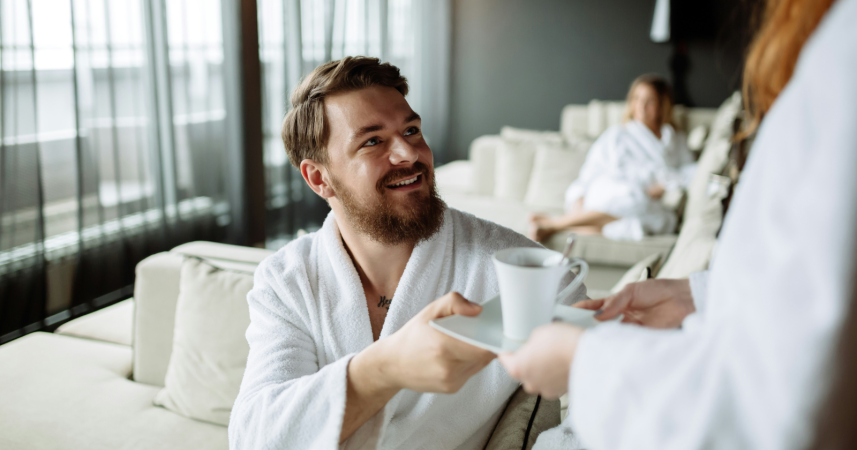
Real care shows up in clean corners, soft doors, and a front desk that notices the mood, not just the ID.
I have a theory about hotels. You can tell the whole story within the first 15 minutes, before you even unpack your toothbrush.
It’s in the little things. The hello, the way the room smells, the speed of a solution when something goes wrong.
I’ve slept in no-frills roadside spots and in glossy towers with marble lobbies. What separates them most clearly are nine small behaviors that show up over and over.
It's all about attention, respect, and rhythm. This also translates to how we treat people in daily life. Because the habits that make a hotel feel elevated are the same habits that build trust anywhere.
Let’s get into it.
1. The welcome sets your nervous system, not just your bags
How a hotel receives you sets the tone for your entire stay.
In basic stays, I’m often met with a quick check of the ID and a point toward the elevator.
Efficient, yes, but it leaves me floating. In better-run places, the greeting slows my pace. Someone meets my eye, uses my name naturally, and makes a micro observation like, “Long travel day?”
Then they offer water or a seat while they do the admin.
When we flew to Santiago to visit family, we arrived with a sleepy toddler and three pieces of luggage that looked like they contained a small kitchen.
The front desk saw us coming and quietly rolled over a luggage cart. No announcement. Just a human noticing and helping. That is skill.
As Maya Angelou said, “People will never forget how you made them feel.” I think about that each time a welcome either steadies me or keeps me rushing.
2. Names and preferences are used like memory, not like a script
In budget stays, I usually hear “ma’am” or nothing at all.
In luxury stays, the team remembers names and threads them into moments that matter.
The difference is not just remembering, it’s using the memory to reduce friction. On our second morning in a Sheraton Rio hotel, the host said, “Bom dia, Ainura. Window seat again?”
That tiny sentence saved me from asking, and it made breakfast feel like a continuation, not a restart.
The same goes for preferences. If you ask for an extra blanket once, the best teams set the room that way the next day. They write it down somewhere, sure, but they also act on it. That is what real care looks like. It’s the habit of closing loops.
3. Problems are handled at the speed of trust
Things go wrong everywhere. The real test is how the team responds.
The better hotels fix issues quickly and follow up without making you retell the story.
In budget places, I’ve had to call three times about a broken crib or a noisy vent. In the nicer ones, someone arrives with a toolkit in five minutes and another person calls later to check that the baby finally slept.
Danny Meyer captured it well: “Service is the technical delivery of a product. Hospitality is how the delivery of that product makes its recipient feel.” The hotels that get this right treat the solution as an opportunity to deepen the relationship, not an interruption in their shift.
4. Clean corners tell the truth
Anyone can make a bed look crisp. The difference shows up in corners and edges.
I look at grout lines in the shower, the underside of the faucet, the gap between the safe and the shelf.
In budget stays, these places often hold dust or a hint of mildew. In better ones, there’s a mild, neutral scent and every hard-to-reach edge is thought through.
I travel with a curious toddler. She will find the single paperclip under the sofa. Good cleaning is partly about hygiene, but it’s also about psychology.
When corners are cared for, I relax. My mind stops scanning for what else was missed. That calm is worth more than a fancy lobby.
5. Sound is treated like part of the design
Noise control is a quiet luxury. I learned this after a series of work trips where I woke up to hallway chatter at 6 a.m.
The most thoughtful properties manage sound like lighting. Doors close softly. Housekeeping carts are padded. Elevators are positioned away from rooms.
There is a consistent hum, not random bangs.
In budget stays, you often hear the plumbing symphony from three floors. In elevated stays, you sleep as if the building is protecting you. As a mom who values routines, solid rest is the real treat.
If I’m in a hotel where my daughter can nap easily, that stay feels twice as valuable.
6. Bed setup shows if someone cares about how your body feels
Sheets matter. So do pillows that don’t crumple into nothing at 3 a.m.
The standout hotels layer comfort without showiness. They use breathable materials, give you an extra pillow without asking, and keep the mattress at that supportive-but-forgiving place that avoids back pain.
In basics-only spots, I often see the opposite. Heavy synthetic duvets that trap heat. Pillows that are either rock-hard or marshmallows.
One quick test I use is the bedside lighting. In better rooms, I can read without lighting up the entire space. There’s a switch I can find in the dark. The light is warm, not blue.
Thoughtful sleep is a cascade of small decisions that say, “We want you to wake up well.”
7. Food and beverage choices respect different bodies and beliefs
I’m not vegan, though half my close friends are. When a hotel treats plant-based options as a normal default, I notice.
There’s oat milk at breakfast without having to ask. A protein-rich plant entree that’s not just pasta. In everyday places, you still see the tired salad-without-the-cheese as the only choice.
That sends a message about who they planned for.
I love when late-night room service has something simple and nourishing instead of only fries. I also look for water that is easy to access and refill. The best hotels make good hydration effortless. You feel taken care of before you even realize you were thirsty.
8. Follow-through is consistent from start to finish
In some stays, I’ll ask a question at check-in and never hear back.
In the better ones, the answer arrives with more than I asked for. “You wanted a taxi at 7. We booked it. Also, traffic is heavy today, so we set it for 6:45 and can adjust if needed.”
That kind of initiative is the real differentiator.
I travel with a tight daily system so our family can have quality time in the evenings. When a hotel respects that rhythm, I feel partnered rather than managed.
They text a concise update when the laundry is done. They leave a note if the playground nearby is closed for maintenance and suggest a park with more shade. If a team can anticipate once, they can usually anticipate again. That pattern compounds.
9. The goodbye lingers in the best way
The last five minutes are as important as the first. In budget stays, checkout is transactional. In better ones, there’s a sense of closure.
A real thank you, a quick glance to make sure nothing is left behind, a short wish for your next stop. They may send a follow-up message asking if anything could be improved. Not a long survey, just a clean question.
I remember checking out of a small hotel in the south of Chile. The receptionist had noticed my daughter’s love for the hotel’s wooden duck at the play corner.
She handed us a tiny duck keychain and said, “For her travel backpack.” That was the cheapest “amenity” of the entire trip. It’s also the one we still talk about.
Ritz-Carlton’s famous credo captures this focus on dignity: “We are ladies and gentlemen serving ladies and gentlemen.” Titles aside, the spirit is what counts. Mutual respect elevates every interaction.
What this taught me about daily life
When I pay attention to these behaviors, I learn a lot about my own habits at home.
Do I greet my family in a way that calms them or speeds them up? Do I use people’s names with care? Do I fix problems in a way that builds trust or just checks a box?
I’m a believer in routines because they let me be present for what matters. The best hotels do the same. They run on quiet systems that carry the load so guests can relax into the moment. That is what I try to build at home. A simple dinner plan, a consistent bedtime routine, a tidy living room after the baby sleeps. Small choices that make our life feel more spacious.
Travel also sharpens my lens for value. I don’t need a chandelier to feel well cared for. I need clean corners, natural kindness, and solutions that move at the speed of my day. Those are the behaviors I’m willing to pay for. Those are also the behaviors I try to practice with others, from the barista downstairs to my own kid learning to push her limits safely.
When I catch myself cutting corners, I remember the quiet confidence of a great front desk. No theatrics. Just presence and competence. That is what elevates any space, hotel or home.
A quick checklist you can use on your next stay
- Notice the welcome. Did your shoulders drop a little?
- Look at the corners, edges, and grout
- Listen to the hallway and doors at night.
- Scan the bedside setup and lighting.
- Check how quickly a small issue gets solved.
- See if water and plant-forward options are easy.
- Pay attention to follow-up.
- Watch how they use your name and preferences.
- Evaluate the goodbye. Do you feel complete?
These little signals tell a big story. Once you start noticing them, you can’t unsee them. The good news is you can also re-create them in your own life.
Better hellos. Faster fixes. Kinder goodbyes.
That is the real luxury.
Just launched: Laughing in the Face of Chaos by Rudá Iandê
Exhausted from trying to hold it all together?
You show up. You smile. You say the right things. But under the surface, something’s tightening. Maybe you don’t want to “stay positive” anymore. Maybe you’re done pretending everything’s fine.
This book is your permission slip to stop performing. To understand chaos at its root and all of your emotional layers.
In Laughing in the Face of Chaos, Brazilian shaman Rudá Iandê brings over 30 years of deep, one-on-one work helping people untangle from the roles they’ve been stuck in—so they can return to something real. He exposes the quiet pressure to be good, be successful, be spiritual—and shows how freedom often lives on the other side of that pressure.
This isn’t a book about becoming your best self. It’s about becoming your real self.