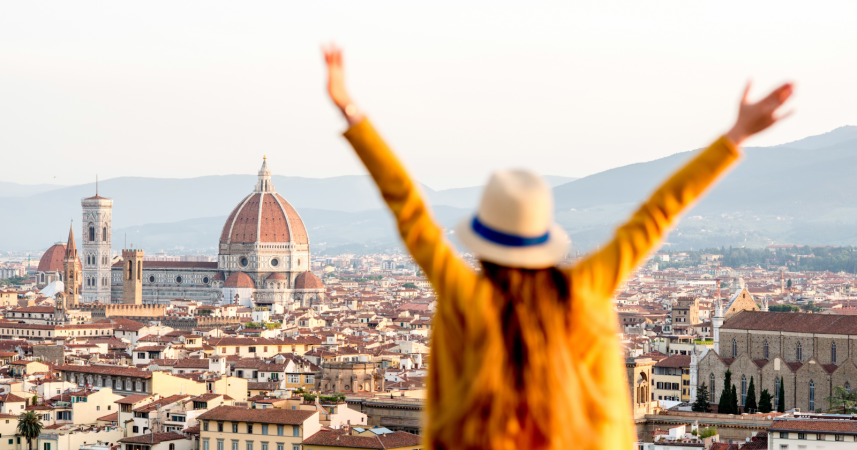
Some of us feel most rested when we’re learning something new on a crowded street.
If you give me a skyline over a shoreline nine times out of ten, same.
Here’s what I’ve noticed about people like us—city-choosers who feel more alive weaving through neighborhoods than reclining under umbrellas.
It’s not just taste; it hints at who we are and how we move through the world. I’m writing this for the curious self-observers and practical optimists who want to understand the psychology behind that choice.
Here’s how I see it, based on years of watching my own habits and talking to fellow urban diehards .
1. Urban curiosity
Cities reward curiosity.
If you always choose a city, there’s a good chance you crave novelty—new cafés, new side streets, new faces on the subway.
Marvin Zuckerman once defined sensation seeking as “the seeking of varied, novel, complex, and intense sensations and experiences, and the willingness to take physical, social, legal, and financial risks for the sake of such experience.”
That matches the micro-risks we take in cities every day: hopping on a bus to a neighborhood we’ve never seen, ordering the weird special, committing to a last-minute gallery opening.
I’m not saying this makes beach people uncurious. It’s more that urban environments offer a dense buffet of stimuli, and some of us love sampling everything.
If your brain lights up at the sound of three languages in one coffee line, you’re probably high in this trait.
2. Openness
Look at your travel photos. Are they filled with street art, markets, and clashing textures?
That’s openness—comfort with complexity, ambiguity, and ideas that might contradict each other.
Cities compress difference into a few square blocks. You pivot from a temple to a techno club to a tofu stall in an afternoon.
For some folks, that’s chaos. For others, it’s fuel. When you default to cities, you’re signaling a willingness to let the world be bigger than your current mental model.
Personally, I love the feeling of being a beginner in my own language—decoding a transit map, learning a neighborhood’s unspoken rules. That beginner’s mind is openness in action.
3. Self-direction
No shade to beach itineraries, but cities are a choose-your-own-adventure every hour.
Self-directed people like to design their days. We enjoy stringing together tiny quests: that pop-up bookstore across town, the plant-based arepa truck two lines over, a late-night film at a micro-cinema.
The reward isn’t a single “highlight”; it’s the arc we build by making a hundred small calls.
A friend once asked why I’d rather walk 25 minutes than sit still on a lounge chair for the same amount of time.
The real answer? Agency. Moving through a city is constant decision-making. If that energizes you, you probably lean self-directed.
4. Time awareness
Cities run hot. You either like that temperature or you don’t.
Psychologist Robert Levine famously compared the “pace of life” in large cities across 31 countries by measuring things like walking speed, work speed, and even the accuracy of public clocks.
Big, economically developed cities moved faster—no surprise to anyone who has tried to cross Shibuya at rush hour.
If you choose cities, there’s a decent chance you’re comfortable with time pressure—stacking a museum hour before lunch, a neighborhood ramble before dinner, a late show after.
That doesn’t mean you worship busyness. It means you see time as elastic: a day can hold a lot if you choreograph it well.
On a beach, the hours flatten. In a city, they multiply.
5. Social scanning
I’m an introvert who likes being around people—just not always with people. Cities are perfect for that weird middle zone.
If you favor cities, you likely enjoy “social scanning”: people-watching on a tram, catching half a conversation outside a venue, noticing how a barista negotiates a line.
It’s not necessarily extroversion; it’s social curiosity. Crowds give you data. You learn micro-cultures fast—where to stand, when to order, which door locals actually use.
I’ve mentioned this before but one of my favorite travel rituals is a long walk with headphones off. No soundtrack. Just the city’s soundtrack. If that sounds like bliss, welcome to the club.
6. Ambiguity tolerance
Beaches are (often) predictable: sun, water, repeat. Cities? Not so much. Trains skip stops. Menus rotate daily. Street names change mid-block for no clear reason.
People who prefer cities tend to tolerate ambiguity. We can hold two truths at once: the map says turn left, but the construction fencing says walk around the block.
We don’t mind improvising because the detour might be the point. Urbanist Jane Jacobs put it beautifully: “Cities have the capability of providing something for everybody, only because, and only when, they are created by everybody.”
That “everybody” energy is messy and democratic—and yes, occasionally frustrating. But if your shoulders drop the second your plan B becomes plan A, that’s ambiguity tolerance at work.
7. Growth mindset
If you always pick cities, you probably pick experiences that grow you, even on vacation.
A city trip is a low-stakes lab for skill-building: navigation, negotiation, language micro-wins, comfort with difference.
You might choose a food tour because you’re exploring plant-based eats in a place that treats tofu like an art form. You might book a tiny design museum instead of the blockbuster because you want to sharpen your taste.
None of that screams “relaxation,” but it does scream learning.
Beach people can absolutely have a growth mindset—reading, reflecting, journaling. This is about where you do your growth.
For me (and likely you), the most alive version of rest involves discovery: the smell of steam from a noodle shop, a neighborhood co-op with a bulk spice wall, the last train sprint that turns into a shared laugh with strangers when you make it.
Even the misfires become part of the story.
How these traits play together
-
Curiosity and openness make you say yes to neighborhoods you can’t pronounce yet.
-
Self-direction helps you architect a day that would make your calendar blush.
-
Time awareness keeps the whole thing humming without boiling over.
-
Social scanning turns crowds into teachers instead of stressors.
-
Ambiguity tolerance turns wrong turns into good stories.
-
Growth mindset ties it all together—you came home different.
What to do with this insight
If you recognize yourself here, use it. Plan city time like a city person: keep a short list, not a fixed schedule. Build in room to pivot. Eat where the line looks happy. Walk two stops before you metro. Find the indie theater, the community garden, the neighborhood market.
If you’re plant-based, map the family-run spots first. Let your interests drive the map instead of the other way around.
And hey, try the occasional beach day if your nervous system asks for it. Growth also means stretching into settings that aren’t your default.
You might find the perfect balance—one day for the ocean, two for the avenues.
The bottom line
Choosing cities over beaches doesn’t make you better, trendier, or busier.
It just reveals a cluster of traits—curiosity, openness, self-direction, time comfort, social curiosity, ambiguity tolerance, and a bias toward growth—that thrive where the lights stay on a little later.
If that’s you, own it. Book the train. Lace up. Let the city teach you something new.
What’s Your Plant-Powered Archetype?
Ever wonder what your everyday habits say about your deeper purpose—and how they ripple out to impact the planet?
This 90-second quiz reveals the plant-powered role you’re here to play, and the tiny shift that makes it even more powerful.
12 fun questions. Instant results. Surprisingly accurate.