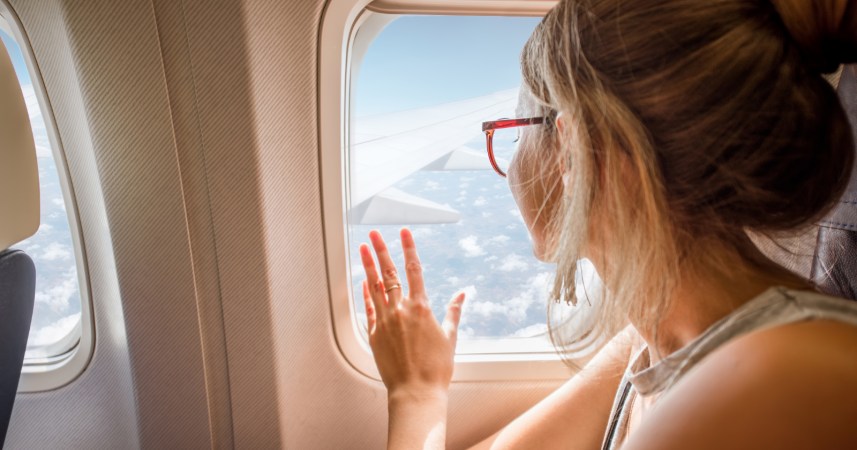
Some of your best thinking starts with your forehead against cool glass.
You can tell a lot about me from a seat map.
I’m the person who’ll pick 17A over 1C without blinking—the one who plans a playlist for takeoff and quietly times the shade to catch the first blush of sunrise.
Maybe you do this too. Maybe you know the small relief of tucking into your corner, pressing your temple to the cool wall, and letting the world unspool in miniature—rivers like silver threads, neighborhoods like quilt squares, your life suddenly wide enough to hold both the mess and the meaning.
Choosing the window has never just been about a view for people like us.
It’s a way of moving through the world. It’s how we remember to zoom out before we zoom in, to notice the patterns inside the noise, to protect a little sanctuary for our thoughts even when the aisle is tugging at our sleeve.
If that sounds familiar, the traits below will feel like reading your own travel diary—only you don’t need a boarding pass to live them every day.
1. You crave perspective
From a window, cities shrink into circuitry and rivers look like silver threads.
Perspective isn’t just a view; it’s a value.
You reach for altitude when decisions get messy. You zoom out before you zoom in. You ask, “What will this look like in five years?” before you hit send.
As Marcel Proust put it, “The real voyage of discovery consists not in seeking new landscapes, but in having new eyes.”
2. You are quietly observant
Window people study. You track how the wing flexes in turbulence. You notice how the shadow of the plane skims over patchwork fields. You clock the way weather stacks up in layers like a parfait.
That observational streak shows up on the ground, too. You see micro-expressions in conversations. You catch small shifts in your energy before they balloon into burnout.
Simone Weil once wrote that “attention is the rarest and purest form of generosity.” When you choose the window, you practice giving it.
3. You are a pattern spotter
From seat 19F, the world becomes a living infographic.
You notice the geometry of farms in the Midwest, the fractal veins of deltas, the regular pulse of town–highway–town.
Off the plane, that same wiring helps you connect dots others miss.
You recognize the arc of your motivation during a project. You spot cognitive biases mid-flight in a meeting. You connect a book you read last month with a conversation today.
Pattern recognition is how you metabolize chaos into clarity.
4. You bet on patience
The window seat is a commitment. You can’t pop up without negotiating elbows and laptop cables. So you prepare. You curate a little ritual—playlist, podcast, that chapter you’ve avoided because it asks more of you.
Patience becomes a muscle. You practice moving when it’s time to move and stillness when it’s time to be still.
I’ve mentioned this before but the fastest way I’ve found to think clearly is to give myself fewer opportunities to flee my thoughts. The window forces that.
That bias toward patience shows up as finishing the draft before fiddling with fonts, or letting a tough conversation marinate for a day before responding.
5. You choose story over speed
Aisle people win on logistics. They own the quick exit. Window people opt for narrative.
You like to see where you are in the story—how the coast unfolds, how mountains give way to desert, how night erases borders.
Once, descending into Phoenix at golden hour, the red rock glowed like a lit ember and I wrote a better email because of it—slower, kinder, more human.
You’d rather arrive with a thread to pull than simply arrive.
6. You honor boundaries
The window is a soft boundary. You tuck in. You create a little studio with a wing view.
That preference usually maps onto life. You’re clear about edges. You block time for deep work. You carve out Sunday mornings for a long walk, or batch-cook sweet potato tacos so future-you can eat like someone who cares. You understand that “No, thank you” is a complete sentence.
Boundaries aren’t walls; they’re trail markers.
7. You value autonomy
There’s a small sovereignty in choosing the light. Shade up, shade down. Photo now, journal later.
You don’t need to control everything—just the part you can. You’ll sit in the back if it means the left side for sunrise. You’ll plan your work around your energy, not the other way around. You pick your seat in projects, too, gravitating to roles where you can see the horizon and make meaningful calls.
Autonomy isn’t about being alone. It’s about self-direction aligned with your values.
8. You still believe in wonder
Window people keep a private pact with awe. You want to be surprised by your own planet.
Psychologists Dacher Keltner and Jonathan Haidt famously defined awe as a mix of “perceived vastness” and a “need for accommodation”—the sense that what you’re seeing is so large or layered that your mind must stretch to hold it.
“Awe experiences can be characterized by two phenomena: ‘perceived vastness’ and a ‘need for accommodation.’” That’s what the window is: a training ground for mental stretch.
And that stretch changes how you act. You exit the plane with a slightly looser grip on your to-do list and a slightly tighter grip on what matters.
You text people you love. You recycle the cup. Small, yes. But that’s how wonder works—quietly shifting the settings on your attention.
How to use these traits on the ground
If these eight traits resonate, here are a few ways to turn them into practice when you’re not 30,000 feet up:
-
Make altitude a habit. Ask “What will this look like in five years?” before reacting. Perspective is a decision you can make at sea level.
-
Schedule pure observation. Try a 20-minute “look out the window” walk. No podcasts. No photos. Just noticing. If you need a spark, reread Proust’s reminder to look with “new eyes” and then go find a familiar street you’ve never really seen.
-
Log patterns. Keep a tiny “pattern journal.” Each day, capture one repeating loop—energy, behavior, mood—and one variable that might be driving it.
-
Practice voluntary stillness. Choose a window-seat equivalent at home: a corner chair by a plant, a cafe bench with a view, a park bench at dusk. Sit. Let your attention do the generous thing.
-
Invite awe on purpose. Seek out vastness—mountain overlooks, starry rooftops, cathedral ceilings, or just the grand opera of a thunderhead. Wonder recalibrates us, and it doesn’t require a boarding pass.
The quick takeaway
Choosing the window seat is a tiny preference with a big philosophy behind it.
You like context, craft, and a clear view. You’re patient with process, generous with attention, and open to being moved by a sky that refuses to be ordinary.
Keep that pact with perspective. The view is worth it.