Your mind doesn’t always need more control—it often needs rhythm, slowness, and something simple enough to remind it how to rest.
You know that feeling when you’re exhausted, but your brain is still auditioning for an all-night talk show?
Every little worry takes center stage — that email you forgot to send, that thing you said at lunch, that big “what am I even doing with my life” question you didn’t plan to tackle at midnight.
I’ve been there. Often.
And here’s what I’ve learned: you can’t outthink a restless brain. You have to out-slow it.
When your mind refuses to shut down, slow hobbies can be like a dimmer switch for your thoughts — quieting the buzz, grounding you back in your body, and helping you drift off naturally.
They’re not just distractions. They’re antidotes to the pace we live at.
So if you’ve tried every sleep hack, meditation app, and melatonin gummy on the market, maybe it’s time to try something simpler.
Let’s explore eight slow hobbies that can completely change your relationship with nighttime restlessness.
1) Reading (the slow kind)
Let’s start with a classic.
Not reading for anything — not self-improvement, not news, not work — but reading for the sake of it.
When was the last time you let yourself get lost in a story? The kind where, for a few minutes, your own life fades into the background?
Psychologists call it narrative transportation — when you become so absorbed in a story that your brain’s default mode (the self-referential, worry-prone part) temporarily powers down.
For me, fiction before bed works better than any mindfulness app. I’ll dim the lights, grab a paperback (usually something with great character depth but low chaos), and just read until my eyelids start to feel heavy.
It’s not about finishing the book. It’s about giving my brain a gentler rhythm to follow.
Try it tonight — and choose something with a good story, not a good moral. Your brain doesn’t need another life lesson at midnight.
2) Photography walks
A few years ago, I started taking photography walks in the evenings. No destination, no playlist — just me, my camera, and the slow art of noticing.
At first, I thought it was just a creative outlet. But I quickly realized it was something deeper — a kind of walking meditation.
When you’re looking for interesting light or subtle patterns, you automatically stop thinking about yourself. The brain switches from verbal to visual mode, and suddenly all those looping thoughts fade into the background.
You start noticing details you’ve ignored all day — the symmetry of shadows, the texture of walls, how the air changes at dusk.
It’s like training your mind to see again instead of just scroll.
And yes, I’ve sometimes come home with terrible photos — but always with a quieter mind.
3) Knitting, crocheting, or any tactile craft
Knitting, pottery, macramé, whittling — it doesn’t really matter what you pick. What matters is that your hands move slowly, rhythmically, and purposefully.
There’s something profoundly calming about repetitive motion. Scientists note that repetitive, rhythmic hand tasks can help activate the parasympathetic nervous system — the “rest and digest” side of your nervous system.
In a world that constantly asks us to produce, slow crafting gives us something rare: process without pressure.
A friend of mine once said, “Knitting saved my sanity during grad school.” At first, I laughed — but now I get it. When you loop, pull, repeat, you create both a pattern and peace.
Personally, I’ve started making small candles — heating, pouring, waiting. There’s this moment right after pouring when the wax starts to solidify — it’s slow, silent, and completely mesmerizing.
If you want your brain to calm down, give your hands something repetitive to do.
4) Journaling — but not the way you think
Let’s be honest — most journaling advice online sounds like homework. Gratitude lists. Prompts. Structure.
But when your brain won’t shut up, the last thing you need is more structure.
This is where “dump journaling” comes in.
You literally grab a notebook and unload everything swirling in your mind. Spelling doesn’t matter. Logic doesn’t matter. Just get it all out — the petty frustrations, the endless what-ifs, the things you’d never actually say out loud.
It’s like emptying your mental recycling bin.
I’ve kept one notebook by my bed just for this purpose. I never reread it — that’s key. It’s not a record; it’s a release.
After a long, chaotic day, dumping your thoughts on paper gives your mind permission to stop rehearsing them. You’re telling your brain, I’ve captured it. You can rest now.
And nine times out of ten, it listens.
5) Gardening (or growing something)
You don’t need a backyard to do this. One pot. One plant. One act of patience. That’s enough.
Gardening is the slowest, most grounding therapy I know. It teaches you that growth happens in silence — and that sometimes the best thing you can do is step back and wait.
When you’re anxious or mentally overstimulated, you crave control. Gardening does the opposite. It humbles you. You water, you wait, you adjust. You start paying attention to small details — how the leaves droop when they need light, how the soil smells after watering.
I grow basil, mint, and occasionally a stubborn rosemary plant that tests my emotional resilience more than any human ever has.
But here’s the secret: it’s not really about the plants. It’s about re-learning natural timing. You can’t rush anything — and that’s exactly what your brain needs to remember before bed.
6) Puzzles and slow games
You know that satisfying feeling of finding the right puzzle piece after ten minutes of trying? That’s your brain exhaling.
Puzzles and slow games are underrated forms of rest. They give your mind a manageable challenge — something you can solve — which interrupts the endless loop of unsolvable thoughts.
There’s a reason jigsaw puzzles, crosswords, and strategy board games made a huge comeback recently. They’re analog. They require focus but not pressure.
When I was traveling through Japan a few years back, I stayed with a family who did puzzles every night after dinner. No TV, no phones — just quiet conversation and small victories as pieces clicked into place. It was such a peaceful rhythm, and I remember thinking, This is what unwinding actually looks like.
If you can’t sit still long enough for a puzzle, try digital “cozy games” — slow-building worlds like Stardew Valley or Animal Crossing. They’re calm, repetitive, and wonderfully non-urgent.
7) Playing an instrument
Music slows everything down — your breathing, your pulse, your thoughts.
And no, you don’t have to be good at it. In fact, the less pressure you put on yourself, the more relaxing it becomes.
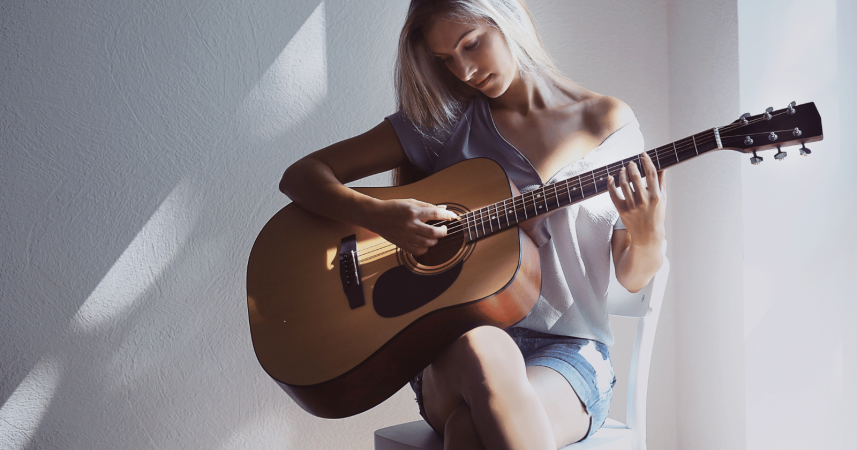
Playing guitar is my version of journaling without words. I’ll sit down at night, pick up the same old acoustic I’ve had since my twenties, and just play a few simple chords. No songs, no goals. Just sound.
There’s something deeply human about touching an instrument and creating vibration from nothing. It’s impossible to multitask while playing — your focus narrows, your shoulders drop, and for a few minutes, your inner critic shuts up.
Even humming counts. Music anchors you in your breath, and breath anchors you in the present.
As Nietzsche once said, “Without music, life would be a mistake.” He was probably talking about this kind of moment.
8) Slow cooking or baking
Cooking can be chaos when you’re in a rush. But when you treat it as a ritual instead of a race, it becomes meditation in motion.
There’s a rhythm to slow cooking — chopping vegetables, heating oil, stirring slowly — that naturally brings you into flow. And when your senses are fully engaged (smell, taste, touch, sound), anxiety loses its grip.
I’ve mentioned this before, but for me, the kitchen is where I process life. Some people go to therapy — I roast carrots.
I’ll play some mellow indie music (Bon Iver or Phoebe Bridgers, usually), light a candle, and cook something that takes time — a curry that simmers for an hour, or slow-roasted chickpeas with cumin and lemon.
By the time I’m done, I’ve not only made food, but quiet. And that, to me, is the perfect bedtime prelude.
The science behind slowing down
Here’s the wild part: all these hobbies work for the same neurological reason.
When you engage in a slow, embodied task — something tactile, rhythmic, or sensory — you shift your brain out of its default mode network (the part responsible for rumination and self-talk) and into task-positive mode.
That means you’re focused on what’s in front of you, not what’s behind or ahead.
It’s why people describe these activities as “flow states.” Your awareness expands and contracts at the same time — you’re calm, but alert. And afterward, your brain doesn’t snap right back into chaos. It carries that slower tempo into rest.
That’s why I believe hobbies aren’t luxuries. They’re mental hygiene. Especially the slow ones.
The bottom line
In a world that glorifies hustle, speed, and constant mental stimulation, slowing down feels almost rebellious.
But here’s the truth: your mind isn’t broken. It’s just overloaded. And the cure isn’t another app, technique, or productivity system. It’s time, patience, and slowness.
So next time your thoughts refuse to turn off, don’t fight them. Redirect them — into something simple, tactile, and real.
Because when you let your hands slow down, your brain eventually follows. And in that quiet, sleep finds you — not as a goal, but as a side effect of being present.
Just launched: Laughing in the Face of Chaos by Rudá Iandê
Exhausted from trying to hold it all together?
You show up. You smile. You say the right things. But under the surface, something’s tightening. Maybe you don’t want to “stay positive” anymore. Maybe you’re done pretending everything’s fine.
This book is your permission slip to stop performing. To understand chaos at its root and all of your emotional layers.
In Laughing in the Face of Chaos, Brazilian shaman Rudá Iandê brings over 30 years of deep, one-on-one work helping people untangle from the roles they’ve been stuck in—so they can return to something real. He exposes the quiet pressure to be good, be successful, be spiritual—and shows how freedom often lives on the other side of that pressure.
This isn’t a book about becoming your best self. It’s about becoming your real self.