It’s funny how the hobbies we once mocked as boring turn out to be exactly what our burnout brains crave.
I spent my twenties chasing the latest trends, convinced that anything old was automatically outdated. New apps, new restaurants, new bands nobody had heard of yet. That was the sweet spot, right?
Then I watched my grandmother spend an entire Saturday afternoon in her garden, hands deep in soil, completely absorbed. No phone. No notifications. Just her, some seeds, and hours that seemed to disappear.
I remember thinking it looked boring as hell.
I was wrong.
Somewhere between doomscrolling and digital burnout, I started noticing something. The hobbies that Boomers never abandoned, the ones we rolled our eyes at, actually offer something our hyperconnected lives desperately lack: presence, patience, and a break from the performance anxiety of social media.
Today, we're exploring eight Boomer hobbies that turn out to be surprisingly therapeutic in our chaotic modern world.
1) Gardening
There's actual science behind why getting your hands dirty feels so good.
Research shows that soil contains bacteria that trigger serotonin release in our brains, literally making us happier. But beyond the biochemistry, gardening forces you into a different relationship with time.
You can't rush a tomato plant. You can't hack growth with a productivity app. You just have to show up, water, wait, and trust the process.
I started with herbs on my balcony after one too many anxiety-fueled nights staring at my phone. Basil, cilantro, nothing fancy. But checking on them became this daily ritual that had nothing to do with metrics or engagement or any of the other measurements that dominate our lives.
Something either grew or it didn't. And weirdly, that binary simplicity was exactly what I needed.
2) Birdwatching
Yes, I know how it sounds. Birdwatching feels like the punchline to a joke about retirement hobbies.
But here's the thing: it's meditation disguised as a hobby.
You have to be still. You have to be quiet. You have to actually pay attention to your surroundings instead of whatever's happening in your pocket. It's basically forced mindfulness, except you're looking for a California scrub jay instead of focusing on your breath.
The best hobbies are the ones that get you out of your head without trying. Birdwatching does exactly that. You're hunting for movement, listening for calls, totally absorbed in something that has nothing to do with you or your problems.
Plus, there's something oddly satisfying about identifying a bird correctly. It's a tiny win in a world that often feels like it's running on nothing but losses.
3) Letter writing
When was the last time you sat down and actually wrote something by hand?
Not a grocery list or a Post-it note. An actual letter to another person.
Letter writing forces you to slow down in a way that texts and emails simply can't replicate. You have to think about what you want to say before you say it. There's no autocorrect, no delete button that makes revision effortless. You commit to your words as you write them.
My grandmother used to write letters to her sister every week, even though they talked on the phone regularly. She once told me that writing helped her figure out what she actually thought about things. The act of forming sentences with a pen somehow clarified her mind in a way conversation didn't.
In an age where we're all broadcasting constantly but connecting rarely, taking the time to write something intended for just one person feels almost radical.
4) Woodworking
There's something deeply satisfying about making a physical object with your hands.
Not coding something or designing something digital. Actually building a thing that exists in three dimensions and will still be there when you turn off your devices.
Woodworking demands your full attention. You can't half-ass it while checking your phone. A table saw doesn't care about your distraction, it will absolutely punish you for it. That forced presence is exactly what makes it therapeutic.
Plus, you end up with something tangible. A shelf, a cutting board, a frame. Proof that you spent time on something besides scrolling.
In a world where so much of our work disappears into the cloud or gets deleted or becomes obsolete in months, creating something solid and permanent hits differently.
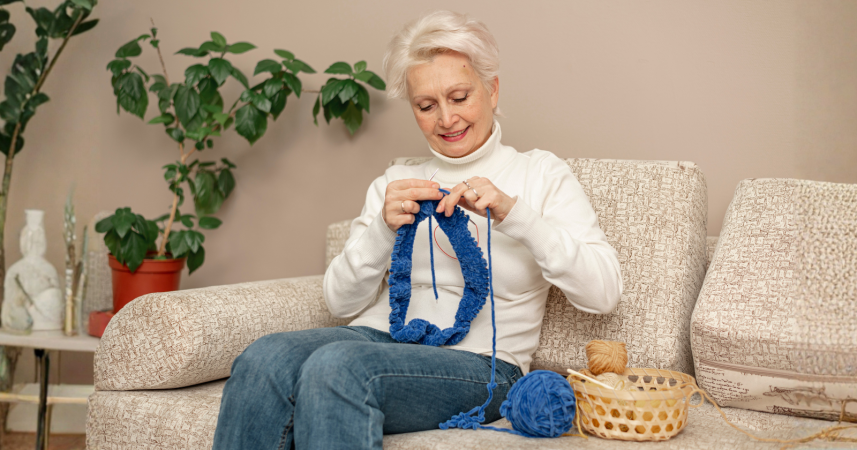
5) Knitting and crocheting
I used to think knitting was something grandmothers did while watching soap operas.
Turns out, according to research, the repetitive motion of knitting actually lowers blood pressure and heart rate. It's been compared to meditation in multiple studies, with similar effects on stress reduction and mental clarity.
The rhythm of it, the way your hands learn the movements until they become automatic, creates this flow state that's increasingly hard to find in our fragmented attention economy.
And unlike most of what we do on screens, you end up with something real. A scarf, a blanket, a hat. Something you can give to someone or use yourself. There's a completion to it that feels rare these days.
You start with a ball of yarn and some sticks. You end with a wearable thing. The transformation is clear, measurable, and entirely yours.
6) Model building
Model trains, model planes, model ships. Pick your miniature obsession.
What they all have in common is this: they require patience, precision, and sustained focus over time. You can't build a detailed model in one sitting. You have to come back to it, day after day, adding tiny pieces, waiting for glue to dry, getting the paint just right.
It's the opposite of instant gratification. And that's exactly why it works as therapy.
We're so used to immediate results that the practice of working toward something slowly, methodically, without rushing, feels almost foreign. But that's where the therapeutic value lives.
Each session with a model is a small meditation. You're not trying to finish. You're just trying to get this one piece right. And then the next one. And eventually, maybe weeks or months later, you have something complete.
The journey actually matters more than the destination. Which is a lesson our productivity-obsessed culture keeps trying to teach us and we keep refusing to learn.
7) Genealogy research
Tracing your family tree might seem like a weird hobby for the digital age, but studies show that it actually can be a form of therapy, especially for older people who are thinking about matters like legacy.
You've got access to census records, immigration documents, and databases that would have been impossible for previous generations to search.
But the research itself requires old-school detective work: following leads, piecing together clues, making connections that aren't obvious.
What makes it therapeutic is the narrative aspect. You're not just collecting names and dates. You're uncovering stories, understanding how your family moved through history, seeing patterns across generations.
As Rudá Iandê writes in his book Laughing in the Face of Chaos: A Politically Incorrect Shamanic Guide for Modern Life, "We live immersed in an ocean of stories, from the collective narratives that shape our societies to the personal tales that define our sense of self."
It's grounding in a way that's hard to describe. When everything feels uncertain and temporary, understanding where you came from provides this sense of continuity and rootedness.
Plus, it gets you thinking beyond your own lifespan. You start seeing yourself as part of something bigger, a chain that stretches backward and forward in time. That perspective shift alone can be incredibly calming when modern life feels overwhelming.
8) Jigsaw puzzles
Puzzles are having a moment right now, and I see how it makes perfect sense.
In a world where everything is designed to be addictive, algorithmically optimized to keep you scrolling and clicking and consuming, puzzles offer something radically different: a problem with a clear solution, boundaries that don't change, and an endpoint that actually means something.
You can't hack a puzzle. You can't optimize it. You just have to do it, piece by piece, using nothing but patience and pattern recognition.
There's something meditative about the search. Looking for that one piece that fits. Trying it. Realizing it doesn't work. Trying another. No anxiety, no stakes, just this calm, methodical process of completion.
And when you finish, you actually finish. The puzzle is done. It's complete. You can see the whole picture.
In a digital life that never really ends, where your inbox refills overnight and your social media feeds are infinite, that sense of completion is genuinely therapeutic.
Conclusion
Here's what I've learned from dabbling in these supposedly old-fashioned hobbies: sometimes the best response to modern chaos isn't more technology or optimization or life hacks.
Sometimes it's just doing something slow, analog, and completely pointless by productivity standards.
These Boomer hobbies work because they offer what our screen-saturated lives can't: presence, patience, tangible results, and the rare experience of actually finishing something.
So maybe that grandmother spending Saturday in her garden wasn't wasting time after all. Maybe she knew something about balance that took me another twenty years to figure out.
The therapeutic value isn't in the hobby itself. It's in the permission it gives you to slow down, focus on one thing, and exist without performing or producing or optimizing every moment.
If You Were a Healing Herb, Which Would You Be?
Each herb holds a unique kind of magic — soothing, awakening, grounding, or clarifying.
This 9-question quiz reveals the healing plant that mirrors your energy right now and what it says about your natural rhythm.
✨ Instant results. Deeply insightful.