When your mind won't stop spinning, the fastest way out isn't through more thinking — it's through your fingertips.
Your mind is loud, isn't it?
Mine's a relentless commentator, narrating every decision, replaying old conversations, rehearsing future ones that'll probably never happen. It's exhausting.
I've noticed something, though. When my hands are busy, my head gets quiet. Not silent, exactly, but quieter. The volume drops from stadium concert to coffee shop background noise.
There's actual science behind this. Our brains are wired to process physical sensations and movements, and when we engage our hands, we activate neural pathways that can interrupt the rumination cycle.
But honestly, I didn't care about the research when I first discovered this. I just knew that kneading dough made me stop spiraling about a work deadline.
Here are seven things you can do with your hands that might help you escape that mental hamster wheel.
1) Cook something from scratch
Not reheating leftovers or assembling a sandwich. I mean actually cooking. Chopping vegetables, measuring spices, watching something transform under heat.
When I'm dicing onions for a Thai curry, I'm not thinking about the email I need to send or the conversation I botched three days ago. I'm focused on keeping my fingers away from the blade and getting the pieces uniform enough that they'll cook evenly.
There's a rhythm to cooking that pulls you into the present. The sizzle when garlic hits hot oil. The way tomatoes break down into sauce. The gradual shift in color and texture that tells you when something's done.
My lentil bolognese has saved me from more anxiety spirals than I can count. Not because it's particularly special, but because making it requires attention. You can't be fully in your head when you're monitoring a simmer and adjusting seasoning.
Plus, you get to eat something at the end. Which beats rumination on every possible metric.
2) Take photographs with intention
I don't mean scrolling through your camera roll or snapping quick pics for social media. I mean actually looking for shots. Framing them. Adjusting the light and angle.
Photography forces you to see what's actually there instead of what your mind is telling you is there. You start noticing the way afternoon light hits a building, or how shadows create patterns on the sidewalk, or the exact shade of green on new leaves.
When I'm walking around Venice Beach with my camera, my internal monologue shifts from "why did I say that stupid thing in the meeting" to "how do I capture the texture of that weathered fence." It's still thinking, but it's thinking that's tethered to something real and external.
You don't need expensive equipment for this. Your phone works fine. The point isn't creating gallery-worthy art. It's giving your hands and eyes something to do together that doesn't involve refreshing the same three apps.
3) Write by hand
Not typing. Not texting. Actual pen on actual paper.
There's something about the physical act of writing that slows everything down. Your hand can't move as fast as your thoughts, so you're forced to be more deliberate about which thoughts get translated into words.
I keep a small notebook for when my brain won't stop spinning. Sometimes I write about what I'm thinking. Sometimes I just write whatever comes out, even if it's "I don't know what to write" repeated until something else surfaces.
The point isn't producing anything meaningful. It's the movement itself. The slight resistance of pen against paper. The visual feedback of seeing your thoughts take physical form outside your head.
Morning pages work for some people. Lists work for others. Sometimes I just copy out paragraphs from books I'm reading. The specific content matters less than the act of doing it.
4) Work with clay or dough
You need something that responds to pressure. Something you can push and shape and manipulate.
I'm not a potter, but I've noticed that even just rolling out dough for homemade pasta gets me out of my head. There's immediate, tactile feedback. You press, it responds. You knead, it changes texture. You're in constant conversation with the material.
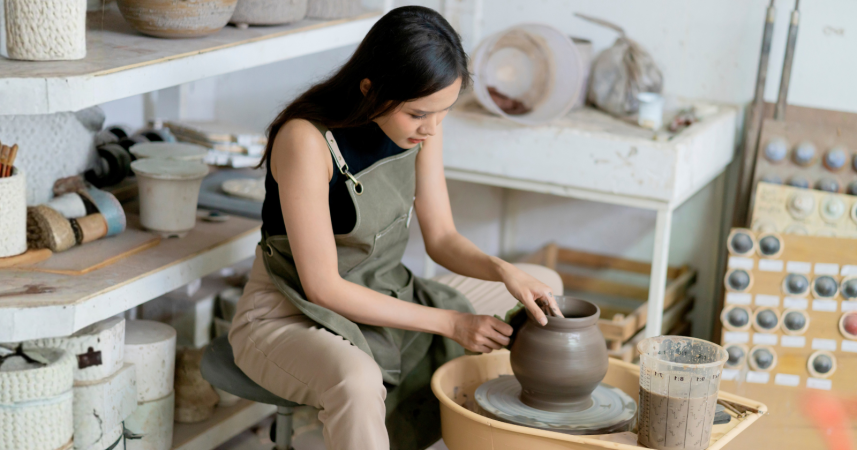
Clay is even better for this if you have access to it. It's messy and demands attention. You can't be checking your phone while working with clay. Your hands are occupied, and if you zone out, whatever you're making collapses.
The repetitive motion has its own meditation built in. Push, fold, turn. Push, fold, turn. Your breathing syncs up with the rhythm. Your thoughts become less frantic.
And there's something satisfying about making something three-dimensional, even if it's lumpy and imperfect. It exists in space. You made it. Your anxious thoughts didn't.
5) Practice an instrument
I'm talking about actually playing, not just noodling around. Learning a new song. Working on a difficult section. Focusing on technique.
When I dust off my guitar and try to get through a song without messing up, I can't simultaneously worry about whether I'm living my life correctly. My brain doesn't have the bandwidth. It's too busy trying to remember the next chord change.
You don't need to be good at this. Actually, being not-good might be better because you have to concentrate harder. Every note requires attention. Every transition needs thought.
Music pulls you into a flow state faster than almost anything else. There's a clear feedback loop. You play something, you hear it immediately. If it sounds wrong, you adjust. If it sounds right, you keep going.
Even fifteen minutes of focused practice can reset your mental state. Your hands remember patterns your conscious mind has forgotten, and that muscle memory creates a kind of moving meditation.
6) Garden or tend plants
Getting your hands in soil does something. I'm not sure I can explain it well, but there's a groundedness that comes from literally working with the ground.
I grow herbs on my balcony, nothing elaborate. But when I'm trimming basil or repotting something that's outgrown its container, I'm not catastrophizing about the future. I'm focused on the immediate task. Is this plant getting enough light? Does it need water? Are there pests?
There's a slowness to plant care that's the opposite of the frantic pace of mental rumination. Plants don't hurry. They grow on their own timeline. You can't force them, you can only provide conditions and wait.
Pulling weeds is surprisingly meditative. It's methodical. You spot one, you pull it, you move to the next. Your hands get dirty. You can see the immediate result of your work.
Even if you don't have outdoor space, a few houseplants work. The act of watering, pruning, checking for new growth gives your hands and attention something gentle to focus on.
7) Build or fix something
There's a particular satisfaction in repair work. Taking something broken and making it functional again.
When you're fixing a drawer that sticks or assembling furniture or even just organizing a cluttered space, you're problem-solving with your hands. It's concrete. The problem is right in front of you, not abstract and spiraling.
I'm not particularly handy, but I've learned that even small repairs get me out of my head. Tightening loose screws. Organizing cables. Patching small holes in the wall. These are tasks with clear beginnings and endings, unlike the thoughts that loop without resolution.
There's a tangible before and after. This was broken or messy, now it's fixed or organized. That kind of clear progress feels good when your mental state feels stuck.
You don't need major projects. Sometimes just rearranging a bookshelf or cleaning out a drawer gives your hands enough to do that your mind can take a break from its usual programming.
Conclusion
Your hands are smarter than you think. They know how to knead and build and create without your conscious mind micromanaging every move. When you give them something to do, they take over, and that mental narrator finally shuts up for a while.
I've been reading Rudá Iandê's new book "Laughing in the Face of Chaos," and one idea that stuck with me is this: "Your body is not just a vessel, but a sacred universe unto itself, a microcosm of the vast intelligence and creativity that permeates all of existence."
That resonated because it's exactly what I experience when I stop thinking and start doing with my hands.
Not every technique works for everyone. Maybe cooking does nothing for you but photography clicks. Maybe you hate gardening but love fixing things. The point is finding what gets your hands busy enough that your head can quiet down.
Try something. See what happens. Your ruminating mind will still be there later if you really need it, but you might find you don't miss it as much as you thought.
What’s Your Plant-Powered Archetype?
Ever wonder what your everyday habits say about your deeper purpose—and how they ripple out to impact the planet?
This 90-second quiz reveals the plant-powered role you’re here to play, and the tiny shift that makes it even more powerful.
12 fun questions. Instant results. Surprisingly accurate.