Some of the best things for adult wellbeing are activities we abandoned after elementary school.

Add VegOut to your Google News feed. 
Remember finger painting? Building with blocks? Playing make-believe for hours without self-consciousness?
Most of us abandoned these activities somewhere between elementary school and adulthood, filing them away as "kid stuff" we've outgrown. We replaced them with more serious pursuits, hobbies that feel age-appropriate and productive.
But here's what's interesting: behavioral science research suggests that many childhood activities we left behind actually offer significant psychological benefits for adults. We didn't outgrow them so much as we were socialized out of them.
I've been reading about how play and creativity impact adult wellbeing, and it's made me reconsider some of the things I used to do without thinking twice.
Today, I want to explore eight childhood hobbies that psychology says we should bring back into our adult lives.
1) Drawing and coloring without worrying about the result
Most of us stopped drawing somewhere around middle school when we became hyper-aware that our stick figures weren't turning into realistic portraits. We decided we "weren't good at art" and abandoned it entirely.
Research on art therapy shows that the act of drawing itself, regardless of skill level, reduces cortisol levels and activates the brain's reward centers. The process matters more than the product, but we've been conditioned to judge our creative output rather than enjoy the act of creation.
Adult coloring books became trendy a few years ago, and there was actually solid psychological reasoning behind it. The repetitive, focused activity induces a mild meditative state while giving your hands something to do.
It's the same benefit children get, minus the pressure to produce anything impressive.
I recently bought a sketchbook after not drawing for probably twenty years. My drawings are terrible by any objective standard, but spending thirty minutes sketching while listening to music does something for my mental state that scrolling through my phone never does.
The key is approaching it the way you did as a kid, when you drew because it was fun, not because you were trying to make something frame-worthy.
2) Building things with your hands
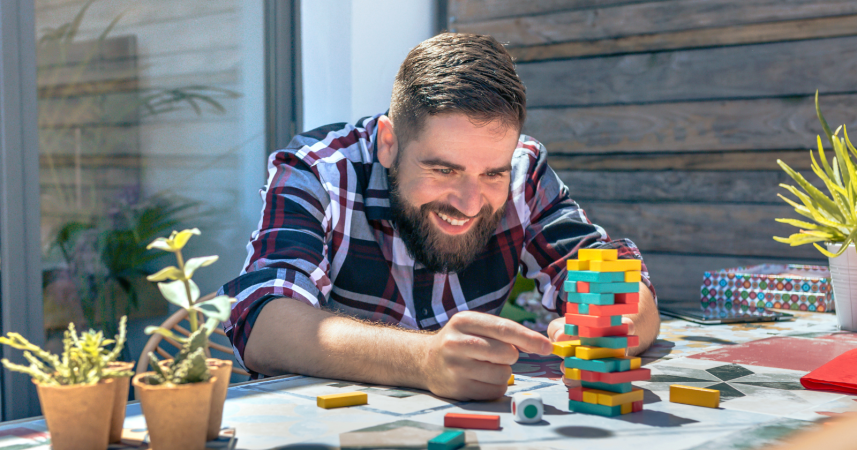
LEGOs, blocks, model kits. Most of us spent countless childhood hours constructing things for the simple satisfaction of seeing pieces become something whole. Then we grew up and decided that unless we were building something functional, it wasn't worth our time.
Psychological research shows that hands-on construction activities are particularly effective at inducing this optimal experience where you lose track of time and become fully absorbed. Your brain enters a state of focused engagement that's increasingly rare in our distraction-filled adult lives.
There's also something satisfying about tangible results. In knowledge work especially, your outputs are often abstract and intangible. Building something physical provides concrete evidence of your effort and skill.
The shame around "playing with toys" as an adult is cultural conditioning, not evidence that these activities have no value.
3) Climbing trees and playground equipment
When was the last time you climbed something just for the fun of it? Most adults stopped climbing the moment it became socially inappropriate, which is unfortunate because the activity offers significant benefits.
Physical play that involves proprioception, your body's sense of position and movement in space, helps maintain neural pathways that desk work actively degrades.
Climbing requires problem-solving, risk assessment, and full-body coordination in ways that gym workouts often don't.
There's also the psychological benefit of mild, manageable risk-taking. Adults tend to eliminate all physical risk from their lives, which might contribute to anxiety. Engaging in activities with small, controlled risks can actually improve your ability to assess and manage fear.
I'm not suggesting you start scaling playground equipment and confusing parents at the park. But adult versions exist. Rock climbing gyms, obstacle course facilities, even tree-climbing courses designed for adults provide the same benefits we got as kids.
4) Making up stories and playing pretend
Children spend enormous amounts of time in imaginative play, creating elaborate narratives and inhabiting different characters. Adults largely abandon this unless they're professional writers or actors, treating imagination as something childish rather than valuable.
But research in creative cognition shows that engaging in imaginative thinking, even without producing a finished product, enhances problem-solving abilities and emotional regulation. When you imagine different scenarios and perspectives, you're literally exercising your brain's ability to think flexibly.
This doesn't mean you need to play dress-up, though honestly, if that appeals to you, go for it. It can be as simple as writing fiction without the pressure to publish, joining a tabletop role-playing game, or even just allowing yourself to daydream without immediately dismissing it as unproductive.
We've been taught that imagination is only valuable if it produces something marketable. That's not actually how creativity works. Sometimes the process of imagining is the point.
5) Dancing without caring what it looks like
Kids dance constantly. They hear music and their bodies respond without self-consciousness or concern about looking foolish. Most adults stop dancing anywhere except maybe at weddings after a few drinks, and even then, many feel uncomfortable.
The psychology behind this shift is straightforward: we become aware of social judgment and decide that dancing badly is embarrassing. So we stop entirely rather than risk looking silly.
But movement and music together create powerful neurological effects. According to research, dancing releases endorphins, reduces stress hormones, and activates reward pathways in the brain.
I rediscovered this accidentally when my partner caught me dancing around the kitchen while cooking. I was embarrassed for about thirty seconds before realizing I felt better in that moment than I had all week.
Now I do it regularly, usually when I'm alone, and it's become one of my more effective mood regulation tools.
The trick is recovering that childhood attitude where dancing is just something you do when music plays, not a performance that requires an audience or skill.
6) Collecting things just because you like them
Remember collecting rocks, stamps, trading cards, or whatever random objects captured your interest as a kid? You weren't thinking about investment value or whether your collection impressed anyone. You just liked having them.
Adults often dismiss collecting as frivolous unless it's a "serious" collection with financial value. We've turned what should be a simple pleasure into another arena for status and investment strategy.
But psychology shows that collecting provides psychological benefits regardless of monetary value. The act of searching, acquiring, organizing, and appreciating a collection gives structure and purpose to leisure time. It creates narratives and meaning around objects.
I still have my vinyl collection from my music blogging days, and adding to it occasionally brings a specific kind of satisfaction that's hard to explain. It's not about the records' value. It's about the hunt, the discovery, the tangible representation of my interests.
If you're drawn to collecting something, whether it's vintage cameras, interesting rocks, or action figures, the psychological benefit comes from the engagement, not the collection's market value.
7) Playing simple games with no real stakes
Card games, board games, tag, hide and seek. Kids play games constantly, not for prizes or competition rankings, but because playing is inherently enjoyable. Adults tend to need higher stakes or clear purposes to justify game-playing.
Psychology research shows that low-stakes play serves important functions beyond entertainment. It helps maintain social bonds, provides safe spaces to practice strategic thinking, and offers structured opportunities for friendly competition without serious consequences.
The board game renaissance among adults isn't just nostalgia. People are rediscovering that sitting around a table playing a game creates a specific kind of social interaction that's increasingly rare.
You're focused on the same thing, responding to each other's moves, laughing at absurd outcomes, all without the conversation pressure of a dinner party.
The key is approaching games the way kids do, where winning is nice but not the actual point. The point is the playing itself.
8) Spending time doing absolutely nothing productive
This might be the hardest one for adults to reclaim. Children are masters of unstructured time. They'll spend an afternoon watching clouds, poking sticks into dirt, or just lying in the grass thinking about nothing in particular.
Adults have largely eliminated this kind of time from their lives. Every moment needs a purpose, a goal, a justification. Even our leisure is productive: we're not just reading, we're "staying informed" or "working on ourselves."
But neuroscience research on default mode network activity shows that unstructured, purposeless time is when your brain does essential maintenance work. It processes experiences, makes unexpected connections, and regulates emotional responses. This only happens when you're not directing your attention toward any particular goal.
The constant productivity mindset we've adopted as adults might actually be counterproductive to wellbeing and even to creativity. Sometimes the most valuable thing you can do is literally nothing.
Conclusion
The hobbies we abandoned after childhood weren't outgrown so much as shamed out of us by cultural expectations about what adults should spend their time doing. We learned that unless an activity is productive, impressive, or monetizable, it's not worth pursuing.
But psychology keeps showing that many of these "childish" activities provide genuine benefits for adult wellbeing. They reduce stress, enhance creativity, improve emotional regulation, and create the kind of engaged, present-moment experience that contributes to life satisfaction.
You don't need to reclaim all of these. But if any of them resonated with you, if you felt a small pull toward something you used to do without thinking, maybe that's worth exploring. The worst that happens is you spend a few hours doing something purely because you enjoy it.
And honestly, that might be exactly what you need.
If You Were a Healing Herb, Which Would You Be?
Each herb holds a unique kind of magic — soothing, awakening, grounding, or clarifying.
This 9-question quiz reveals the healing plant that mirrors your energy right now and what it says about your natural rhythm.
✨ Instant results. Deeply insightful.

Jordan Cooper
Jordan Cooper is a pop-culture writer and vegan-snack reviewer with roots in music blogging. Known for approachable, insightful prose, Jordan connects modern trends—from K-pop choreography to kombucha fermentation—with thoughtful food commentary. In his downtime, he enjoys photography, experimenting with fermentation recipes, and discovering new indie music playlists.
More Articles by Jordan