The hobbies your grandparents loved are having a moment, thanks to Gen Z's search for something real.

Add VegOut to your Google News feed. 
I'll be honest with you: when I first saw my neighbor's 22-year-old daughter pull out knitting needles at a coffee shop last month, I had to do a double take.
Here was someone who'd grown up with smartphones glued to her hand, suddenly looking like she'd stepped out of my grandmother's living room.
But here's the thing that caught me off guard even more: she wasn't alone. All around her, other young people were crocheting, sketching, and flipping through actual paper journals.
Something's shifting, and it's beautiful to watch.
We're seeing Gen Z circle back to hobbies that Boomers thought had disappeared forever, and there's real wisdom in this return.
These young people are discovering what their grandparents always knew: sometimes the best way forward is to look back. They're picking up skills that offer something screens can't deliver, something their mental health desperately needs.
Let me walk you through seven hobbies making this surprising comeback, and why each one matters more than you might think.
1. Knitting and crocheting
There's something almost meditative about the rhythm of needles clicking together, and Gen Z has figured this out in a big way.
Walk into any college library during finals week and you'll spot students with yarn and needles, working through their anxiety one stitch at a time. They're creating everything from chunky cardigans to temperature blankets that track the weather throughout the year.
What makes this shift fascinating is how they've completely reimagined what these crafts can be. Where Boomers made practical afghans and baby blankets, Gen Z is crafting bucket hats, stuffed mushrooms, and even crochet tops for music festivals.
They share patterns on TikTok, troubleshoot problems in Reddit communities, and treat their projects like collaborative art.
These fiber arts force you to slow down in a world that never stops moving.
You can't rush a sweater or speed through a complex pattern. Your mind has to focus on counting stitches and following the rhythm, which means all that noise in your head finally gets quiet.
For a generation drowning in notifications and endless scrolling, that kind of forced presence feels like coming up for air.
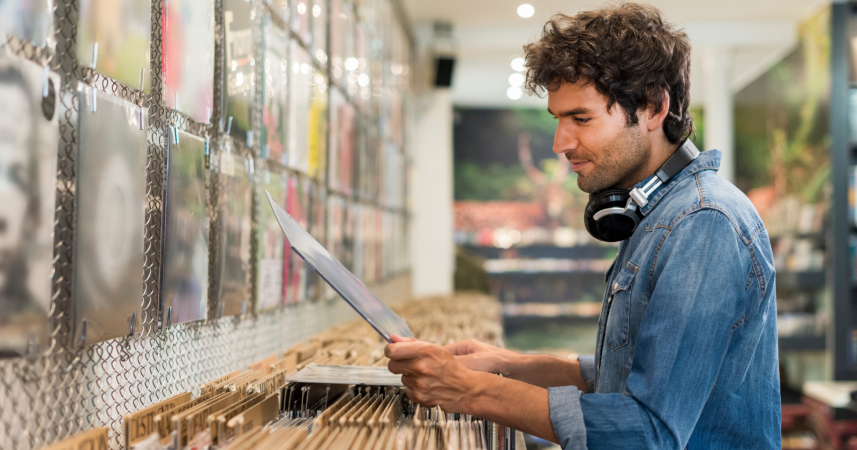
2. Vinyl record collecting
Remember when everyone said digital music would make physical albums obsolete?
Yeah, well, Gen Z missed that memo entirely.
They're buying turntables, hunting through record store bins, and treating vinyl collecting like a treasure hunt.
I watched my nephew spend an entire Saturday afternoon flipping through used records at a local shop, carefully examining each one like he was searching for gold. He ended up buying a beat-up copy of Fleetwood Mac's "Rumours" for fifteen bucks and couldn't stop grinning.
What he told me later stuck with me: "When I play a record, I actually listen to the whole album the way the artist intended. I'm not skipping around or letting an algorithm decide what I hear next."
That intentionality is what's driving this revival. Vinyl forces you to engage with music differently. You have to get up to flip the record, you can see the grooves that hold the sound, and there's this warm, rich quality that digital files just can't replicate.
Boomers grew up with this experience as their only option, but Gen Z is choosing it deliberately. They're creating rituals around listening. Sunday morning becomes coffee and a record.
The physical act of putting on a record becomes a small ceremony that says, "This moment matters enough to do it right."
3. Bread baking, especially sourdough
Can we talk about sourdough starters for a second? Because Gen Z has turned these bubbling jars of flour and water into basically pets.
They name them (I've heard "Doughlores," "Bread Pitt," and "Yeastie Boys"), they feed them on schedule, and they genuinely stress about keeping them alive.
The pandemic kicked off this bread baking surge, but it stuck around because young people discovered something their grandparents knew all along: there's real satisfaction in creating food from scratch.
Kneading dough becomes a workout for your hands and a break for your mind. Watching yeast work its magic teaches patience in a way nothing else can.
I started my own sourdough journey about two years ago, and I'll tell you, the first time I pulled a perfectly crusty loaf out of the oven, I literally texted a photo to five different people.
That sense of accomplishment hits different when you've spent days nurturing starter and hours letting dough rise.
Gen Z gets this. They're baking because the process itself feels grounding. Every step demands your attention and respect. You can't microwave good bread into existence, and that limitation becomes a gift.
4. Embroidery and cross-stitch
Who would've thought that threading tiny needles and making thousands of little X's would become cool again?
But here we are, with young people stitching everything from traditional floral patterns to internet memes and pop culture references.
They're embroidering denim jackets with their favorite song lyrics, cross-stitching snarky quotes to hang in their apartments, and basically turning their clothing into walking art galleries.
The sustainability angle plays a huge role here. Instead of buying fast fashion that falls apart after three washes, Gen Z is learning to customize and repair their clothes.
They're taking plain t-shirts and transforming them into one-of-a-kind pieces. They're mending holes with visible, decorative stitching instead of throwing things away.
Plus, there's something deeply satisfying about taking a blank piece of fabric and slowly, deliberately building an image one stitch at a time.
You're creating something that will last, something that carries the actual time you invested in it. In a world of mass production and identical products, that uniqueness matters. Each slightly imperfect stitch tells the story of your hands making something real.
5. Journaling
Why are young people choosing pen and paper when they could just type notes into their phones?
Because writing by hand does something different to your brain. When I sit down with my journal every morning, my thoughts flow differently than when I'm staring at a screen.
The act of forming letters with a pen slows everything down just enough for clarity to creep in.
Gen Z has latched onto journaling as a lifeline in their overly digital lives. They're bullet journaling to track habits and plan their weeks. They're art journaling with collages and drawings. They're keeping gratitude journals, dream journals, and plain old "here's what happened today" journals.
Some are writing morning pages to clear mental clutter before starting their day. They've also made it aesthetic in that distinctly Gen Z way, with fancy pens, washi tape, stickers, and carefully designed spreads that look like miniature art projects.
But beneath all that decoration is something much simpler: they're processing their lives in private, permanent form. They're writing their deepest thoughts without posting for likes or comments. They're being honest with themselves on paper, creating a record of who they are right now.
That kind of unfiltered self-reflection has become rare and precious.
6. Gardening
Does anything connect you to real time quite like watching a seed become a plant? I don't think so.
You can't rush a tomato into ripening or force herbs to grow faster than nature intended. Gardening teaches patience by making you live on nature's schedule instead of your own, and Gen Z is eating this up.
They're growing vegetables on apartment balconies, propagating houseplants from cuttings, and learning which plants thrive in their local climate.
The appeal crosses multiple needs at once.
There's the environmental angle, since growing your own food reduces your carbon footprint and eliminates packaging waste.
There's the economic benefit of producing your own herbs and vegetables.
There's the mental health boost from nurturing living things and spending time with your hands in soil. When your life exists mostly in climate-controlled spaces and artificial light, having something that responds to sun and rain and temperature feels almost radical.
You remember you're part of nature, not separate from it. That realization shifts something fundamental in how you see your place in the world.
7. Home canning and preserving
Finally, Gen Z is rediscovering the practice of home canning, turning summer's abundance into provisions for winter.
They're canning tomato sauce, making pickles, preserving peaches, and fermenting vegetables. They're taking skills that seemed headed for extinction and making them relevant again.
The motivation combines practicality with values. Home canning lets you control exactly what goes into your food, avoiding the additives and excessive sugar in commercial products.
You can preserve produce when it's at peak season and actually affordable, instead of paying premium prices for sad winter tomatoes. You reduce food waste by dealing with surplus before it spoils.
And you create gifts that feel genuinely thoughtful because they represent your actual time and effort.
Learning the proper techniques takes patience and attention. You have to understand sterilization, processing times, and safety guidelines. You can't cut corners or rush the process.
But once you've mastered the basics, you've gained a skill that makes you genuinely more self-sufficient. You can take raw ingredients and transform them into something that will keep for months or even years.
In an uncertain world, that kind of capability feels empowering in a concrete, tangible way.
Conclusion
These hobbies represent more than a nostalgic trend or a rejection of modern technology. They're Gen Z recognizing what got lost in the rush toward digital everything and making deliberate choices to bring back balance.
They're learning from Boomers without even realizing it sometimes, discovering that the "old ways" often delivered exactly what humans need: patience, presence, and the satisfaction of making something real with your own hands.
The revival of these traditional hobbies shows us that progress doesn't always mean moving forward into new territory.
Sometimes it means circling back to pick up what we left behind, dusting it off, and making it work for who we are right now.
If You Were a Healing Herb, Which Would You Be?
Each herb holds a unique kind of magic — soothing, awakening, grounding, or clarifying.
This 9-question quiz reveals the healing plant that mirrors your energy right now and what it says about your natural rhythm.
✨ Instant results. Deeply insightful.
Maya Flores
Maya Flores is a culinary writer and chef shaped by her family’s multigenerational taquería heritage. She crafts stories that capture the sensory experiences of cooking, exploring food through the lens of tradition and community. When she’s not cooking or writing, Maya loves pottery, hosting dinner gatherings, and exploring local food markets.
More Articles by Maya