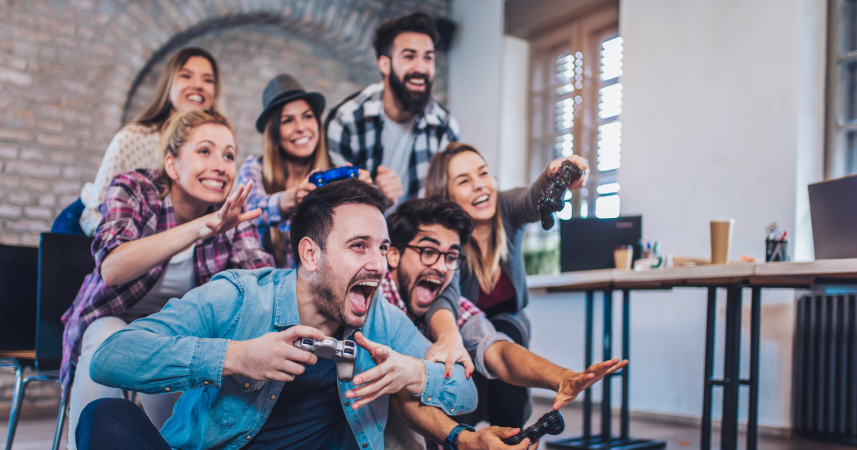
The generational divide between Gen Z and Boomers becomes most visible when you look at how each group chooses to spend their free time, revealing fundamentally different values around entertainment, social connection, and what counts as productive fun.

Add VegOut to your Google News feed. 
Last Thanksgiving, my nephew spent three hours live-streaming himself playing video games to an audience of strangers while my parents sat in the next room genuinely baffled about what he was doing and why. "But he's just sitting there," my mom kept saying. "Why would anyone watch that?"
That moment crystallized something I'd been noticing for a while. The gap between what Gen Z considers fun and what Boomers understand as legitimate entertainment isn't just about technology. It's about completely different frameworks for what makes an activity worthwhile.
I've watched this play out countless times at family gatherings, coffee shops, and even in my own apartment building. Gen Z is doing things that Boomers can't even categorize as activities, let alone enjoyable ones. And the confusion goes both ways, but the Boomer bewilderment is particularly entertaining to witness.
Here are the activities that create the most head-scratching.
1) Watching other people play video games for hours
This is probably the most incomprehensible Gen Z activity for Boomers. Streaming platforms like Twitch and YouTube Gaming have turned watching gameplay into a massive form of entertainment, but older generations genuinely cannot understand the appeal.
"Why don't you just play the game yourself?" is the constant refrain. But that misses the entire point. Gen Z isn't watching for the gameplay mechanics. They're watching for personality, community, commentary, and the parasocial relationships they build with streamers.
It's not that different from watching sports, which Boomers do constantly. But somehow watching someone play Minecraft or Valorant doesn't register as legitimate in the same way watching someone throw a football does.
My nephew makes the comparison all the time and it never lands. His grandfather will spend five hours watching golf on a Sunday but thinks thirty minutes of a gaming stream is a waste of time. The irony is completely lost on him.
2) Creating elaborate content that disappears in 24 hours
Instagram and Snapchat Stories represent everything Boomers don't understand about modern social media. Why would you spend time creating something just to have it vanish?
Gen Z puts genuine effort into Stories. Editing, music selection, aesthetic coherence. Then poof, it's gone the next day. To Boomers raised on the idea that work should produce something permanent, this feels utterly pointless.
But ephemerality is the whole appeal. There's freedom in creating without the pressure of permanence. It's low-stakes creativity that doesn't live on your profile forever. You can experiment, be silly, share mundane moments without cluttering up your permanent feed.
I've tried explaining this to my parents and their faces just glaze over. They still don't understand why I wouldn't want my photos to "last forever." The concept that sometimes temporary is better doesn't compute.
3) Spending real money on digital items that don't physically exist
Fortnite skins, Roblox accessories, digital trading cards, cosmetic items in games. Gen Z will drop actual cash on things that exist only as pixels, and Boomers think they've lost their minds.
"But you don't own anything," they say. Which is technically true but misses how Gen Z thinks about ownership and value. If you spend 40 hours a week in a digital space, why wouldn't you want your avatar to look cool? If your social life happens in virtual worlds, those cosmetic items do matter.
Boomers spent money on temporary things too. Concert tickets, restaurant meals, bar tabs. But because those involved physical presence, they feel more "real" somehow. The logic isn't actually that different, it's just the medium that's changed.
My parents genuinely worried about my nephew when they found out he'd spent his birthday money on Fortnite skins. They thought he was being scammed. He just wanted to look good while playing with his friends.
4) Building parasocial relationships with influencers and content creators
Gen Z follows creators like they're actual friends. They know their schedules, their personalities, their drama. They'll send gifts, show up to meetups, defend them in comment sections. To Boomers, this looks like unhealthy obsession with strangers.
But these relationships serve real social and emotional needs. Content creators provide consistent presence, relatability, and entertainment. Following someone's journey over years creates genuine connection even if it's one-directional.
Boomers had parasocial relationships too. With TV personalities, musicians, authors. The mechanism isn't new. It's just more interactive now, which makes it feel more personal and therefore more concerning to outside observers.
The difference is accessibility. Gen Z can comment and sometimes get responses. That feedback loop makes the relationship feel more real, even though it's still fundamentally parasocial. Boomers see that interaction and worry instead of recognizing it as a more engaged version of what they did with their own celebrities.
5) Participating in viral challenges that seem completely random
TikTok challenges come and go weekly. Dancing to specific songs, recreating trends, participating in memes that have a shelf life of maybe three days. Boomers watch this and see mass hysteria without purpose.
"What's the point?" is the question I hear most. And honestly, that's exactly the point. There isn't one. It's play for the sake of play. It's participating in shared culture. It's the digital equivalent of playground games.
Gen Z isn't doing these challenges because they're productive or meaningful in some deep way. They're doing them because they're fun and because everyone else is doing them. The communal aspect is what matters.
Boomers grew up with trends too. Dance crazes, fashion movements, slang that changed constantly. But those felt more organic somehow because they spread slowly through physical communities. Digital trends move at warp speed and involve documentation, which makes them feel more performative and therefore less authentic.
6) Curating multiple online personas across different platforms
Gen Z often maintains separate accounts for different audiences. A main Instagram for friends, a finsta for close friends, a TikTok for specific content, a Twitter with a completely different personality. Each platform gets a different version of them.
To Boomers, this looks like being fake or not knowing who you are. But Gen Z sees it as sophisticated self-presentation. You wouldn't act the same way at a family dinner as you would at a party with friends. Why should all your social media be one unified front?
Code-switching isn't new. People have always adjusted their behavior based on context. Gen Z has just formalized it through platform-specific personas. It's actually quite intentional and thoughtful.
My dad genuinely cannot understand why I have different Instagram accounts. "Just be yourself," he says, as if there's one authentic self that exists in all contexts. That's not how identity actually works, but good luck explaining that over dinner.
7) Doom-scrolling as a leisure activity
This one's contentious because even Gen Z knows it's not great for them, but they do it anyway. Hours spent scrolling through feeds, consuming endless content, not really enjoying it but unable to stop.
Boomers see this and think it's pure addiction and wasted time. Which it kind of is. But it's also how Gen Z processes information, stays connected, and decompresses in a weird way. It's passive engagement that requires no energy, which has its own appeal after a draining day.
The difference is that Boomers had passive leisure too. They watched TV for hours, flipped through magazines, stared at newspapers. But those activities had natural endpoints. Shows ended. Magazines had back covers. Algorithmic feeds are literally designed to be infinite.
So doom-scrolling is the modern equivalent of vegetating in front of the TV, except it's personalized, endless, and in your pocket. Boomers critique it while spending just as much time on Facebook, which is its own form of scrolling. They just don't call it that.
Final thoughts
The generational divide in leisure activities isn't really about technology. It's about what each generation considers valuable use of time.
Boomers were raised with tangible productivity. Hobbies should produce something, activities should have clear goals, leisure should refresh you for more work. Fun was almost always a means to an end.
Gen Z approaches leisure differently. It can be pointless and still worthwhile. It can be ephemeral and still meaningful. It can be digital and still real. The experience itself is the value, not what it produces or leaves behind.
Neither approach is objectively better. They just reflect different values shaped by different worlds. Boomers lived in scarcity of information and abundance of time. Gen Z lives in abundance of information and scarcity of attention.
What looks pointless from one perspective makes perfect sense from another. My nephew's Twitch streams provide him community and entertainment in a world where those things are increasingly hard to find. My parents' confusion says more about their frameworks than his choices.
The activities will keep evolving. Whatever comes after Gen Z will probably do things that make current teenagers shake their heads in bewilderment. That's how generations work.
But maybe we could all benefit from being a little more curious about why different age groups find meaning where they do, instead of just dismissing what we don't immediately understand as pointless.
If You Were a Healing Herb, Which Would You Be?
Each herb holds a unique kind of magic — soothing, awakening, grounding, or clarifying.
This 9-question quiz reveals the healing plant that mirrors your energy right now and what it says about your natural rhythm.
✨ Instant results. Deeply insightful.

Jordan Cooper
Jordan Cooper is a pop-culture writer and vegan-snack reviewer with roots in music blogging. Known for approachable, insightful prose, Jordan connects modern trends—from K-pop choreography to kombucha fermentation—with thoughtful food commentary. In his downtime, he enjoys photography, experimenting with fermentation recipes, and discovering new indie music playlists.
More Articles by Jordan