Retirement isn’t a slowdown—it’s a brain upgrade powered by ten tiny, joyful habits you’ll actually look forward to doing

Add VegOut to your Google News feed. 
Some people think retirement means downshifting the brain.
I don’t.
Your 60s and 70s can be a cognitive upgrade—if you give your mind the right kind of work: novelty, purpose, precision, people, and a little sweat.
The trick isn’t to grind harder; it’s to pick hobbies that sneak exercise for your memory, attention, and creativity into something you actually enjoy.
Here are ten retirement hobbies that quietly keep your brain sharper than ever.
1. Learn an instrument the way kids do
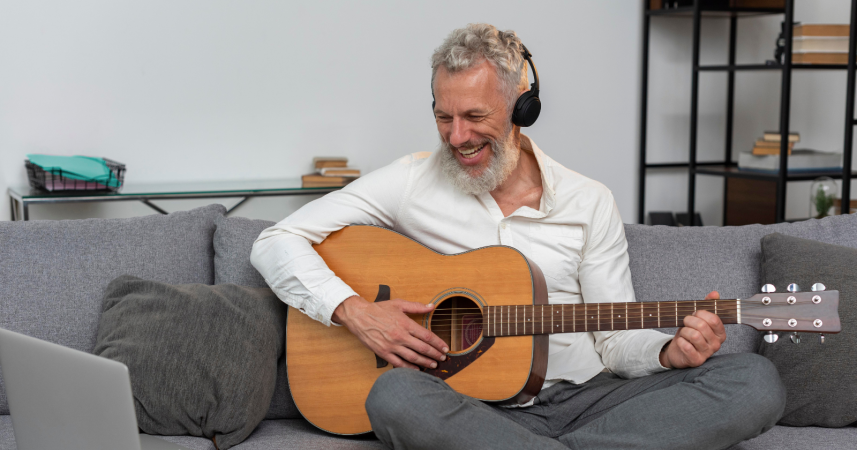
If you’ve ever wanted to play piano, guitar, ukulele, or harmonica, this is your sign. Instrument practice is full-brain training: rhythm (timing), reading (notation or tabs), motor control (fingers and hands), and emotional reward (music you love).
Keep it simple. Pick one song you’d happily hear on loop. Practice ten minutes a day, every day. Use tiny goals: three clean chords, one scale, the left hand alone. You’ll notice something sneaky after a month—your attention span is longer and your recall is faster, because music forces you to track sequences and fix mistakes without drama.
Pro move: learn with a friend and text a 30-second “today’s riff” once a week. Accountability + fun = momentum.
2. Walk with a notebook (not just steps)
Daily steps are great. Steps + noticing are better. Take a 20- to 40-minute walk and bring a pocket notebook or notes app. Jot three things: a color you saw, a smell, a sound. This turns walking into a mindfulness drill that sharpens working memory and attention.
Once a week, add a “theme walk.” Examples: only blue things, only circles, only shadows. I’ve mentioned this before, but the brain loves a scavenger hunt. It’s low effort and high pay-off for concentration. Bonus: your mood lifts because your senses are finally on—less autopilot, more “alive.”
3. Cook from a cuisine you didn’t grow up with
Cooking is basically a playground for executive function: planning, sequencing, timing, and problem-solving.
Take one cuisine—Ethiopian, Vietnamese, Persian, Mexican, Indian, Korean, Caribbean, your pick—and give yourself a 30-day mini-sprint. Learn five pantry staples, two sauces, and three dishes.
You’ll practice measurement, knife skills, and heat control while also learning flavor logic. That “logic” becomes mental scaffolding you can reuse anywhere.
Also, sharing what you make pulls in social cognition: reading faces, adjusting seasoning, telling the story of the dish. That’s brain cross-training.
Tip: keep one “house bowl” loaded with go-tos (garlic, ginger, chilies, citrus, oils, vinegars, herbs). Decision fatigue plummets when the tools are at arm’s reach.
4. Join an improv or storytelling group
You don’t need to be “funny.” You just need to say yes. Improv drills short-term memory (you must remember details your partner invents), perspective-taking (you build on their idea), and language flexibility (finding words quickly). Storytelling circles do the same thing with a little more structure.
The quiet benefit is confidence. When you practice speaking without over-preparing, your brain gets better at retrieving words under light pressure. That carries into daily life—doctor visits, family events, new friends. The social lift alone is worth it.
5. Learn a new language in micro-bursts
Language learning is one of the best “neuroplasticity engines” because it uses sound discrimination, memory, pattern detection, and cultural context at once. Keep it tiny: ten minutes a day, same time, same chair. Pick a narrow goal—ordering coffee, asking directions, greeting a neighbor.
Make it alive, not academic. Watch one YouTube creator in your target language with subtitles, follow one musician, and label five things around the house with sticky notes. Your ear will change in three weeks. Your confidence will change in six.
6. Lift something (then put it down slowly)
Strength training isn’t just for bodies—it rewires focus. Sets and reps teach pacing and consistency; progressive overload teaches “a little harder than last time,” which is a great cognitive mantra. You don’t need a gym. Two dumbbells or a single kettlebell at home works.
Do three moves, three days a week: a push (floor or wall push-ups), a pull (band rows), and a squat or hinge (chair squats or hip hinges). Keep a tiny notebook. Writing “8 reps felt smooth” is a data point your brain loves. Over time, you’ll notice better posture, steadier mood, and less mental fog—movement clears static.
Safety tip: if you’re new, ask a trainer for a 30-minute form check. Good mechanics = confidence to keep going.
7. Tend a small garden (windowsill counts)
Gardening is goal-oriented patience. It trains planning (when to sow), classification (what each plant needs), and feedback loops (what worked, what didn’t). You also get daily micro-joys: new leaves, first blossoms, edible results.
Start with a kitchen-counter herb trio (basil, mint, chives) or a salad box on a balcony. Log quick notes once a week: sun hours, water, growth. That little ledger becomes a memory gym, and your meals get a flavor bump that keeps the habit rewarding.
Pro move: join a local garden club or seed swap. You’ll learn ten things you didn’t know you didn’t know.
8. Become “the family archivist”
Scan old photos, label names, record short interviews with relatives, build a simple timeline. This hobby is a stealth masterclass in attention to detail, systems, and storytelling. It turns nostalgia into a creative project—with deadlines and deliverables you care about.
Set scope so it doesn’t overwhelm: “I’ll scan and caption 100 photos this month,” or “One 15-minute audio with Aunt Rosa on Sunday.” The brain benefit is generational context—linking events across decades—which is excellent practice for memory consolidation. The emotional payoff? You become a bridge. Families need those.
9. Learn street photography (on the phone you already own)
Photography is concentrated seeing. Street shots, in particular, train anticipation (“something interesting might happen”), composition (lines, light, balance), and courage (getting close enough to make the frame matter). You don’t need gear. Your phone is fine.
Give yourself a constraint: one theme per week—reflections, hands, bicycles, masks, doorways, couples, patterns. Pick your best three on Sunday and keep a simple album. You’ll walk more, notice more, and tell better stories because you’re practicing “scene” instead of “stuff.”
10. Tutor or mentor one hour a week
Nothing sharpens understanding like teaching. Pick a subject you care about—reading, math, citizenship prep, conversational English, digital basics—and offer one hour a week at a school, library, or community center.
Teaching forces you to break ideas into steps (executive function), read the room (social cognition), and improvise (flexibility). It also gives you a refreshed sense of purpose—arguably the best cognitive enhancer there is. We remember what matters; other people make things matter.
Short on time? Do “office hours” for your own family: a standing slot where anyone can bring a sticky problem (budgeting app, scholarship essay, bike repair). Being useful keeps your neurons honest.
A simple weekly template (so this sticks)
-
Pick three anchors. One body (strength or walking), one brain (language, instrument), one social (improv, mentoring).
-
Schedule them like flights. Same days, same times. Protect them.
-
Track small wins. A notebook line—“Day 12: mastered G to C chord”—beats a vague “I’m trying.”
-
Review on Sundays. What felt good? What felt heavy? Adjust by 5%, not 50%.
-
Share one thing. Send a photo, a riff, a phrase you learned. Community is glue.
If you’re starting from zero (because life got busy)
-
Two-minute rule: do the first two minutes of the thing. Touch the strings. Open the language app. Step outside. The brain hates starting; it loves continuing.
-
Make it friction-light: instruments out of the case, dumbbells by the chair, notebook on the counter, herbs by the window. Hidden = forgotten.
-
Stack habits: language right after coffee; walk right after lunch; photography on the way to the store. You’re not finding time—you’re braiding it.
What to avoid (so you don’t burn out)
-
All-or-nothing goals. “Practice two hours daily” is a promise to quit. Ten minutes daily becomes twenty when it wants to.
-
Gear procrastination. Don’t wait for the perfect camera or premium pan. Use what you have; upgrade later if the habit sticks.
-
Solo isolation. Even “solo” hobbies are richer with a buddy. Find a duo or a small group. Accountability beats willpower.
Why this works (the quiet science in plain English)
-
Novelty wakes up dopamine (motivation) and attention networks.
-
Complex motor work (fingers on strings, lifting with control) strengthens brain-body pathways.
-
Structured recall (chords, vocabulary) builds memory like a muscle.
-
Social learning (improv, mentoring, cooking for others) trains empathy and processing speed.
-
Meaning flips effort from chore to choice. Purpose is rocket fuel for consistency.
The bottom line
A sharp brain in retirement isn’t luck; it’s design. Learn an instrument. Walk like a noticer. Cook beyond your comfort zone. Say yes to a little stage time. Collect ten minutes of a new language daily. Lift things and put them down slowly. Grow something. Archive your people. Photograph the world you actually live in. Teach someone what you know.
Keep it light. Keep it regular. Keep it human. Your mind will meet you where you show up—one tiny, repeatable habit at a time.
What’s Your Plant-Powered Archetype?
Ever wonder what your everyday habits say about your deeper purpose—and how they ripple out to impact the planet?
This 90-second quiz reveals the plant-powered role you’re here to play, and the tiny shift that makes it even more powerful.
12 fun questions. Instant results. Surprisingly accurate.