These seven kid-friendly activities light them up and feel genuinely good for adults. No glitter. No groaning.
Parenting comes with a lot of logistics.
But the joy? That shows up when we make space for it.
Here are seven simple things I love doing that light kids up and still feel genuinely fun for adults.
No glitter explosions. No forced smiles. Just good times you’ll want to repeat.
1. Backyard microadventures
Adventure doesn’t require a flight or a theme park.
It requires a plot.
After dinner, I’ll announce a 45-minute “expedition.” We pick a quest—spot three constellations, find five different leaf shapes, identify the loudest night sound, map the yard. Headlamps come out. Clipboards appear.
Suddenly the backyard turns cinematic.
Make it yours: name your expedition, set a timer, and end with a “field debrief” over hot cocoa. If you want extra spice, hide a tiny “artifact” earlier in the day—a foreign coin, a seashell—and let the crew “discover” it with a simple map.
Why adults love it: it scratches that explorer itch without packing a car. You’re outdoors, moving, noticing. It’s the opposite of doom-scrolling and it’s over before bedtime chaos kicks in.
2. Kitchen cook-off
I’m vegan and love a good challenge, so we do plant-based cook-offs.
Mystery ingredient goes in the middle of the table—chickpeas, sweet potatoes, strawberries—then we break into teams: adults vs. kids, or mixed pairs. Twenty minutes. One dish per team. Phones are for timers only.
Judging is hilarious and gentle: taste, creativity, presentation. The winning team picks the next ingredient.
Why adults love it: fast flow state. It’s Iron Chef energy with low stakes and real dinner at the end. If you’re worried about chaos, pre-chop anything sharp, set a “safe zone” around the stove, and keep plating simple.
Pro tip: make one dish that scales for leftovers. A chickpea smash for sandwiches. A sheet-pan veggie “nacho” with crispy tortilla wedges. Tomorrow-you will whisper thanks.
3. Museum power hour
Long museum days melt brains (little and big).
So I’ve mentioned this before but a “power hour” solves everything.
Pick one wing. Three must-see pieces. One scavenger list: “Find a painting with a storm,” “Spot a creature with wings,” “Find your color of the day.” Then a nonnegotiable café break.
Add a twist: tell each other a 30-second story about your favorite piece as if you were the artist. Kids love the mic. So do secretly theatrical adults.
Why adults love it: permission to be selective. You leave energized, not depleted, and with a fun coffee you didn’t have to brew.
4. Nature photo safari
On weekends, I’ll grab my camera and announce a photo safari at a nearby park or trail.
Kids get “assignments” like “textures,” “tiny worlds,” or “things that look like faces.” Adults choose lenses—literal or metaphorical.
We move slowly. We look ridiculous crouching near lichen. We compare shots at a picnic bench and pick a “gallery winner” for the day. Later, I’ll make a quick shared album labeled by theme so we can revisit our “exhibit.”
Why adults love it: it dignifies wandering. You’re not herding; you’re hunting for beauty. It’s also sneaky mindfulness—attention, composition, light.
Quote I keep in mind here, from play researcher Stuart Brown: “The opposite of play is not work—it’s depression.” A safari restores that playful state for everyone, camera or not.
5. Farmers’ market challenge
Markets are peak sensory play for kids and peak people-watching for adults.
We make it a game.
Each person gets a small budget and a theme: “Something crunchy,” “Something I’ve never tried,” “Something red.” Then we blend it into a snack board at home. Bonus points for chatting with a farmer about how they’d cook it.
Why adults love it: micro-adventures plus delicious research. You get tastings, tiny conversations, and an excuse to try that weird varietal you keep walking past. If you’re plant-based, the whole place is your playground.
Keep it easy with a “no pressure” rule: if a kid uses their entire budget on strawberries, consider that a strategic choice. Your board doesn’t need to be Instagram. It needs to be eaten.
6. DIY story studio
We make a two-hour “studio” at home: craft paper backdrop, a few costumes, a lamp, and a phone on a mini-tripod.
The job: write and shoot a three-scene story.
Structure helps. Scene 1: “The ordinary world.” Scene 2: “The problem.” Scene 3: “The fix.” Keep it to five lines per scene. Add a prop requirement (a hat, a sticky note, a spoon). Then do a single take.
Adults get roles too—director, sound effects, narrator. Resist the urge to polish. The charm lives in the wobble.
Why adults love it: creativity with constraints. You’re collaborating without endless editing. Later, batch little “premieres” on Friday nights with popcorn.
If you want to teach story beats in disguise, ask at the end: “What did the hero want? What got in the way? What changed?” Kids will start spotting arcs in everything, which is incredibly satisfying for the book-nerds among us.
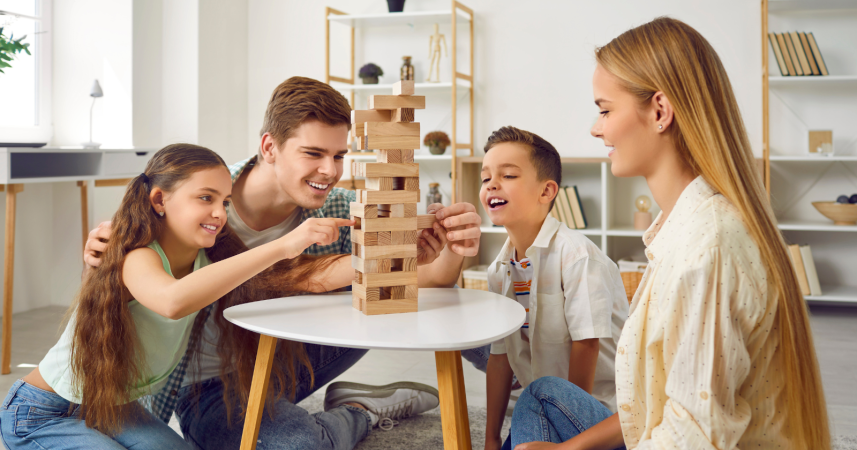
7. Board-game remix
I grew up on board games, and the hack I wish I knew earlier is this: remix the rules.
Kids light up when they’re allowed to tinker. Adults light up when the game doesn’t drag.
Pick three house rules before you start. Examples:
-
Monopoly with a 60-minute timer and no properties bought after 30 minutes.
-
Uno where 0 means everyone passes their hand to the left.
-
Candy Land with “stunt squares” (do five jumping jacks to skip ahead two).
Or invent your own game with a deck of cards and sticky notes—goal, win condition, constraints. In my house, that project becomes a full-blown play-test session with end-credits: “Thank you to our early adopters.”
Why adults love it: it’s design thinking in disguise. You’re balancing simplicity and fun, negotiating rules, and embracing a short feedback loop. Also, the laughs are real.
Final notes
A quick note on why these work for grown-ups too.
They put you in motion or into a role. They set time boundaries (a power hour, a 20-minute cook-off). They use constraints that fuel creativity. And they offer just enough novelty to spark your brain without draining your energy.
They also pull us back outside. As Richard Louv puts it, “The more high-tech our lives become, the more nature we need.” If your days live on screens, a backyard expedition or a photo safari is not a luxury. It’s a reset.
A few micro-tips that keep things smooth:
-
Name the time horizon up front. Kids handle endings better when they see them coming.
-
Give choices inside a container. “We’re doing a cook-off—do you want to plate or chop?”
-
Leave artifacts. A shared album, a map from last night’s expedition, a “house rules” card on the fridge. Memory fuels momentum.
Most of all, let yourself have fun.
Your enjoyment is the permission slip they never forget.
I’ll end where we began: joy shows up when we make space for it.
Pick one idea, put a time box around it, and see what happens tonight.