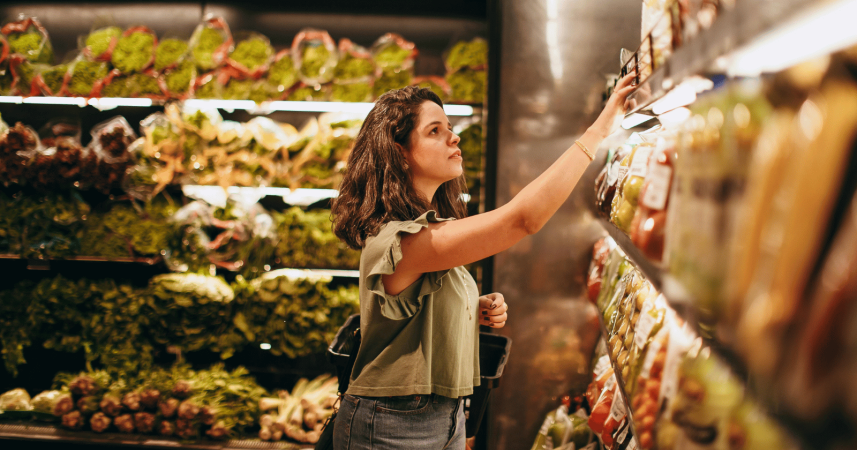
Walking into an American supermarket feels like entering a different dimension where the rules of food, time, and space have been completely rewritten.

Add VegOut to your Google News feed. 
Ever walked into a space where everything felt just slightly off? That's what my European friends describe when they first step into an American grocery store.
I've spent enough time at farmers markets and health food shops around Venice Beach to think I understood the whole food landscape. But hearing their perspectives made me realize just how uniquely American our shopping experience really is.
The differences go way beyond what's on the shelves. They reveal something deeper about how we approach food, time, and consumption itself.
1) The sheer size is overwhelming
Walk into a typical Walmart or Target and you're looking at anywhere from 150,000 to 260,000 square feet of retail space. That's multiple football fields of groceries.
Europeans are used to neighborhood shops where you can see from one end to the other. Their supermarkets average much smaller, designed for quick trips rather than marathon shopping sessions.
My partner's cousin visited from France last year and spent her first hour in our local grocery store just wandering the aisles in disbelief. She kept texting photos back home with captions like "this is just the cereal section."
The scale isn't just impressive. It's actually designed around a different lifestyle, one where you drive to the store once a week rather than walking to the corner shop every few days.
2) Everything comes in massive portions
A European small drink at McDonald's is basically an American small. Their large is our medium. And don't even get me started on what passes for a "family size" bag of chips here.
The portion sizes in American stores reflect our bulk-buying culture. We're talking gallon jugs of milk, 48-packs of toilet paper, industrial-sized peanut butter containers that could last a year.
This makes sense when you realize geography plays a huge role. Many Americans live far from stores and prefer stocking up. Europeans, living in denser cities with shops on every corner, buy what they need for the next day or two.
The mindset shift is real. We optimize for convenience and shelf life. They optimize for freshness.
3) The absurd amount of choice
American supermarkets carry an average of 35,000 different products. European stores typically stock around 1,700 to 3,000.
Stand in the cereal aisle and count how many varieties of Cheerios exist. Regular, Honey Nut, Apple Cinnamon, Frosted, Chocolate, Peanut Butter. The list goes on.
When I went vegan eight years ago, I actually appreciated this variety. Finding plant-based options felt like a treasure hunt, and American stores delivered. But I get why Europeans find it paralyzing rather than liberating.
More isn't always better. Sometimes it's just more.
4) Pre-packaged everything
Hard-boiled eggs in a plastic bag. Pre-cut watermelon. Pre-washed lettuce. Pre-peeled garlic. Pre-shredded cheese.
If it can be pre-prepared and wrapped in plastic, we've done it.
European grocery stores lean heavily toward loose produce. You pick your own vegetables, weigh them yourself, and skip the excess packaging. Their focus leans toward reducing waste and maintaining food in its natural state.
This difference hit me during a trip to Spain a few years back. The market had bins of fresh tomatoes, bunches of herbs, and absolutely zero clamshell packaging. Everything felt more alive, less processed.
I thought about this recently while standing in my local store's produce section, surrounded by individually wrapped cucumbers.
5) Store hours that never end
Need milk at 2 a.m.? No problem. Craving ice cream at 4 a.m.? We've got you covered.
Around 90% of American convenience stores stay open 24 hours. Many large supermarkets keep similar hours, or at least run until midnight.
European shops typically close by 8 or 9 p.m., sometimes earlier. Sundays often mean limited hours or complete closures.
The American approach assumes we should have access to everything, always. It's convenience taken to its logical extreme, which sounds great until you think about the workers staffing those overnight shifts.
6) Service that won't leave you alone
"Finding everything okay?" "Can I help you with anything?" "Would you like to try our new rewards program?"
American grocery store employees are trained to be aggressively helpful. Some stores even have baggers who insist on carrying your groceries to your car.
Europeans find this intrusive. In Germany, staff won't approach unless you ask. In France, you're expected to figure things out yourself. The cultural preference leans toward being left alone to shop in peace.
I've mentioned this before but there's a reason for the American approach. We've built a service culture that equates helpfulness with quality. Europeans have built a culture that respects personal space.
Neither is wrong. They're just solving for different values.
7) The processed food dominance
Walk through an American supermarket and you'll notice entire aisles dedicated to chips, cookies, frozen dinners, and sugary cereals. The processed food section dwarfs the produce department.
European stores flip this ratio. Fresh food takes center stage. Processed items exist but they're not the main event.
The difference becomes even starker when you read ingredient labels. The European Union bans artificial flavors, certain food dyes, and GMOs that American products contain freely. Their standards for what counts as "food" are just stricter.
As someone who reads every label obsessively now, I notice this constantly. The vegan mac and cheese I buy has ingredients I can't pronounce. My grandmother's recipe had four.
8) Prices that don't include tax
This one drives Europeans absolutely crazy. The price tag says $4.99, but at checkout you pay $5.43.
Why? Because American stores don't include sales tax in the displayed price. Tax rates vary by state, county, and sometimes even city, so stores print one price tag and calculate tax at the register.
European prices include VAT (value-added tax) upfront. What you see is what you pay.
For visitors, this feels like a bait-and-switch. For Americans, it's so normal we don't think twice about doing mental math at checkout.
Conclusion
These differences aren't just quirky cultural footnotes. They reveal fundamental approaches to consumption, convenience, and community.
American stores optimize for abundance and accessibility. We want everything, all the time, in whatever quantity works for our schedules. European stores optimize for quality and sustainability, accepting limitations as part of a healthier relationship with food.
Neither system is perfect. But understanding these contrasts helped me rethink my own shopping habits. Now I hit the farmers market more often, buy less at once, and question whether I really need that gallon-sized hummus container.
Sometimes the best insights come from seeing your normal through someone else's eyes.